

What if the biggest threat to your SME’s 2026 growth isn’t a market shift, but a missed deadline you didn’t even know existed? Between managing daily operations and tracking cash flow, it’s easy to feel overwhelmed by Singapore’s dual-stage tax process. We understand that the confusion between your ECI filing Singapore requirements and the final Form C-S can be stressful, especially with heavy IRAS penalties looming. You shouldn’t have to manage these regulatory requirements alone.
This guide helps you master the essential 2026 tax calendar so you can claim every dollar of the 50% CIT rebate you’re entitled to. We’ll clarify waiver conditions for ECI filing Singapore and provide a clear timeline for your Year of Assessment 2026 obligations. You’ll gain a straightforward roadmap to total compliance and the peace of mind to focus on growing your business.
Key Takeaways
- Learn the critical difference between your three-month ECI filing Singapore deadline and the final 30 November submission to stay fully compliant with IRAS.
- Discover how to maximize your SME tax savings by utilizing the YA 2026 50% Corporate Income Tax rebate and identifying valid deductible expenses.
- Follow a step-by-step checklist to finalize your management accounts and prepare for filing without the stress of last-minute errors.
- Understand the common pitfalls that trigger IRAS audits and late filing fees, ensuring you avoid composition sums of up to S$1,000.
Understanding the Two Key Singapore Corporate Tax Deadlines
Managing income tax in Singapore often feels like a balancing act between past performance and future obligations. Many directors find themselves confused by the distinction between their Financial Year (FY) and the Year of Assessment (YA). For the upcoming 2026 cycle, you’re being taxed on profits earned during your financial year ending in 2025. This lag is a standard part of the Singapore system, but it requires careful planning to ensure you’re not caught off guard by tax bills.
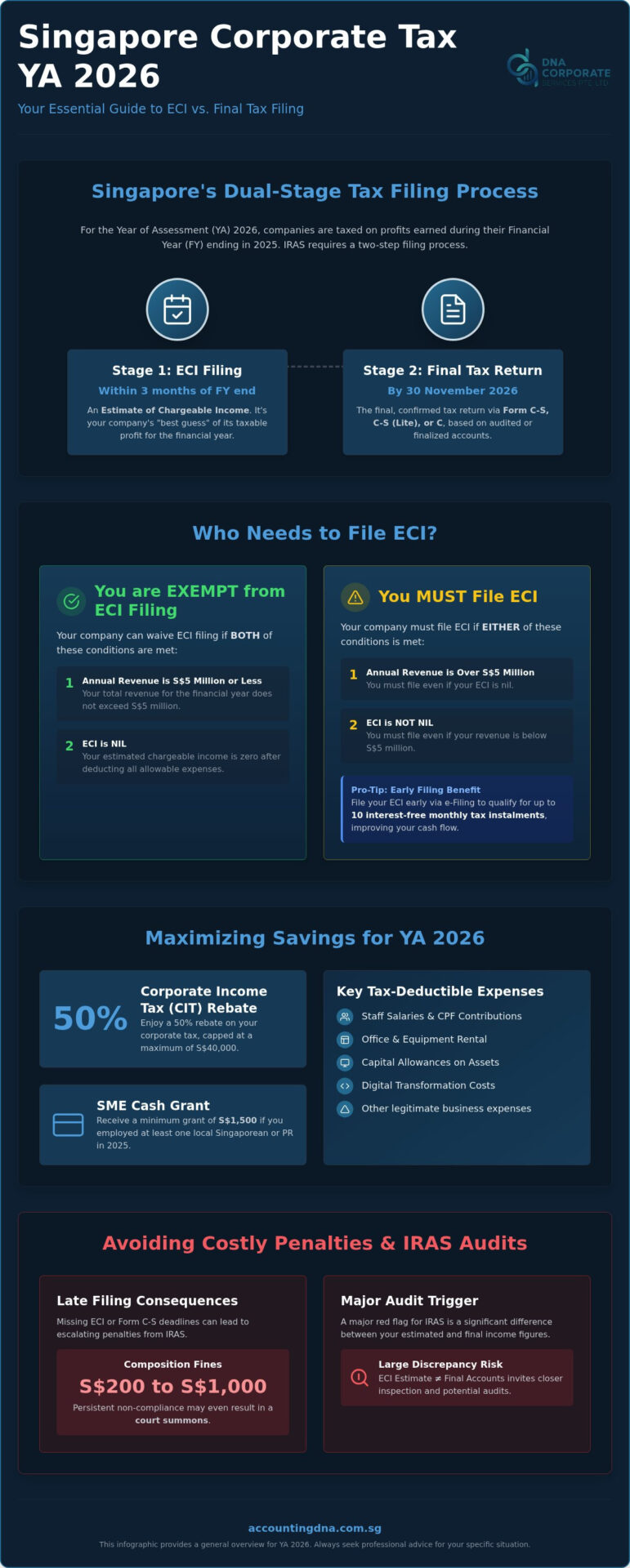
IRAS operates a two-stage filing process. First, you must submit your ECI filing Singapore within three months of your financial year end. This is your company’s “best guess” of its taxable income before the final accounts are fully finalized. The second stage is the final tax return, where you submit Form C-S, Form C-S (Lite), or Form C by 30 November 2026. Failing to distinguish between these two can lead to missed opportunities for cash flow management.
ECI Filing: The 3-Month Rule and Exemptions
While the three-month rule is strict, not every SME needs to file. Your company is exempt from the ECI filing Singapore requirement if it meets two specific criteria: your annual revenue is S$5 million or below, and your ECI is nil for the financial year. Both conditions must be met to qualify for the waiver. If your revenue exceeds this threshold, you must file even if you expect to pay zero tax.
If you don’t qualify for an exemption, filing early is a smart cash flow move. Early e-filers can secure up to 10 interest-free monthly instalments via GIRO. This spreads your tax burden across nearly a year rather than facing a heavy lump sum payment. If you’re feeling overwhelmed by these timelines, our corporate tax and GST filing services provide the personalized support you need to stay ahead of IRAS requirements and protect your company’s financial health.
Preparing Your 2026 Tax Filing: A Step-by-Step Checklist
Success in the 2026 tax season begins long before the actual deadline. First, you must ensure your bookkeeping and accounting services are fully up to date. Accurate management accounts serve as the bedrock for a precise ECI filing Singapore. Without clean records, you risk overestimating your tax or underestimating and triggering an IRAS query. It’s about precision.
Next, identify your tax-deductible expenses. Understanding Singapore’s corporate tax obligations involves more than just reporting revenue. You should claim deductions for staff salaries, office rental, and capital allowances on machinery or office equipment. These small details add up to significant savings for your bottom line.
Maximizing Deductions and 2026 Support Packages
The 2026 SME Cash Grant provides immediate liquidity for eligible firms. If your company employed at least one local Singaporean or Permanent Resident in 2025, you’re eligible for a minimum grant of S$1,500. This grant is part of the broader CIT rebate, which is capped at S$40,000 for the Year of Assessment. When preparing your ECI filing Singapore, don’t forget to factor in digital transformation costs. These are often highly deductible under current schemes.
Stay mindful of the InvoiceNow requirements. For GST-registered businesses, this digital invoicing standard is a central part of the 2026 compliance landscape. It streamlines your record-keeping and ensures IRAS-ready data. If you’re feeling unsure about your eligibility for specific grants, reach out to our advisors for a tailored compliance review.
Penalties and Pitfalls: Navigating Late Filings and IRAS Audits
Missing an IRAS deadline feels like a heavy weight on any director’s shoulders. It’s not just about the money; it’s about the fear of legal repercussions and the stress of regulatory scrutiny. If you miss your ECI filing Singapore window, the consequences escalate quickly. IRAS typically issues composition fines ranging from S$200 to S$1,000. For persistent non-compliance, you may even face a court summons.
One of the most frequent triggers for an audit is a glaring inconsistency between your ECI filing Singapore submission and your final management accounts. While ECI is an estimate, it must be a reasonable “best guess” based on real financial data. Wide discrepancies suggest poor record-keeping, which invites closer inspection. At DNA Accounting, we act as your protective shield. Our boutique approach means we don’t just file forms; we review your data to ensure consistency and represent your interests during any IRAS clarifications.
What to Do if You Miss a Tax Deadline
If you’ve already missed a date, don’t panic. The first step is to file as soon as possible to stop further penalties from accruing. Once you’ve submitted the late return, you can lodge a formal appeal for a waiver of the composition sum. IRAS is often more lenient with companies that have a strong compliance-first reputation and valid reasons for the delay.
Maintaining a clean track record is vital for reducing the risk of intensive audits in the future. We understand that business doesn’t always happen between 9 and 5. That’s why our team remains available for evening consultations to help you resolve urgent compliance issues. If you’re facing a late filing situation, contact DNA Accounting today for immediate support and professional guidance.
Securing Your SME’s Financial Future for YA 2026
Navigating the Year of Assessment 2026 doesn’t have to be a source of worry. By understanding the three-month window for your ECI filing Singapore and preparing your final Form C-S ahead of November, you protect your company from penalties. You now have the roadmap to leverage the 50% CIT rebate and use precise record-keeping to stay clear of IRAS audits.
Since 2016, DNA Accounting has specialized in helping local SMEs master these tax exemption schemes. Our boutique firm provides personalized care, including evening availability to suit your schedule. Let DNA Accounting handle your YA 2026 tax filing; contact us for a stress-free consultation today. We’re ready to ensure your compliance is seamless so you can stay focused on growing your business with total confidence.
Frequently Asked Questions
What is the corporate tax rate in Singapore for 2026?
The flat corporate tax rate for the Year of Assessment 2026 is 17%. However, your effective rate will likely be lower due to the 50% CIT rebate, which is capped at S$40,000 for the year. SMEs also benefit from partial tax exemptions on the first S$200,000 of chargeable income, making Singapore a highly competitive environment for business growth.
Does a dormant company still need to file a tax return by the 30 November deadline?
Yes, a dormant company must continue to file its tax return unless it has received an official waiver from IRAS. If your company has no revenue and no intention to trade in the near future, you can apply for a “Waiver of Submission of Corporate Tax Return”. Until you receive formal approval, you must meet all filing deadlines.
What happens if the ECI I filed is different from my final Form C-S figures?
It’s normal for final figures to vary slightly from your initial ECI filing Singapore estimate. If your final tax is higher, you pay the difference within one month of receiving your Notice of Assessment. If it’s lower, IRAS will refund the excess. You should ensure your estimate is reasonable, as large, unexplained discrepancies can trigger a more detailed IRAS review.
Can I request an extension for my corporate tax filing deadline from IRAS?
IRAS generally does not grant extensions for corporate tax deadlines. Because the ECI filing Singapore window is already three months long, the authorities expect businesses to manage their timelines effectively. For the final Form C-S submission in November, extensions are only granted in very rare, exceptional cases. We recommend filing an estimate early to avoid late fees and composition sums.
Disclaimer
The information provided on this website is for general informational purposes only and is not intended to constitute professional accounting, tax, legal, or financial advice. While we strive to ensure that the content is accurate and up to date, regulations in Singapore, including those administered by ACRA, IRAS, CPF Board, and MOM, may change from time to time and may differ depending on individual circumstances.
Readers should not act or rely on any information contained on this website without seeking specific advice from a qualified professional based on their individual situation.
DNA Corporate Services and its affiliates accept no responsibility or liability for any loss or damage arising from reliance on the information provided in this website or any linked materials.
For tailored advice relating to accounting, taxation, corporate secretarial, or compliance matters in Singapore, please contact us directly for professional consultation.



