

What if a simple administrative oversight could lead to your disqualification as a company director? You’ve likely felt the weight of Singapore’s strict regulatory environment, especially when a deadline slips through the cracks. It’s stressful to receive a notification about an ACRA late filing penalty when you’re already juggling the daily demands of running an SME. We understand that managing a complex compliance calendar is daunting. The fear of legal action from the authorities is a burden no business owner should carry alone.
This guide will help you navigate the penalty framework with confidence and show you exactly how to rectify filing lapses before they escalate into costly court summons. Whether you’re facing a $300 fine for a short delay or a $600 penalty for a longer lapse, we’ll provide the clarity you need to move forward. We will break down the 2026 tiered penalty structures, explain the steps to settle your composition sums, and offer practical strategies to prevent future compliance risks from clouding your company’s future. By understanding these rules, you can protect your corporate reputation and focus on growing your business instead of worrying about the next ACRA letter.
Key Takeaways
- Identify the specific financial costs of an ACRA late filing penalty and how the tiered system penalizes delays longer than three months.
- Navigate the escalation path from initial warning letters to out-of-court settlements to prevent serious legal consequences for company directors.
- Master the rectification process by verifying breaches on BizFile+ and lodging overdue documents immediately to stop further fines.
- Learn how proactive corporate secretarial care and automated compliance tracking can safeguard your SME’s reputation and banking relationships.
- Distinguish between simple administrative fines and the long-term risk of director disqualification or the striking off of your company.
What is the ACRA Late Filing Penalty and Why Does it Exist?
Running a business in Singapore is rewarding, but the paperwork can sometimes feel like a mountain. The Accounting and Corporate Regulatory Authority (ACRA) oversees this ecosystem to ensure every company remains transparent and accountable. An ACRA late filing penalty is a fixed fine imposed when a company fails to lodge required statutory documents within the legal timeframe. It’s not just an administrative fee; it’s a mechanism used to uphold the integrity of Singapore’s reputation as a trusted business hub.
Under the Companies Act, directors are legally responsible for ensuring that financial statements are accurate and filed on time. This transparency allows stakeholders, including creditors and the public, to assess a company’s health. While it might feel like a nuisance, these rules are why Singapore remains a top-tier global destination for investment. If companies don’t file on time, the data becomes stale, which hurts the reliability of the entire corporate registry.
It’s helpful to distinguish between two types of fines. A “Late Lodgment” penalty usually applies to administrative updates, like changing a director’s particulars or a registered office address. A “Late Annual Return” penalty is often more severe because it involves the failure to report the company’s financial status. Both can accumulate quickly if ignored, creating unnecessary financial strain on your SME.
Common Triggers for ACRA Penalties
Most SMEs fall into the penalty trap because they lose track of the calendar. For unlisted companies, you must hold your Annual General Meeting (AGM) within six months of your Financial Year End (FYE). Following that, you have a seven-month window from your FYE to file your Annual Return. Another common slip-up is forgetting to update BizFile+ within 14 days of a change in company officers or registered addresses. These small delays can lead to an unexpected ACRA late filing penalty that eats into your operating budget and distracts you from growth.
The ‘Compliance Rating’ Impact
Beyond the immediate financial cost, late filings tarnish your company’s public record. Your compliance status is visible on BizFile+ to anyone who buys a Business Profile. Banks often review this during annual KYC checks; a “Red” status can lead to restricted credit facilities or even account closures. Investors also view a history of late filings as a sign of poor corporate governance. A “Red” rating can trigger closer scrutiny from IRAS, as it suggests the company’s internal management may be lacking in other areas of tax compliance. If you’re feeling overwhelmed by these timelines, engaging professional corporate secretarial services can provide the protective shield your business needs.
How ACRA Calculates Late Filing Penalties (Tiered System)
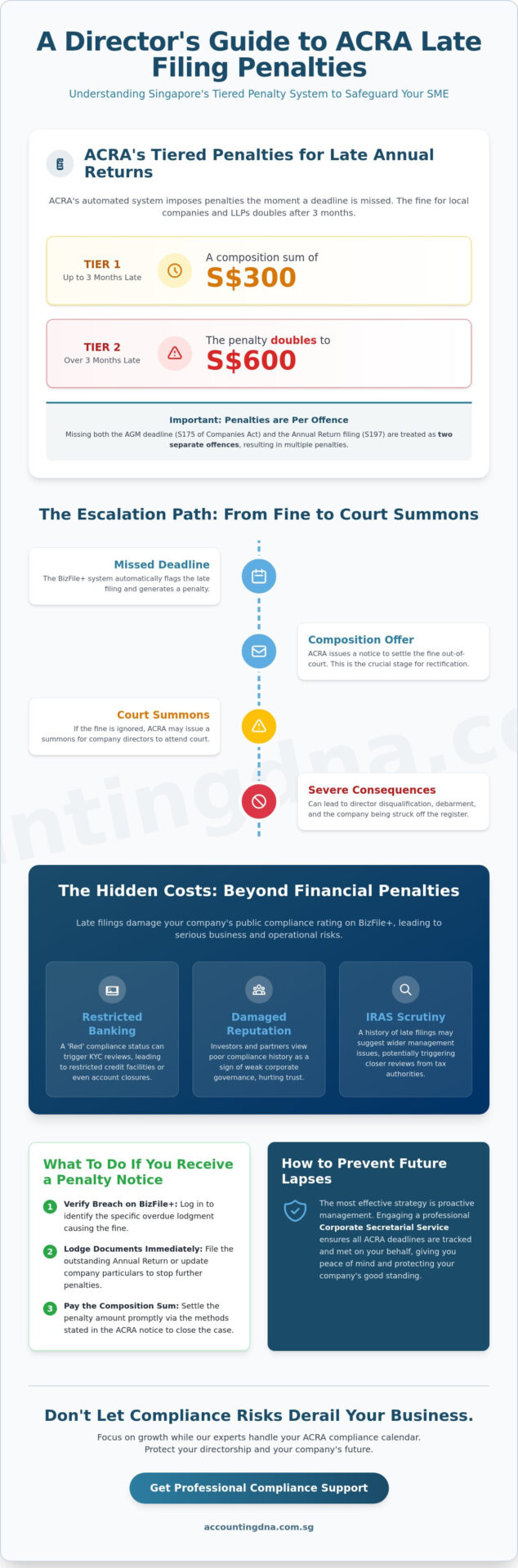
ACRA’s enforcement framework is designed to be predictable, but that doesn’t make receiving a penalty notice any less stressful. The system is entirely automated. This means the moment your deadline lapses in the BizFile+ system, an ACRA late filing penalty is generated. As of May 2026, these penalties are tiered based on how long the lodgment has been overdue. For local companies and Limited Liability Partnerships (LLPs), the cost of filing an Annual Return up to three months late is $300. If you exceed that three-month window, the fine doubles to $600.
It’s vital to understand that ACRA often views a single missed deadline as multiple offences. When we talk about the ‘per-offence’ nature of these fines, we’re referring to the different sections of the Companies Act you might have breached. Section 175 governs the holding of an AGM, while Section 197 governs the filing of the Annual Return. If you miss both, you’ve committed two separate offences. ACRA’s automated system tracks these independently. This is why a single oversight can result in a mountain of paperwork and multiple composition offers landing on your desk at once.
Tiered Penalty Breakdown for Annual Returns
Let’s look at a practical scenario. If your company’s Financial Year End was December 31, and you missed the July filing deadline by 95 days, you’ve crossed the three-month threshold. Your penalty would be $600 for the late Annual Return alone. For foreign branches, the deadlines and penalties follow a similar tiered structure, though their filing window is tied to the head office’s financial activities. Remember that every “officer in default” can be held liable. This means both the directors and the company secretary share the responsibility for these lapses. If the matter escalates to court, the maximum fine can reach $5,000 per charge, making early rectification essential.
Penalties for Other Statutory Updates
Not all penalties are as high as the Annual Return fines, but they add up quickly. Updating your business activity (SSIC codes), changing a director’s residential address, or making updates to the Register of Registrable Controllers (RORC) must be done within 14 days. If these are filed within three months of the due date, the penalty is $50. Beyond three months, it rises to $200. The RORC in particular has become a major focus for ACRA recently as they tighten anti-money laundering controls. Even if your company is dormant, you aren’t exempt from these requirements. Neglecting these small administrative tasks often leads to a “Red” rating on your business profile. If you’re unsure where your company stands, you can reach out for a compliance health check to clear up any lingering doubts.
The Escalation Path: From Fines to Court Summons
Ignoring an ACRA notice is a gamble you won’t win. When a deadline is missed, ACRA usually issues an “Offer of Composition.” Think of this as an out-of-court settlement. It’s an opportunity to resolve the breach by paying a fixed sum, which often starts at $500 for combined AGM and Annual Return lapses. If you ignore this offer, the next letter won’t be an invitation; it’ll be a court summons. We’ve seen many directors assume that paying the ACRA late filing penalty at the last minute stops the legal gears from turning, but that’s not always true. Once a summons is issued, you must attend court unless you receive explicit confirmation that the summons has been withdrawn.
One of the most common myths we hear is that ACRA is too busy with multinational corporations to notice a small SME. In reality, their enforcement system is entirely automated. The system doesn’t care about your company’s revenue or how many employees you have; it only cares about the dates in the registry. If the filing isn’t lodged, the system triggers the enforcement sequence. This is why a single oversight can quickly spiral from a minor fine into a serious legal headache that threatens your company’s standing.
Director Disqualification (Section 155)
The stakes are highest for directors. Under Section 155 of the Companies Act, ACRA enforces what’s commonly known as the “three strikes” rule. If a director is responsible for three or more filing defaults within a five-year period, they face automatic disqualification. This means you’re banned from managing any company in Singapore for five years. This disqualification isn’t private; it’s recorded on your personal BizFile+ profile for banks, investors, and future partners to see. It’s a heavy price to pay for what often starts as a simple administrative delay.
Court Fines and Criminal Records
There’s a massive gap between a statutory composition fine and a court-imposed penalty. While settling a composition sum avoids a criminal record, a court conviction is a different story. If you’re prosecuted and convicted, the fine can reach up to $5,000 per charge. Beyond the financial hit, a criminal record can have long-lasting effects on your professional life. Professional corporate secretarial services act as a vital insurance policy. They ensure your documents are lodged correctly and on time, keeping you out of the courtroom and focused on your business growth. We take pride in being the protective partner that handles these complexities so you don’t have to.
Rectification Guide: What to Do if You Receive a Penalty Notice
Finding a penalty notice in your inbox can feel like a heavy blow to your workday. While your first instinct might be to panic, there’s a logical sequence of steps you can take to resolve the issue before it escalates. Think of this as a recovery checklist for your company’s corporate health. The faster you act, the less damage is done to your public compliance rating.
First, log in to the BizFile+ portal using your Singpass to verify the exact nature of the breach. You need to see which specific sections of the Companies Act were triggered. Second, you must file the overdue lodgments immediately. You cannot settle an ACRA late filing penalty or file an appeal while the documents are still outstanding. Filing stops the penalty clock from ticking further. Once the lodgment is successful, you can evaluate whether you have valid grounds for an appeal. If not, settle the fine promptly via the ACRA e-payment portal to avoid a court summons. Finally, appoint a professional to conduct a full compliance audit to ensure your internal processes are robust enough to prevent a repeat performance.
Appealing an ACRA Penalty: What Works and What Doesn’t
ACRA is known for its strictness, and they don’t grant waivers lightly. Valid grounds for an appeal usually involve circumstances beyond your control, such as a director’s serious medical emergency or a verified technical glitch within the BizFile+ system. In these cases, you’ll need to provide documentary evidence, like medical certificates or screenshots of system errors. On the other hand, claims like “I was too busy,” “I forgot the deadline,” or “My previous accountant didn’t tell me” are almost always rejected. When drafting your appeal to the Registrar, be concise, honest, and provide a clear plan for how you’ll maintain compliance moving forward. If your current support system failed you, it might be time to discuss a more reliable secretarial arrangement with our team.
Applying for an Extension of Time (EOT)
Prevention is always more cost-effective than a cure. If you realize you won’t meet your AGM or Annual Return deadline, you can apply for an Extension of Time (EOT) of either 30 or 60 days. You must do this before the original deadline passes. The cost of an EOT application is significantly lower than the minimum $300 fine for a late filing. Managing these dates requires a proactive approach to statutory compliance Singapore, ensuring your SME stays on the right side of the law without the stress of last-minute scrambles. We often help clients set up these extensions early if we anticipate delays in finalizing their financial statements.
How DNA Accounting Protects Your Company from Filing Lapses
Managing your own statutory filings might seem like a way to save costs, but the risk of an ACRA late filing penalty often outweighs the perceived savings. At DNA Accounting, we’ve built our ‘Bespoke Care’ model around the understanding that your business isn’t just a row in a database. We don’t wait for you to remember your deadlines. Our team utilizes automated compliance tracking to alert you months before your AGM is due, giving us plenty of time to prepare your financial statements without the last-minute stress that leads to errors.
By choosing a centralized service model, you eliminate the communication gaps that often occur between separate firms. We integrate our accounting and bookkeeping services directly with our corporate secretarial duties. This seamless flow ensures that as soon as your accounts are finalized, the lodgment process begins. You won’t have to play middleman between an accountant and a secretary while a deadline looms. Because we are a boutique firm, you gain direct access to senior advisors who understand your specific business context, rather than being passed off to junior staff.
Our Compliance Recovery Programme
If you’re already facing a backlog of unfiled returns or have received an ACRA late filing penalty, we can help you regain control. Our recovery programme focuses on clearing outstanding defaults and managing back-dated filings to stop further enforcement actions. We act as your protective partner, liaising directly with ACRA to manage appeals or composition offers. Our goal is to restore your company to ‘Green’ status on BizFile+, which is vital for maintaining your corporate standing with banks and investors. We believe every SME deserves a second chance to build a clean compliance record.
Proactive Secretarial Support for 2026
The 2026 regulatory landscape requires more than just filing a form once a year. We proactively manage the latest requirements for XBRL filing in Singapore and the maintenance of your Register of Registrable Controllers (RORC). We understand that business doesn’t always happen between nine and five. That’s why we maintain availability during evenings and non-working days to answer urgent compliance queries when they matter most. Don’t let administrative burdens slow your growth. Contact us today for a confidential compliance health check and let us secure your company’s future.
Secure Your Company’s Compliance Future
Managing an SME in Singapore is a marathon, not a sprint. We’ve explored how a single missed deadline can trigger an automated ACRA late filing penalty, which can quickly double from $300 to $600 if left unaddressed for more than three months. Beyond the immediate financial hit, the real cost lies in the lasting damage to your corporate reputation and the very real risk of director disqualification under Section 155. You don’t have to navigate these complex statutory requirements alone.
Stop the fines today by booking a free compliance consultation with DNA Accounting. Let’s turn your compliance worries into a solid foundation for your company’s long-term success.
Frequently Asked Questions
How much is the ACRA late filing penalty for an Annual Return?
The ACRA late filing penalty for an Annual Return is $300 if the lodgment is made within three months of the due date. If the delay exceeds three months, the fine increases to $600. These rates are applied automatically by the BizFile+ system as of May 2026. It’s vital to remember that additional fines may apply if you also missed the deadline for holding your Annual General Meeting.
Can ACRA waive my late filing penalty if it’s my first time?
No, ACRA does not typically grant waivers for first-time offences or administrative oversights. The regulatory framework is designed to be strict to ensure the integrity of the corporate registry. Appeals are generally only considered in cases of extreme hardship, such as a director’s serious illness or a verified system glitch on the ACRA portal. Claiming you were unaware of the deadline or that your staff made a mistake won’t result in a waiver.
What happens if I cannot afford to pay the ACRA penalty immediately?
You should still file the overdue documents immediately to stop the penalty from escalating further. While ACRA expects prompt payment of composition sums, the most critical step is to stop the clock on the delay. If you ignore the penalty notice because of cash flow issues, the matter will eventually escalate to a court summons. At that stage, you’ll face significantly higher fines and the risk of a criminal record.
Will a late filing penalty affect my ability to renew my work pass or PR?
Yes, persistent non-compliance can have serious implications for your immigration status in Singapore. Authorities like MOM and ICA often review the compliance track record of companies and their directors during renewal applications. If you have an outstanding ACRA late filing penalty or a history of “Red” compliance ratings, it suggests a lack of professional responsibility. This can lead to delays or even rejections of Employment Pass or Permanent Residency renewals.
How do I check if my company has any outstanding ACRA fines?
The fastest way to check is by logging into the BizFile+ portal using your Singpass. Navigate to the “Enforcement” tab to see if there are any pending composition offers or court summonses against your company. You can also purchase a Business Profile for a small fee. If your compliance rating is listed as “Red,” it’s a clear signal that there are unresolved filing breaches that need your immediate attention.
Is the company secretary personally liable for late filing penalties?
Yes, the company secretary is considered an “officer in default” under the Companies Act. This means they share the legal responsibility with directors for ensuring that all statutory documents are lodged on time. If a filing is late, ACRA can issue penalty notices or summonses to both the directors and the secretary. This shared liability is why choosing a reliable, professional corporate secretary is a critical decision for SME owners.
Can a company be struck off by ACRA for not filing Annual Returns?
ACRA can initiate the striking-off process if a company fails to file its Annual Returns for two or more consecutive years. This is a severe enforcement action that results in the dissolution of the company. Once a company is struck off, its bank accounts are frozen and any remaining assets are transferred to the state. Directors of companies struck off by ACRA also face disqualification from managing other businesses for up to five years. If you are considering winding down your business voluntarily, it is important to understand how to close a company in Singapore through the proper regulatory channels to avoid these severe consequences.
How long does it take for ACRA to process a penalty appeal?
It typically takes about 10 to 14 working days for ACRA to process an appeal submitted via their online portal. You’ll receive a notification of the outcome through the contact details provided in your BizFile+ profile. While waiting for the result, you must ensure that the underlying filing breach has already been rectified. ACRA won’t even consider an appeal if the overdue documents haven’t been lodged first.
Disclaimer
The information provided on this website is for general informational purposes only and is not intended to constitute professional accounting, tax, legal, or financial advice. While we strive to ensure that the content is accurate and up to date, regulations in Singapore, including those administered by ACRA, IRAS, CPF Board, and MOM, may change from time to time and may differ depending on individual circumstances.
Readers should not act or rely on any information contained on this website without seeking specific advice from a qualified professional based on their individual situation.
DNA Corporate Services and its affiliates accept no responsibility or liability for any loss or damage arising from reliance on the information provided in this website or any linked materials.
For tailored advice relating to accounting, taxation, corporate secretarial, or compliance matters in Singapore, please contact us directly for professional consultation.



