

Did you know that leaving a dormant business to sit idle can often cost you more in late filing penalties than the total cost to close a pte ltd company in Singapore through proper channels? Closing a chapter on your business is a significant milestone, yet many directors find the final compliance steps more daunting than the initial setup. You’ve likely felt the pressure of ensuring every ACRA filing is perfect and every IRAS tax obligation is settled, all while worrying about hidden liabilities that could surface later.
It’s understandable to feel overwhelmed by the technicalities of striking off versus winding up. We’re here to provide the clarity you need to move forward with peace of mind. This 2026 guide breaks down every statutory fee and professional cost involved in a clean exit, ensuring you don’t overpay or miss a critical deadline. We’ll explore the budget you’ll need for ACRA’s $40 filing fees, the timeline for final tax clearances, and the essential steps to ensure your company is dissolved without any lingering legal strings. By the end of this article, you’ll have a clear roadmap to close your doors with your professional reputation fully intact.
Key Takeaways
- Understand the financial differences between striking off and formal winding up to choose the most affordable exit route for your business.
- Identify every component of the cost to close a pte ltd company in Singapore, from the $40 ACRA statutory fee to professional corporate secretarial charges.
- Learn how to navigate the IRAS tax clearance process and GST cancellation to avoid unexpected penalties or future liabilities.
- Discover practical strategies to minimize expenses, such as maintaining a three-month dormancy period to simplify your final filings.
- Gain peace of mind by following a compliant closure checklist that protects directors from potential disqualification or legal risks.
Understanding the Exit Routes: Striking Off vs. Winding Up Costs
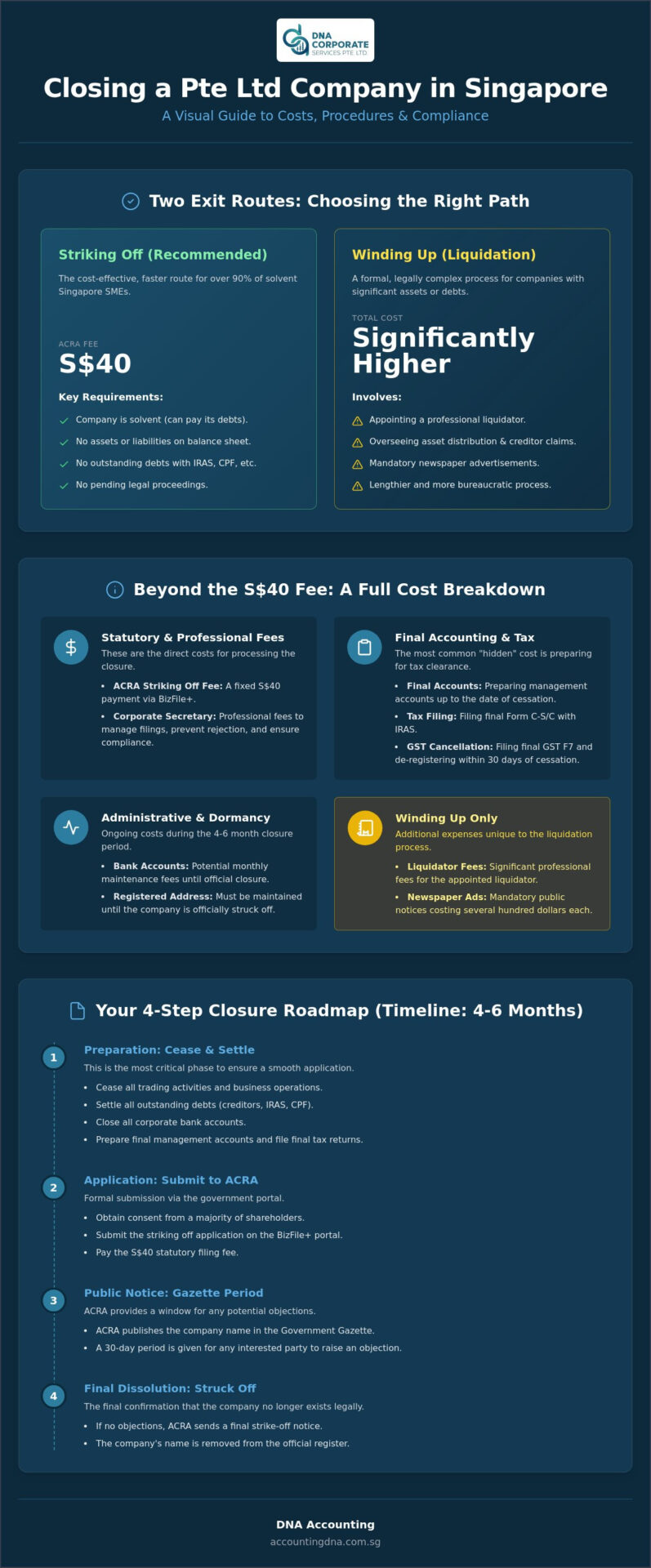
When you decide it’s time to move on, the path you choose significantly impacts your final bill. For the vast majority of local business owners, the cost to close a pte ltd company in Singapore is kept manageable by choosing the striking off route. This is a simplified process designed for companies that have finished their journey cleanly, without lingering debts or complicated asset distributions. It’s the most straightforward way to ensure you’re compliant with ACRA without breaking the bank.
Striking Off: The Cost-Effective Option for Solvent Companies
Striking off is the preferred choice for approximately 90% of Singapore SMEs. It’s faster, less bureaucratic, and involves a modest $40 filing fee to ACRA. However, it isn’t a shortcut. To qualify, your company must be solvent and have stopped trading for at least three months. You’ll need to ensure the following criteria are met:
- No outstanding debts with IRAS, CPF, or other government agencies.
- No current or pending legal proceedings in Singapore or abroad.
- No assets or liabilities remaining on the balance sheet.
Engaging professional corporate secretarial services ensures your application isn’t rejected due to technical errors. A single oversight in your final accounts or a forgotten bank account with a small balance can lead to a rejection from ACRA, forcing you to restart the entire four-month process.
Winding Up: When Legal Complexity Increases the Price
If your company still holds significant assets or cannot pay its debts, you’ll need to look at Understanding Winding Up. This is a formal legal procedure that is naturally more expensive. Unlike striking off, winding up requires a liquidator to oversee the distribution of assets and the settlement of creditor claims. While the Official Receiver might be involved in certain compulsory cases, most solvent SMEs opt for a Members’ Voluntary Winding Up. This requires engaging private liquidators whose professional fees can quickly escalate. This complexity is why the total cost to close a pte ltd company in Singapore varies so widely between a simple deregistration and a full liquidation.
Breakdown of ACRA Fees and Professional Service Costs
When you look at the ACRA website, the only price tag you’ll see for striking off is a S$40 filing fee. While this is the only direct statutory payment, it’s rarely the total cost to close a pte ltd company in Singapore. For most directors, the real investment lies in the professional expertise required to ensure every regulatory box is checked. Relying on a professional Corporate Secretary to manage the BizFile+ submission doesn’t just save time; it prevents the costly rejection of your application due to lingering assets or unresolved liabilities.
It’s also vital to distinguish between striking off and winding up when it comes to public notices. For a simple strike-off, ACRA handles the Gazette notifications as part of your filing. However, if your company follows the winding-up route, you’re legally required to place advertisements in local newspapers. These ads can cost several hundred dollars each, adding a significant layer to your closure budget that many business owners overlook until the invoice arrives.
Tax Clearance and Final Accounting Costs
The biggest “hidden” expense in closing a company is often the preparation for tax clearance. IRAS doesn’t issue a physical “Letter of No Objection” anymore. Instead, directors must self-verify that all tax obligations are met via the myTax Portal. This means you must file a final Form C-S or Form C and prepare management accounts up to the date of cessation. If your business was GST-registered, you’ll also need to cancel that registration within 30 days of stopping operations and file a final GST F7 return. Managing these final tax filings correctly is the only way to ensure the company is truly ready for closure.
Administrative and Dormancy Fees
Don’t forget the administrative tail. Your corporate bank account may incur monthly maintenance fees or minimum balance penalties until it’s officially closed. Similarly, your company must maintain a registered office address until the final strike-off date, which typically takes four to six months. If you’re unsure if your accounts are ready for the final submission, you can reach out to us to review your current compliance status.
Strategies to Minimize the Cost of Closing Your Singapore Company
Reducing the cost to close a pte ltd company in Singapore starts long before you click “submit” on the BizFile+ portal. The most effective strategy is proactive management of your statutory obligations. When you allow unfiled Annual Returns or tax computations to pile up, you aren’t just delaying the inevitable; you’re inviting compounding penalties that can quickly eclipse the actual service fees for striking off. By tidying your compliance house early, you ensure the closure process remains a predictable expense rather than a financial drain.
To keep your budget lean, ensure your company remains truly dormant for at least three months. This means zero transactions, including bank charges or small interest payments. A clean, transaction-free period simplifies the tax clearance process significantly. You should also verify that all corporate bank accounts are closed and every asset is distributed to shareholders. If you fail to do this, any remaining assets are treated as “Bona Vacantia” and legally pass to the State, creating a complex and expensive recovery process later. Consolidating your corporate secretarial services and accounting with one firm often allows for a bundled closure package, further reducing your total outlay.
Avoiding ACRA Late Filing Penalties
Late filing penalties are the primary cause of “cost creep” during a company closure. If your company has missed previous Annual Returns, ACRA will require these to be rectified before the striking off application is even considered. These penalties can double your expected cost to close a pte ltd company in Singapore. We highly recommend performing a comprehensive ACRA compliance check to identify and resolve these issues before you begin the formal exit process.
Leveraging Professional Expertise for a Seamless Exit
While a DIY approach might seem cheaper initially, the risk of rejection or missed tax deadlines often leads to higher long-term expenses. Choosing a boutique partner like DNA Accounting provides better cost-to-value by identifying potential compliance roadblocks before they become costly errors. Our centralized model ensures that your final accounting and tax filings are perfectly aligned, which prevents costly IRAS queries and ensures a smooth de-registration process without the stress of hidden liabilities.
Moving Forward with a Clean Slate and Total Compliance
Managing the total cost to close a pte ltd company in Singapore is much simpler when you have a dedicated guide in your corner. At DNA Accounting, we offer bespoke care designed for the unique challenges of Singapore SMEs. Our deep expertise in ACRA and IRAS regulations means we handle the technical heavy lifting, while our availability during non-traditional hours ensures we’re there when you need us most. If you’re ready to finalize your company’s journey with absolute confidence, contact DNA Accounting for a stress-free company closure consultation. We’re here to help you close this chapter cleanly so you can focus on your next big success.
Frequently Asked Questions
Can I close my company if I have outstanding taxes with IRAS?
No, you cannot successfully close your company if there are outstanding tax liabilities or unfiled returns with IRAS. ACRA will reject your application if any government agency raises an objection during the gazetting period. It’s essential to settle all tax assessments and file your final tax returns through the myTax Portal before starting the process. This ensures a clean break without the stress of last minute rejections.
How long does the striking off process take in Singapore?
The striking off process in Singapore generally takes between 4 to 6 months to complete. This timeline accounts for the mandatory 60 day notice period in the Government Gazette, which allows creditors or other stakeholders to raise objections. If no objections are received during this window, ACRA will proceed to issue the final notice of dissolution, officially ending the company’s legal existence.
What happens to the company’s remaining assets after it is struck off?
Any assets left in the company’s name at the time of dissolution automatically pass to the State under the principle of “Bona Vacantia.” This includes bank balances, motor vehicles, or property. To avoid this, directors must ensure all assets are distributed to shareholders and all bank accounts are closed before the application. Recovering assets from the state after a strike off is a significantly more expensive and complex legal hurdle.
Is it cheaper to keep a company dormant or to strike it off?
Striking off is typically the more cost effective choice for companies with no future business plans. Even if a company is dormant, you’re still obligated to pay for a registered office address, corporate secretarial services, and annual ACRA filing fees. Over several years, these recurring expenses far exceed the one time cost to close a pte ltd company in Singapore. Closing the company permanently removes these annual compliance burdens and the risk of late filing penalties.
Disclaimer
The information provided on this website is for general informational purposes only and is not intended to constitute professional accounting, tax, legal, or financial advice. While we strive to ensure that the content is accurate and up to date, regulations in Singapore, including those administered by ACRA, IRAS, CPF Board, and MOM, may change from time to time and may differ depending on individual circumstances.
Readers should not act or rely on any information contained on this website without seeking specific advice from a qualified professional based on their individual situation.
DNA Corporate Services and its affiliates accept no responsibility or liability for any loss or damage arising from reliance on the information provided in this website or any linked materials.
For tailored advice relating to accounting, taxation, corporate secretarial, or compliance matters in Singapore, please contact us directly for professional consultation.



