

What if the “clean break” you expected when closing your business was actually a ticking clock of hidden legal risks? Many directors in Singapore mistakenly believe that once a company is struck off the ACRA register, their personal responsibilities vanish into thin air. However, the reality is that liabilities after striking off a company Singapore remain enforceable against officers and members as if the entity had never been dissolved. It’s a heavy thought, especially when you’re already navigating the emotional and logistical hurdles of moving on from a business venture.
We understand the underlying anxiety that comes with the mandatory six-year record-keeping rule and the fear of a surprise IRAS inquiry landing on your doorstep years later. You deserve a transition that is both legally sound and professionally handled. This guide is designed to replace that uncertainty with total confidence by showing you exactly how to protect your personal assets and meet every regulatory requirement. We’ll walk you through the 2026 compliance standards, from settling final tax obligations to ensuring your documentation is robust enough to withstand any future scrutiny, allowing you to move forward with complete peace of mind.
Key Takeaways
- Understand that dissolution is not a legal shield; the law still enforces liabilities after striking off a company Singapore as if the business were still active.
- Learn why you must retain all accounting and statutory records for at least five years to remain compliant with IRAS and ACRA post-dissolution.
- Identify the specific scenarios, such as wrongful trading or breach of fiduciary duty, where directors can be held personally accountable for company debts.
- Discover the importance of a “Clean Slate” audit to ensure all assets are distributed and liabilities are settled before filing your final application.
- Master the process of securing tax clearance from IRAS to guarantee a smooth, professional exit and protect your personal reputation.
Striking Off vs. Liabilities: Does Dissolution Mean Debt Disappears?
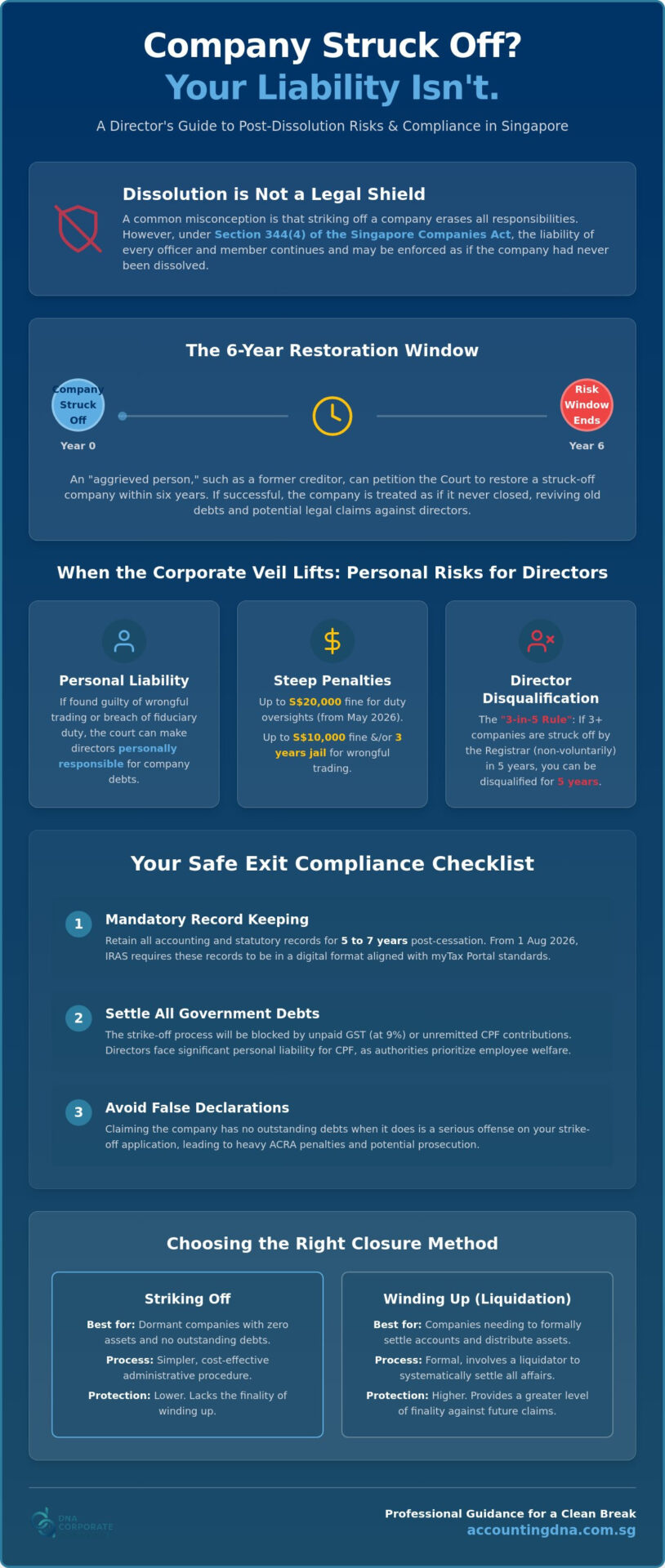
Striking off is an administrative deregistration process under the Singapore Companies Act, designed for companies that have ceased all business operations and have no remaining assets or debts. Many directors assume that the gazetting of their company’s name by ACRA marks the end of their legal exposure. However, it’s a common misconception that dissolution acts as a total shield. In reality, liabilities after striking off a company Singapore remain enforceable against every officer and member as if the entity were still active. Under Section 344(4) of the Companies Act, the liability of every officer and member of the company continues and may be enforced as if the company had not been dissolved.
Striking Off vs. Winding Up: Which Protects You More?
While striking off is a cost-effective, “summary” way to close a dormant SME, it lacks the finality of a formal winding up. Winding up involves a liquidator who systematically settles all accounts, providing a higher level of protection against future claims. A deeper understanding insolvency is vital here, as the method you choose to close your doors depends heavily on whether you can pay your debts in full. We typically recommend striking off only for companies with zero assets, no outstanding government debts, and no active creditors.
The 6-Year Restoration Window
Did you know a company can be brought back to life long after you’ve moved on? Any “aggrieved person,” such as a former creditor or a claimant with a pending legal suit, can petition the Court to restore a struck-off company within six years of its dissolution. If the court grants this order, the company is treated as if it had never been struck off. This means past directors can suddenly find themselves facing old legal claims or unpaid debts that they thought were buried. It’s why we emphasize a proactive compliance audit before you even touch the BizFile+ portal; you don’t want a ghost from your business past reappearing years later.
Personal Liability and the 6-Year Rule for Singapore Directors
Closing a company doesn’t mean you can simply walk away from your duties as a director. If a director is found to have engaged in wrongful trading or breached their fiduciary duties, the courts can “lift the corporate veil.” This legal action removes the protection of the company’s separate legal personality, making you personally responsible for the business’s debts. Under regulatory updates from May 2026, oversights in director duties during the company closure process can lead to personal fines of up to S$20,000. Additionally, if you’re found guilty of wrongful trading, you could face a fine of up to S$10,000, imprisonment for up to three years, or both.
Even after the company is officially gone, your paperwork must remain accessible. Singapore law mandates that you maintain all accounting records and supporting documents for at least five to seven years post-cessation. As of August 1, 2026, IRAS requires all financial records for dissolved entities to be maintained in a digital format that aligns with myTax Portal standards for easy retrieval during statutory reviews. Making a false declaration on your strike-off application, such as claiming the company has no outstanding debts when it does, is a serious offense that can lead to heavy ACRA penalties and potential prosecution.
Director Disqualification Risks
Are you managing multiple entities? You need to be aware of the “three in five” rule. ACRA can disqualify a director from managing companies for five years if they have three or more companies struck off by the Registrar within a five-year period. It’s vital to distinguish between a voluntary strike-off and a “Registrar’s Motion.” A Registrar’s Motion happens when ACRA initiates the closure because the company failed to file annual returns, which leaves a permanent mark on your professional record and counts toward disqualification.
Unpaid CPF and GST Obligations
Government agencies are often the first to object to a striking off application. If your company owes GST at the current 9% rate or has unremitted CPF contributions for former employees, the IRAS or CPF Board will block the process. Directors face significant personal liability risks regarding unpaid CPF; the authorities are particularly strict about ensuring employee welfare is protected. Clearing these debts is the only way to ensure a clean break. If you’re feeling overwhelmed by these statutory requirements, you can speak with our advisors to ensure your exit is fully compliant.
The Safe Exit Strategy: Ensuring a Liability-Free Dissolution in 2026
How can you be certain that your exit is truly permanent? Achieving a clean break requires more than just a few clicks on BizFile+. Before you submit your application, conduct a thorough “Clean Slate” audit of your balance sheet. This means ensuring all assets are zeroed out and every single creditor is paid in full. If you leave assets behind, they become “bona vacantia” and belong to the state. Worse, if you leave debts, you trigger the risk of liabilities after striking off a company Singapore being enforced against you personally by creditors who feel aggrieved.
The most critical milestone is obtaining tax clearance from IRAS. While IRAS no longer issues formal paper letters for strike-offs, you must retrieve your latest Notice of Assessment and Statement of Accounts from mytax.iras.gov.sg to prove no outstanding tax matters exist. Don’t forget to close your corporate bank accounts only after the final tax refund is received and all assets are distributed to shareholders. You’ll also need to engage a corporate secretarial service to draft the necessary board resolutions and ensure the members’ voluntary agreement is legally documented.
2026 IRAS and ACRA Filing Requirements
Your compliance journey doesn’t end until the very last day of cessation. You must file Form C-S (Lite) or Form C covering the period up to the exact date the business stopped. Check the ACRA portal for any outstanding Annual Returns or AGM penalties. Since penalties for late filing typically range from S$300 to S$600 per return, clearing these early prevents a costly objection to your striking-off application from the Registrar.
Why Professional Guidance is Essential
Navigating the final months of a company’s life is often the most stressful period for a director. At DNA Accounting, we act as your protective partner, managing the complex interface between your business and regulatory bodies. Our centralized accounting and tax service ensures that your final accounts are bulletproof, significantly reducing the chance of an IRAS audit or an objection letter. For a deeper dive into the broader regulatory landscape, we invite you to read The Master Guide to Statutory Compliance in Singapore. We are here to ensure your next chapter starts with a truly fresh start.
Protect Your Professional Future with a Compliant Exit
Closing your company is a significant milestone that should bring a sense of relief, not a lingering fear of legal repercussions. As we have discussed, liabilities after striking off a company Singapore continue to exist for directors and officers under the Companies Act, making a proactive “Clean Slate” audit non-negotiable. By securing your IRAS tax clearance and committing to the mandatory six-year digital record-keeping rule, you transform a potentially risky administrative process into a secure, professional exit.
Secure your business exit with a professional striking off consultation today and ensure your next chapter begins with total peace of mind.
Frequently Asked Questions
Can I be sued after my company is struck off in Singapore?
Yes, you can still face legal action. Under the Singapore Companies Act, any creditor or aggrieved person can petition the Court to restore your company within six years of the striking-off date. Once restored, the company is treated as though it never ceased to exist. It’s also vital to remember that liabilities after striking off a company Singapore remain enforceable against directors and officers personally if there was evidence of wrongful trading or a breach of fiduciary duty.
How long do I need to keep company records after striking off in 2026?
You’re legally required to maintain all accounting records and supporting documents for at least five years according to IRAS. However, many seasoned advisors recommend a seven-year retention period to ensure total compliance. As of August 2026, IRAS requires all records for dissolved entities to be kept in a digital format that aligns with myTax Portal standards. Failing to produce these records during a post-dissolution audit can lead to significant penalties for former directors.
What happens to the company’s bank account and assets after it is struck off?
Any assets remaining in the company’s name at the time of dissolution are transferred to the Singapore government under the principle of bona vacantia. This includes cash in corporate bank accounts, which the bank will freeze as soon as the strike-off is officially gazetted. To avoid losing your business property, you must ensure all assets are distributed to shareholders and all bank accounts are closed before your final ACRA application is filed.
Will striking off my company affect my ability to be a director of other companies?
A voluntary strike-off for a company with no outstanding debts won’t affect your ability to hold other directorships. Risk only arises if you have three or more companies struck off by the Registrar’s motion within a rolling five-year period. This specific scenario can trigger a five-year disqualification from managing any company in Singapore. We always recommend a voluntary, compliant closure to keep your professional record clean and avoid the complications of a Registrar-initiated strike-off.
Disclaimer
The information provided on this website is for general informational purposes only and is not intended to constitute professional accounting, tax, legal, or financial advice. While we strive to ensure that the content is accurate and up to date, regulations in Singapore, including those administered by ACRA, IRAS, CPF Board, and MOM, may change from time to time and may differ depending on individual circumstances.
Readers should not act or rely on any information contained on this website without seeking specific advice from a qualified professional based on their individual situation.
DNA Corporate Services and its affiliates accept no responsibility or liability for any loss or damage arising from reliance on the information provided in this website or any linked materials.
For tailored advice relating to accounting, taxation, corporate secretarial, or compliance matters in Singapore, please contact us directly for professional consultation.



