

If your business faced a lawsuit tomorrow, would your personal savings, car, and home be safe? It’s a heavy question that keeps many Singaporean entrepreneurs awake at night. You likely started your venture for freedom, but as profits grow, the fear of personal asset seizure or missing an ACRA filing deadline can feel overwhelming. We understand that deciding between a sole proprietorship vs private limited company Singapore isn’t just about administrative paperwork; it’s about protecting your hard-earned future.
In this 2026 comparison, you’ll discover the critical legal, tax, and compliance differences between these structures to ensure you choose the right path. We’ll explore the massive tax savings potential of the Start-Up Tax Exemption (SUTE) scheme and provide a clear roadmap for staying compliant with IRAS and ACRA without the stress. By the end, you’ll have a certain decision on which entity to register.
Key Takeaways
- Learn how the separate legal entity status of a Private Limited company protects your personal assets and family home from business liabilities.
- Evaluate the trade-offs of a sole proprietorship vs private limited company Singapore to determine which structure offers the best tax efficiency for your income level.
- Understand how to leverage the Start-Up Tax Exemption (SUTE) scheme to significantly reduce your corporate tax liability during your first three years of operation.
- Gain a clear roadmap of ACRA and IRAS compliance duties, from appointing a corporate secretary to meeting essential annual filing deadlines.
Legal Identity and Liability: Protecting Your Personal Assets
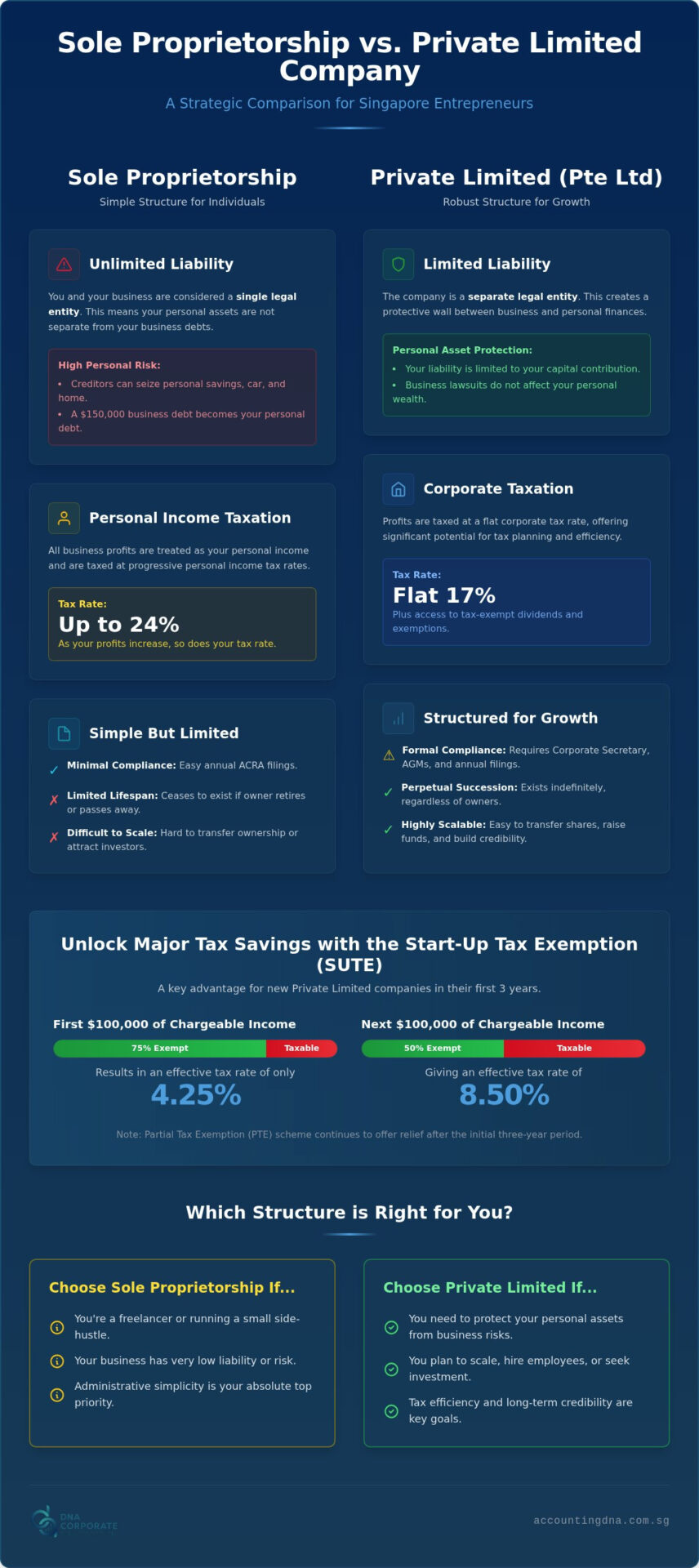
When you register as a sole proprietor, ACRA views you and your business as a single legal entity. There’s no legal “curtain” between your business revenue and your personal savings. This is the fundamental risk in the sole proprietorship vs private limited company Singapore comparison. If your business defaults on a lease or faces a professional negligence claim, you’re personally liable for the full amount. Your liability isn’t capped by what’s in the business bank account; it extends to everything you own.
A Private Limited structure changes the game entirely. It functions as a private company with its own “corporate personhood.” This means the company enters into contracts and incurs debts under its own name, not yours. Understanding the nuances of sole proprietorship vs private limited company Singapore helps you decide when it’s time to build that protective wall. As a shareholder, your risk is strictly limited to the capital you’ve already contributed to the company.
The Reality of Unlimited Liability in Singapore
In contrast, the “Limited” suffix in a Pte Ltd serves as a vital shield for your family’s financial security. Unless you’ve signed a personal guarantee or committed a breach of director’s duties, your personal life stays separate from your business failures. Choosing the right structure isn’t just about administrative ease; it’s about making sure a bad business month doesn’t become a personal catastrophe.
Taxation and Financial Benefits: Personal vs Corporate Rates
Tax efficiency is often the primary driver when comparing a sole proprietorship vs private limited company Singapore. For a sole proprietor, business income is treated as personal income. This means as your profits climb toward $1,000,000, you could face a marginal tax rate as high as 24%. While this structure is simple for side-hustles, it doesn’t offer the strategic tax planning tools available to corporate entities.
A Private Limited company enjoys a flat corporate tax rate of 17%. When evaluating Singapore business structures, the corporate model stands out because it allows you to optimize how you receive funds. You can draw a modest salary to stay in a lower personal tax bracket and distribute additional profits as tax-exempt dividends. This dual approach often results in significantly lower total tax paid compared to a sole proprietorship, especially as your revenue scales.
Maximizing Savings with the Startup Tax Exemption Scheme
The Start-Up Tax Exemption (SUTE) scheme provides a significant head start for new companies. For the first three consecutive Years of Assessment, qualifying companies receive a 75% exemption on the first $100,000 of normal chargeable income and a 50% exemption on the next $100,000. This results in an effective tax rate of just 4.25% on your first $100,000 of profit. Even after the initial three-year period, the Partial Tax Exemption scheme continues to offer relief on your first $200,000 of income. Our professional corporate tax filing ensures you meet all IRAS requirements to claim these deductions. If you’re ready to see how these savings apply to your specific numbers, speak with our tax advisors today.
Compliance, Scalability, and Making the Final Decision
The administrative shift is often what scares founders away from incorporating. While a sole proprietorship requires minimal ACRA filings, a Private Limited company must appoint a qualified corporate secretary within six months of incorporation and hold an Annual General Meeting (AGM) or dispense with it via shareholder resolution. These requirements aren’t just red tape; they’re the pillars of a professional, transparent business. If you’re serious about growth, the sole proprietorship vs private limited company Singapore debate usually ends here because this structure is the gold standard for credibility.
Scalability is where the Private Limited model truly shines. Unlike a sole proprietorship, which ends if the owner passes away or retires, a company has perpetual succession. You can easily transfer ownership through share transfers, making it simple to bring in partners or plan an exit. Banks and venture capitalists almost exclusively prefer the Private Limited structure because it allows for clear equity distribution and professional governance. It’s the necessary engine for any business aiming to hire a team or secure a commercial lease.
Trigger Points: When to Convert to a Private Limited Company
How do you know when it’s time to make the switch? We typically advise clients to consider conversion when their annual profits approach the $100,000 mark. At this stage, the tax savings from the SUTE scheme often outweigh the additional compliance costs of maintaining a company. Other triggers include signing high-value contracts where personal liability becomes too risky or when you need to hire your first employee under the CPF system.
Managing the transition requires careful timing to avoid double taxation or missed ACRA deadlines. You’ll need to cease your old business within three months of the new setup. Our corporate secretarial services ensure you stay compliant throughout the transition and beyond. Don’t let the paperwork hold you back from the next stage of your entrepreneurial journey.
Securing Your Business Future in 2026
Choosing between a sole proprietorship vs private limited company Singapore is a defining moment for your business journey. While the simplicity of a sole proprietorship is tempting for early days, the Private Limited structure offers the asset protection and tax efficiency required for sustainable growth. Protecting your family’s personal assets and maximizing corporate tax exemptions are strategic moves you won’t regret as your revenue scales.
As an ACRA-registered filing agent, we’re here to help you navigate these statutory waters with total confidence. Our team provides bespoke corporate secretarial support and specialized SME tax advisory to ensure you never miss a filing deadline or a deduction. You don’t have to manage these complexities alone. Get a personalized consultation for your Singapore business setup and let’s turn your entrepreneurial vision into a secure, scalable reality. You’ve built something great; let’s make sure it’s built to last.
Frequently Asked Questions
Do I need a local director for a Private Limited company if I am a foreigner?
Can I convert my Sole Proprietorship to a Private Limited company later?
You can transition your business structure as your revenue grows. There isn’t a direct “conversion” process; instead, you’ll incorporate a new company and transfer your existing assets and contracts to it. When comparing a sole proprietorship vs private limited company Singapore, many owners choose to make this move once their annual profits reach $100,000 to take advantage of corporate tax exemptions and limited liability.
Is a Sole Proprietorship required to have a corporate secretary in Singapore?
No, a sole proprietorship doesn’t need to appoint a corporate secretary. This entity type is governed by simpler regulations designed for low-risk, solo operations. However, if you decide to incorporate a Private Limited company, you’re legally required to appoint a qualified secretary within six months. This role is essential for managing ACRA filings, board resolutions, and ensuring your company’s statutory books are always up to date.
What are the annual filing requirements for a Pte Ltd vs a Sole Proprietorship?
Sole proprietors have simpler duties, mainly reporting business trade income on their personal tax returns annually. A Private Limited company has more rigorous requirements, including filing an Annual Return with ACRA and submitting corporate tax returns to IRAS. You must also file your Estimated Chargeable Income (ECI) within three months of your financial year end. We provide bespoke secretarial support to help directors manage these recurring deadlines.
Disclaimer
The information provided on this website is for general informational purposes only and is not intended to constitute professional accounting, tax, legal, or financial advice. While we strive to ensure that the content is accurate and up to date, regulations in Singapore, including those administered by ACRA, IRAS, CPF Board, and MOM, may change from time to time and may differ depending on individual circumstances.
Readers should not act or rely on any information contained on this website without seeking specific advice from a qualified professional based on their individual situation.
DNA Corporate Services and its affiliates accept no responsibility or liability for any loss or damage arising from reliance on the information provided in this website or any linked materials.
For tailored advice relating to accounting, taxation, corporate secretarial, or compliance matters in Singapore, please contact us directly for professional consultation.



