

Could a single missed deadline really cost your startup S$600 and a blemish on your ACRA record before you’ve even scaled? It’s a valid concern for founders juggling product-market fit with the weight of Singapore’s statutory regulations. You want to focus on growth, but the complexity of GST, CPF, and IRAS filings often feels like a full-time job. We know traditional firms often go quiet during the evenings when you’re actually working.
This guide to accounting for startups in Singapore will help you master these strict requirements while building a scalable financial foundation. We’ll walk through the 2026 compliance landscape, including the latest CIT rebates and mandatory InvoiceNow requirements. You’ll learn how to achieve zero penalties and maintain real-time financial visibility, all with a partner who stays available during your weekend sprints to keep your business’s DNA healthy and compliant.
Key Takeaways
- Learn to navigate ACRA and IRAS requirements to avoid late filing penalties of up to S$600 while keeping your regulatory record spotless.
- Understand how accurate bookkeeping builds a transparent financial foundation that makes your startup more attractive to potential investors.
- Determine whether your startup should register for GST based on the S$1 million turnover threshold or if voluntary registration is more strategic for your 2026 growth plans.
- Use this comprehensive guide to accounting for startups in Singapore to find a boutique partner who works on your schedule, including evenings and weekends.
Navigating the Singapore Regulatory Landscape: ACRA and IRAS Compliance for Startups
Startup accounting in Singapore isn’t just about recording transactions; it’s a holistic framework that connects bookkeeping, tax planning, and statutory secretarial duties. Understanding the players is your first step toward stability. The Accounting and Corporate Regulatory Authority (ACRA) governs registration and ongoing governance, while the Inland Revenue Authority of Singapore (IRAS) handles taxation, including GST and Corporate Tax. To keep your reporting accurate, the Singapore Financial Reporting Standard (SFRS) for Small Entities serves as the critical benchmark for your startup’s financial statements.
Your 2026 Singapore Compliance Calendar: Key ACRA & IRAS Deadlines
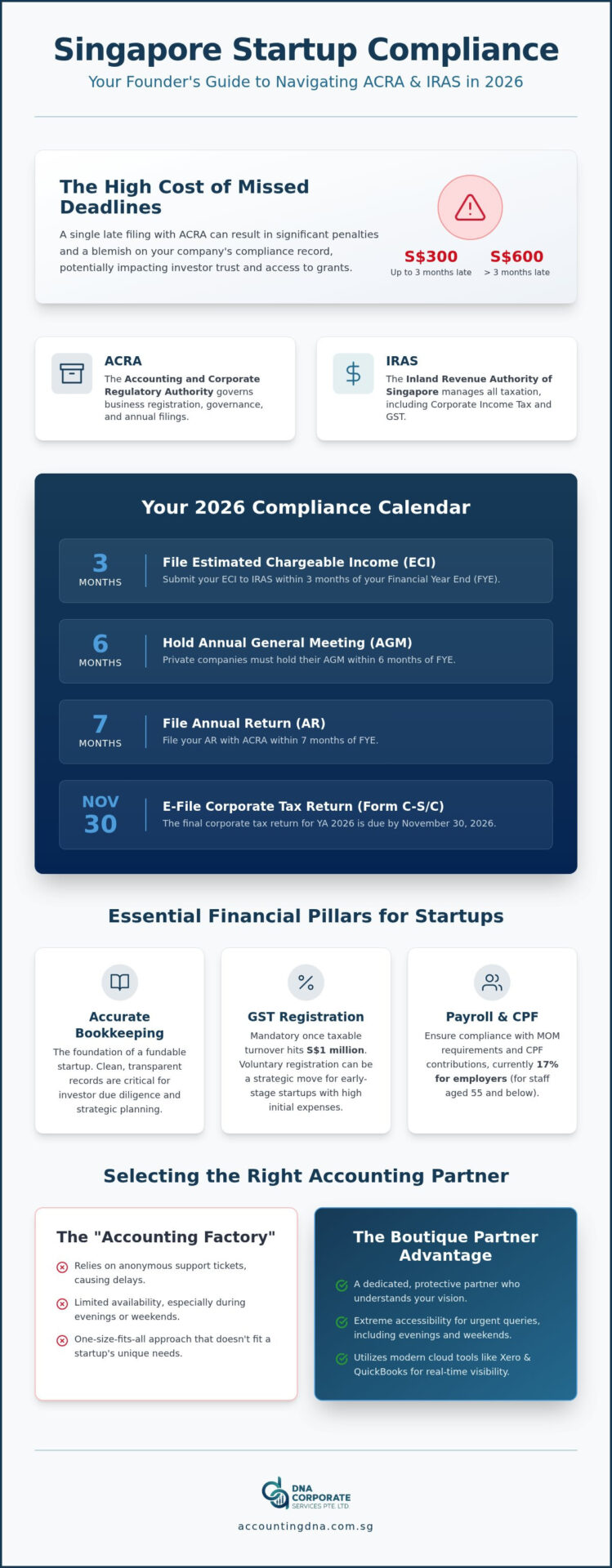
Staying ahead of deadlines is simpler than you think. This guide to accounting for startups in Singapore ensures you won’t miss these essential 2026 dates:
- AGM and AR Filing: Private companies must hold their Annual General Meeting within 6 months and file their Annual Return with ACRA within 7 months of the Financial Year End.
- IRAS ECI: You must file your Estimated Chargeable Income within 3 months of your Financial Year End.
- Form C-S/C: The final corporate tax return for YA 2026 must be e-filed by November 30, 2026.
Missing these windows can lead to unnecessary stress and enforcement actions. For a deeper dive into your statutory duties, explore The Master Guide to Statutory Compliance in Singapore (2026 Edition).
Essential Startup Accounting Services: From Bookkeeping to Strategic Scaling
Monthly bookkeeping is the fundamental building block of your business’s DNA. It isn’t just about balancing the books; it’s about maintaining a transparent ledger that keeps your startup fundable and ready for scrutiny. When investors review your records, they look for clarity and precision. This Singapore startup guide from Startup SG emphasizes that building a solid foundation early is key to scaling with confidence. This guide to accounting for startups in Singapore highlights how consistent data entry prevents the “catch-up” scramble before an audit or funding round.
Navigating GST is another critical milestone for growing companies. While registration is mandatory once your taxable turnover hits S$1 million, voluntary registration in 2026 can be a strategic move to recover GST on high initial expenses. Don’t forget your people either. Integrated payroll ensures you stay on top of CPF contributions, currently 17% for employers of staff 55 and below, and MOM requirements. Managing these through a centralized workflow reduces administrative friction. Our professional accounting services in Singapore help transform these tasks from burdens into strategic assets for your team.
Leveraging Cloud Accounting: Xero and QuickBooks for Real-Time Insights
Why settle for an “accounting factory” when your business needs a tailored partner? Many high-volume firms rely on anonymous support tickets, leaving you waiting days for answers. For a founder, this guide to accounting for startups in Singapore emphasizes that timing is everything. You need an advisor who understands your vision and picks up the phone during evenings or weekends when urgent investor queries arise. We position ourselves as a protective partner, offering the extreme accessibility that larger firms simply cannot match. If you’re worried about costs, our transparent pricing tiers are built specifically for the lean realities of growing Singapore SMEs, ensuring you get bespoke care without the hidden fees.
Seamless Transition: How to Switch to a More Attentive Accounting Service
The biggest hurdle to better support is often the fear of a messy transition. However, switching accountants is a straightforward, seamless process when handled by a professional firm. We manage the heavy lifting to ensure zero disruption to your ACRA or IRAS filing cycles. Our roadmap follows three simple steps:
- Notice of Termination: You provide formal notice to your current provider; we can even provide the template for you.
- Professional Clearance: We coordinate the transfer of corporate records and statutory files directly with the previous firm to ensure all data is migrated accurately.
- DNA Health Check: We perform a deep-dive review of your past ledgers to identify and rectify any existing compliance gaps before they become penalties.
Don’t let the fear of “breaking up” with a slow-moving firm hold your growth back. A professional transition ensures your ledgers are clean, your filings are current, and your financial DNA is ready for the next stage of your journey.
Build Your Startup on a Compliant Foundation
Since 2016, we’ve specialized in helping founders navigate these complexities with bespoke care tailored to their unique business DNA. Whether you need a health check on your current ledgers or a dedicated advisor available during evenings and non-working days, we’re here to help. Secure your startup’s financial future with a personalized consultation at DNA Accounting. Your vision deserves a financial foundation that’s as ambitious as your goals.
Frequently Asked Questions
What are the typical accounting fees for startups in Singapore in 2026?
Startup accounting fees in Singapore are typically structured around the volume of monthly bookkeeping entries and the frequency of financial reporting. Most providers offer tiered packages tailored to your specific activity level. This ensures you aren’t overpaying for services you don’t need while maintaining a clear audit trail. It’s best to request a customized quote based on your projected monthly transactions and reporting requirements.
Does my startup need to register for GST if revenue is below S$1 million?
You don’t have to register for GST if your annual taxable turnover stays below S$1 million. However, voluntary registration is a popular choice for startups with high setup costs, as it allows you to recover the 9% GST paid to suppliers. You should evaluate if your clients are GST-registered, as you’ll need to collect and remit GST on all taxable sales once registered.
Can I use the same firm for both corporate secretarial services and accounting?
You can certainly use the same partner for both corporate secretarial services and accounting. This centralized approach is highly recommended for startups because it streamlines data sharing and ensures your ACRA and IRAS filings are consistent. It prevents the administrative friction that happens when different firms handle your books and your statutory records, allowing you to focus on scaling your core business operations.
What is the difference between ECI and Form C-S/C for a new Singapore company?
The Estimated Chargeable Income (ECI) is a preliminary report of your company’s taxable income filed within three months of your financial year-end. Conversely, Form C-S or Form C is the finalized corporate tax return due by November 30. As part of a comprehensive guide to accounting for startups in Singapore, it’s vital to remember that both filings are mandatory unless you meet specific exemption criteria.
Disclaimer
The information provided on this website is for general informational purposes only and is not intended to constitute professional accounting, tax, legal, or financial advice. While we strive to ensure that the content is accurate and up to date, regulations in Singapore, including those administered by ACRA, IRAS, CPF Board, and MOM, may change from time to time and may differ depending on individual circumstances.
Readers should not act or rely on any information contained on this website without seeking specific advice from a qualified professional based on their individual situation.
DNA Corporate Services and its affiliates accept no responsibility or liability for any loss or damage arising from reliance on the information provided in this website or any linked materials.
For tailored advice relating to accounting, taxation, corporate secretarial, or compliance matters in Singapore, please contact us directly for professional consultation.



