

What if the difference between a seamless ACRA filing and a S$600 late penalty wasn’t your accounting software, but simply knowing which reporting framework actually applies to your business? Most SME owners find the jump from basic bookkeeping to statutory reporting incredibly daunting. It’s completely normal to feel overwhelmed by the technical divide between SFRS and the “Small Entity” framework, especially with the 2026 updates and mandatory XBRL requirements looming.
This guide simplifies the process of how to prepare financial statements Singapore regulators expect, turning a stressful compliance chore into a clear, manageable roadmap for your company’s year-end. We’ll break down the 2026 audit exemption thresholds, clarify the new SFRS(I) standards, and show you exactly how to navigate the filing deadlines to keep your business in good standing. From understanding the S$10 million revenue rule to mastering the latest IRAS tax rebates, you’ll gain the confidence to manage your 2026 obligations with ease.
Key Takeaways
- Identify whether your company qualifies for the “Small Entity” framework to streamline your reporting process and reduce administrative overhead.
- Follow a step-by-step roadmap on how to prepare financial statements Singapore authorities mandate, including the Director’s Statement and XBRL filing requirements.
- Understand the specific 2026 audit exemption criteria to ensure you’re not paying for unnecessary services while staying compliant with the Companies Act.
- Secure your company’s “Good Standing” status by mastering the critical 7-month filing deadline for ACRA and the November tax deadlines for IRAS.
Understanding the Singapore Financial Reporting Standards (SFRS) Landscape
In 2026, the focus has shifted toward the accrual basis of accounting. This method records income and expenses when they occur, rather than when cash changes hands. While it might seem complex, it offers a far more accurate view of your financial health than simple cash-based tracking. Effective compliance now requires a proactive approach. You can’t just treat bookkeeping as a year-end chore. You need a centralized system that prepares you for statutory filings long before the ACRA deadlines arrive.
SFRS for Small Entities: Does Your Startup Qualify?
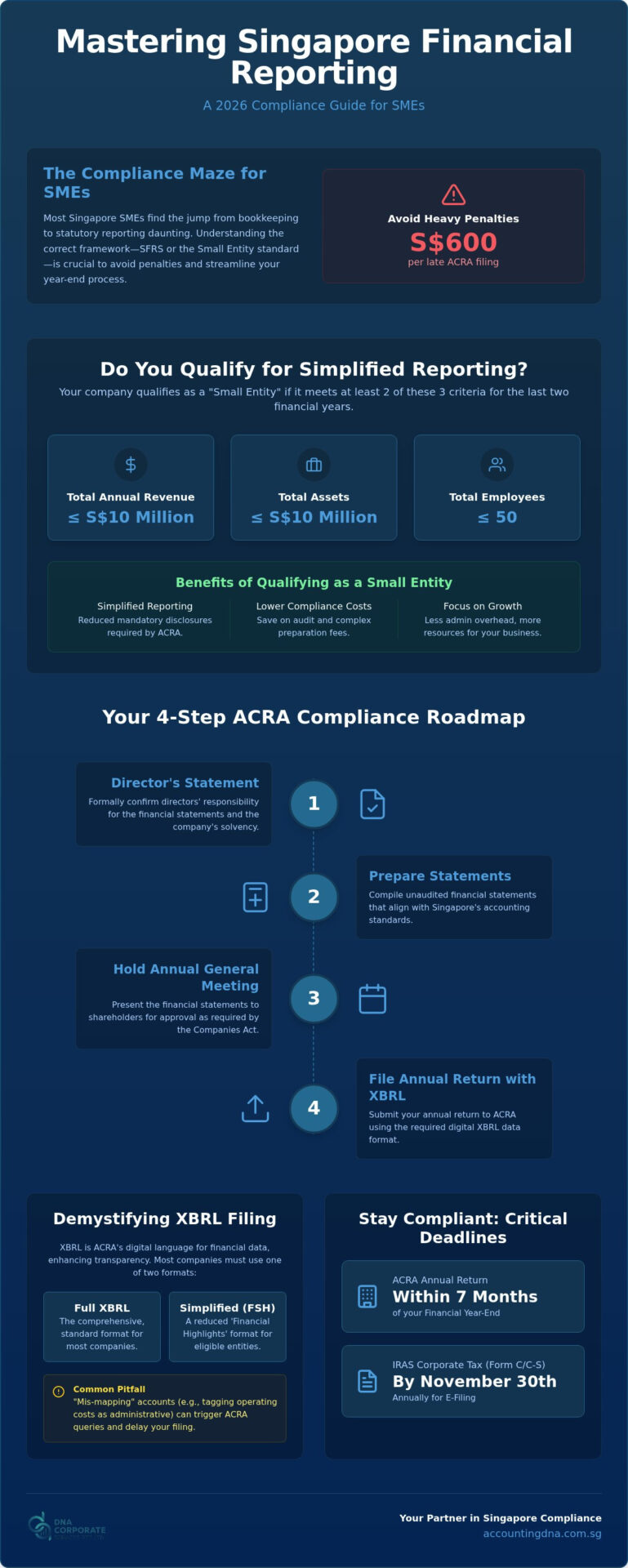
The “Small Entity” framework is a welcome relief for many entrepreneurs. This is a game-changer for lean teams. If your company qualifies, you can benefit from simplified reporting and significantly lower compliance costs. To qualify, your company must meet at least two of the following three criteria for the last two consecutive financial years:
- Total annual revenue of S$10 million or less.
- Total assets of S$10 million or less.
- A workforce of 50 or fewer employees.
Choosing this framework reduces the volume of mandatory disclosures. This allows you to focus your energy on growth while still meeting every legal obligation. It’s a strategic choice that simplifies your administrative burden.
Practical Steps for Financial Reporting and ACRA Compliance
How do you transition from raw transaction data to a compliant ACRA filing? Knowing how to prepare financial statements Singapore authorities will accept is the first step toward a stress-free year-end. It begins with the Director’s Statement. This formal document confirms the directors’ responsibility for the financial statements and their belief that the company can pay its debts. Following this, you must prepare the unaudited financial statements for the Annual General Meeting (AGM). To ensure these documents meet the mark, they must align with Singapore’s accounting standards accurately.
Maintaining rigorous statutory compliance Singapore is vital for your company’s “Good Standing.” This status isn’t just a label; it’s often required for bank loans and government grants. Reliability starts with clean data. Professional accounting and bookkeeping services ensure your trial balance is accurate before the year-end crunch begins. This proactive approach helps you avoid the #1 founder fear: heavy ACRA late filing penalties. These fines can hit S$600 per late return and escalate if left unaddressed.
Demystifying XBRL Filing Requirements for 2026
XBRL is a digital language used by ACRA to enhance financial transparency across the Singapore business ecosystem. While it sounds technical, it’s essentially a way of tagging financial data so computers can analyze it easily. Most companies must file a Full XBRL set, but some qualify for the simplified Financial Highlights (FSH). Common mistakes often involve “mis-mapping” accounts, such as incorrectly tagging operating expenses as administrative costs. These errors trigger ACRA queries that can delay your filing. If you’re unsure which format your company needs, speak with our team to clarify your 2026 obligations.
Navigating Accounting Standards with a Professional Partner
Why settle for a generic corporate service when your startup’s future is at stake? Larger firms often provide a one-size-fits-all approach, but a boutique partner offers the personalized attention needed to truly master how to prepare financial statements Singapore regulators demand. This bespoke care ensures your specific business nuances aren’t lost in a sea of client files. We believe that your accounting framework is the foundational “DNA” of your business, requiring a protective partner who understands your unique growth trajectory.
Integrating corporate secretarial services into your financial workflow is a strategic move for any busy director. A dedicated secretary manages your entire compliance calendar, from drafting AGM minutes to tracking ACRA deadlines. This centralized model simplifies your year-end obligations by ensuring financial data flows seamlessly into your corporate tax filing Singapore. Because founders don’t just work nine-to-five, we provide proactive support during evenings and non-working days. This extreme accessibility means you’re never left waiting for answers when a compliance question keeps you up at night.
Choosing the Right Framework for Long-Term Growth
While the Small Entity framework is efficient, you must evaluate if full SFRS is better for your long-term goals. If you’re eyeing future VC funding or international expansion, adopting full standards early builds immediate credibility with sophisticated investors, especially when deciding how to prepare financial statements Singapore investors will trust. This choice also ripples through your GST filing services, as robust accounting standards improve overall tax efficiency and audit readiness. DNA Accounting acts as your protective guide through the 2026 regulatory landscape, ensuring every financial decision supports your vision for growth.
Empowering Your 2026 Financial Success
Mastering the Small Entity criteria and accurate XBRL mapping ensures you stay ahead of ACRA’s strict deadlines. Proactive reporting isn’t just about avoiding penalties. This process builds a credible foundation for future funding and business expansion. Since 2016, DNA Accounting has specialized in serving as a protective guide for startups. We offer deep expertise in ACRA and IRAS regulatory standards through a centralized, bespoke service model. Understanding how to prepare financial statements Singapore regulators require is the first step toward long-term stability. Our team is uniquely available during evenings and weekends to support your growth whenever you need us. Ready to simplify your compliance journey? Book a stress-free consultation with DNA Accounting today and focus on what you do best: growing your business.
Frequently Asked Questions
What are the primary differences between SFRS and IFRS in 2026?
Singapore Financial Reporting Standards (SFRS) are almost entirely based on International Financial Reporting Standards (IFRS). In 2026, the primary difference lies in the specific effective dates for certain amendments and local interpretations issued by the Accounting Standards Council (ASC). While they remain nearly identical for most SMEs, SFRS includes specific modifications designed to suit the local regulatory environment in Singapore.
Can a dormant company be exempt from preparing financial statements in Singapore?
Yes, a dormant company may be exempt from preparing financial statements if it meets ACRA’s strict criteria. The company must have no accounting transactions during the period and its total assets must not exceed S$500,000. Even if you’re exempt from preparation, you must still file a dormant declaration with ACRA during your Annual Return to remain compliant.
What happens if my company fails to meet the ACRA filing deadlines in 2026?
Missing your filing deadline triggers an immediate late filing penalty, which typically starts at S$600 per return. Beyond these fines, your company’s “Good Standing” status is revoked, potentially affecting bank loan approvals and government grant eligibility. If you’re unsure how to prepare financial statements Singapore authorities require, early intervention is the best way to protect your business from these costs.
How often are Singapore accounting standards updated by the ASC?
The ASC updates standards continuously to maintain alignment with global IFRS changes. While updates occur throughout the year, major revisions usually become effective on January 1st. In 2026, several new SFRS(I) amendments took effect, focusing on enhanced disclosure requirements. Staying updated requires regular monitoring of ASC announcements or partnering with a professional advisor who manages these regulatory shifts for you.
Disclaimer
The information provided on this website is for general informational purposes only and is not intended to constitute professional accounting, tax, legal, or financial advice. While we strive to ensure that the content is accurate and up to date, regulations in Singapore, including those administered by ACRA, IRAS, CPF Board, and MOM, may change from time to time and may differ depending on individual circumstances.
Readers should not act or rely on any information contained on this website without seeking specific advice from a qualified professional based on their individual situation.
DNA Corporate Services and its affiliates accept no responsibility or liability for any loss or damage arising from reliance on the information provided in this website or any linked materials.
For tailored advice relating to accounting, taxation, corporate secretarial, or compliance matters in Singapore, please contact us directly for professional consultation.



