

What if your daily point-of-sale numbers are quietly misleading your balance sheet? Mastering financial reporting for retail businesses SG demands synchronizing daily sales data with strict statutory accounting standards. If you are constantly juggling transactions across physical storefronts, Shopee, and your POS terminal, you already know how exhausting retail reconciliation can be. Between tracking inventory shrinkage and avoiding IRAS penalties on 9% GST promotions, staying compliant often feels like a full-time job on top of running your shop.
You don’t have to navigate these regulatory demands alone or risk late filing penalties from ACRA. This comprehensive 2026 checklist provides a clear roadmap to align your multi-channel sales, inventory valuation, and Singapore Financial Reporting Standards seamlessly. Here is your step-by-step compliance guide to monthly reconciliations, tax deadlines, and stress-free year-end statutory reporting.
Key Takeaways
- Understand statutory compliance under the Singapore Companies Act and determine whether your store qualifies for simplified reporting under SFRS for Small Entities.
- Streamline daily POS settlement batches and multi-channel payouts to eliminate common gross margin discrepancies and payment gateway fee leaks.
- Implement proper inventory valuation methods and shrinkage tracking to ensure accurate balance sheet figures and avoid costly IRAS corporate tax miscalculations.
- Evaluate the operational trade-offs between an internal finance hire and outsourced support to maintain robust financial reporting for retail businesses SG without overburdening your overhead.
Singapore Retail Financial Reporting: ACRA Requirements and SFRS Standards
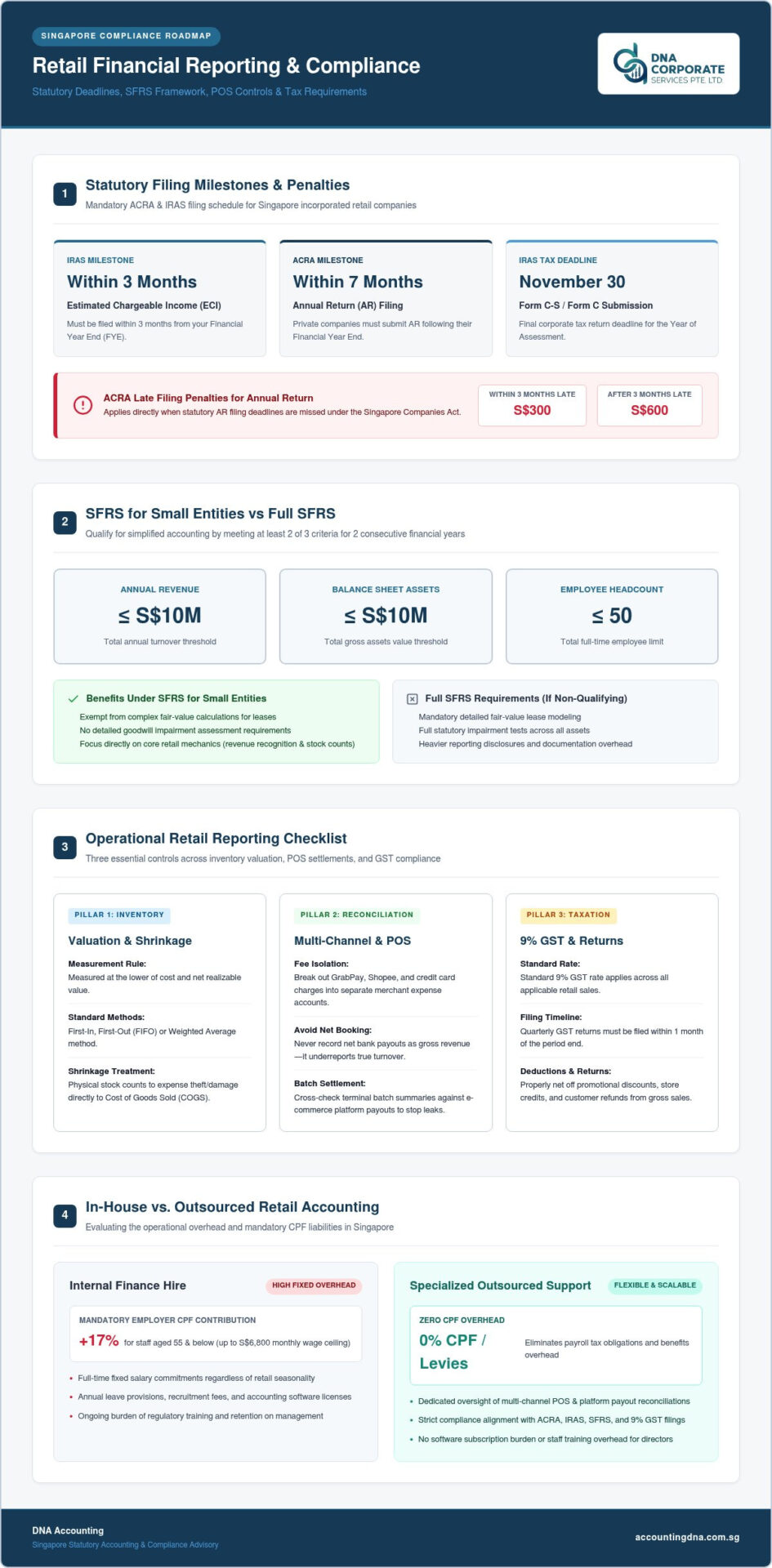
Every retailer incorporated in Singapore must prepare annual financial statements under the Singapore Companies Act. Grounded in baseline financial accounting principles, these statements must give a true and fair view of your company’s fiscal position. Staying compliant is not just about keeping neat ledgers; it directly drives your Annual Return (AR) submission with ACRA and your corporate tax filing with IRAS. Missing these milestones carries real financial consequences. ACRA levies late filing penalties of S$300 if your AR is submitted within three months past the deadline, jumping to S$600 thereafter.
Private companies must file their AR within seven months following their Financial Year End (FYE). In addition, IRAS mandates filing an Estimated Chargeable Income (ECI) within three months of your FYE, followed by Form C-S or Form C by November 30. Maintaining accurate, timely records ensures you meet these deadlines without panic.
SFRS for Small Entities vs Full SFRS for Retailers
Navigating financial reporting for retail businesses SG becomes substantially simpler if your store qualifies for the Singapore Financial Reporting Standard for Small Entities. A private enterprise qualifies if it meets at least two of these criteria for two consecutive financial years:
- Total annual revenue not exceeding S$10 million
- Total balance sheet assets not exceeding S$10 million
- Total employee headcount of 50 or fewer
Adopting this framework frees retail directors from onerous full SFRS requirements, such as complex fair-value calculations for leases and detailed goodwill impairment assessments. Instead, you can focus on core retail mechanics like revenue recognition and stock counts. To ensure your ledgers remain fully compliant without diverting attention from shopfront operations, partnering with professional bookkeeping and accounting services provides dedicated oversight tailored to local retail regulations.
The Essential Retail Reporting Checklist: Inventory, POS, and GST Compliance
Operational reality often clashes with statutory reporting when daily shop floor activity hits the general ledger. Effective financial reporting for retail businesses SG requires rigorous controls across three core pillars: inventory valuation, point-of-sale reconciliations, and quarterly Goods and Services Tax (GST) returns. Overlooking any of these leads to warped gross margins and compliance exposure with IRAS.
Under SFRS, inventory must be measured at the lower of cost and net realizable value, typically applied using First-In, First-Out (FIFO) or the weighted average method. For retailers registered for GST, remember that the standard rate sits at 9%. You must account for gross sales correctly, making sure promotional discounts, store credits, and customer refunds are netted off properly before filing quarterly returns within one month of your period end.
Reconciling POS Systems, Merchant Fees, and Inventory Shrinkage
Multi-channel retail operations create complex settlement trails. A common operational error is booking net bank deposits as total top-line revenue, which masks underlying payment gateway charges and underreports your true sales turnover.
- Isolate payment processing charges: Break out transaction fees deducted by payment providers like GrabPay, Shopee, and credit card gateways into separate merchant expense accounts.
- Reconcile daily closing batches: Cross-check physical terminal batch summaries against e-commerce platform payouts to catch timing delays and unrecorded revenue leaks.
- Quantify physical shrinkage: Run routine physical stock counts to identify theft or damage, expensing obsolete inventory to Cost of Goods Sold with clean supporting documentation.
Untangling these high-volume transactions takes time away from serving customers. If multi-channel payout discrepancies are slowing down your month-end close, you can consult our retail compliance team for practical reconciliation guidance.
In-House vs Outsourced Retail Accounting in Singapore
Hiring an internal finance executive gives your retail business on-site staff, but it creates substantial fixed operational costs. In Singapore, full-time staff salaries come paired with mandatory Central Provident Fund (CPF) employer contributions of 17% for staff aged 55 and below, on monthly wages up to the S$6,800 ceiling. Add annual leave provisions, recruitment fees, and software subscriptions, and managing your own team quickly strains cash reserves. It also places the ongoing burden of staff training squarely on you.
Specialized outsourced firms eliminate that structural overhead entirely. Instead of managing personnel, you secure dedicated professionals who handle multi-channel point-of-sale reconciliations and marketplace settlement files daily. An external provider ensures your ledgers remain current, while scaling alongside seasonal sales peaks and quiet trading months without adding headcount.
Strengthening Your Retail Compliance with DNA Accounting
Since 2016, DNA Accounting has supported Singapore SMEs and emerging retailers through practical, end-to-end statutory assistance. Managing financial reporting for retail businesses SG requires hands-on familiarity with local compliance frameworks, from routine journal entries to complex year-end statutory statements.
Our boutique firm delivers dependable support designed around the intense schedules of business owners, providing communication outside traditional office hours when shop doors close. You gain direct advisory to protect your business against filing penalties, keeping your quarterly GST declarations and corporate tax submissions fully compliant with IRAS standards. Discover how our adaptable service tiers match your operating model by exploring our clear pricing options today.
Master Your Retail Compliance and Protect Your Margins
Operating a thriving storefront or e-commerce brand requires crystal-clear numbers behind the scenes. From synchronizing multi-channel sales channels to applying SFRS for Small Entities and submitting accurate quarterly GST returns, sound accounting keeps your business protected from costly statutory penalties. Clean ledgers do more than satisfy regulators; they give you a realistic view of gross margins, inventory holding costs, and genuine business growth.
Staying on top of financial reporting for retail businesses SG doesn’t have to consume your evenings or pull you away from your customers. Since 2016, DNA Accounting has helped Singapore retail entrepreneurs streamline their bookkeeping, GST submissions, and corporate tax obligations with accessible, boutique advisory. Schedule a consultation with DNA Accounting today to simplify your compliance routine and build a rock-solid financial foundation for the trading year ahead.
Frequently Asked Questions
What financial statements are retail businesses in Singapore legally required to prepare?
Singapore incorporated retail companies must compile a complete set of financial statements under the Singapore Companies Act. This includes a Statement of Comprehensive Income, Statement of Financial Position, Statement of Changes in Equity, and a Statement of Cash Flows, alongside accompanying notes. These records form the mandatory basis for your annual filing with ACRA and your corporate tax submission to IRAS.
How should a retail store account for inventory shrinkage and damaged goods under SFRS?
Under SFRS guidelines, inventory must be written down to its net realizable value whenever goods become obsolete, damaged, or lost to shrinkage. You should record the difference directly as an expense within Cost of Goods Sold. Documenting these losses through formal stock-take variance reports ensures IRAS recognizes the write-off as an allowable business deduction during tax assessment.
Do retail businesses need to register for GST immediately upon opening in Singapore?
No, newly opened retail shops don’t need to register for GST right away unless registration is mandatory. Under IRAS rules, registration is compulsory only when your taxable turnover exceeds S$1 million at the end of a calendar year, or if you reasonably expect it to exceed S$1 million in the next 12 months. Voluntary registration is optional below this threshold.
Why is daily POS reconciliation crucial for Singapore retail financial reporting?
Daily reconciliations prevent discrepancies between your physical point-of-sale registers, card terminals, and bank deposits. Consistent financial reporting for retail businesses SG requires isolating processing fees charged by credit cards and digital wallets rather than recording net payouts. Daily matching flags unrecorded cash discrepancies, cashier errors, and delayed merchant settlements before they skew your monthly management reports.
Disclaimer
The information provided on this website is for general informational purposes only and is not intended to constitute professional accounting, tax, legal, or financial advice. While we strive to ensure that the content is accurate and up to date, regulations in Singapore, including those administered by ACRA, IRAS, CPF Board, and MOM, may change from time to time and may differ depending on individual circumstances.
Readers should not act or rely on any information contained on this website without seeking specific advice from a qualified professional based on their individual situation.
DNA Corporate Services and its affiliates accept no responsibility or liability for any loss or damage arising from reliance on the information provided in this website or any linked materials.
For tailored advice relating to accounting, taxation, corporate secretarial, or compliance matters in Singapore, please contact us directly for professional consultation.



