

E-commerce merchants that rely on bank-statement bookkeeping routinely understate gross turnover by 20% to 30%. When a net payout arrives from Shopee, Lazada, or Amazon, it’s easy to treat that lump sum as your top-line revenue. However, net deposits hide platform commissions, ad spend, and gateway fees, which is why rigorous bookkeeping for e-commerce sellers Singapore stores depend on is vital to avoid painful backdated tax penalties.
Handling thousands of high-volume digital sales across multiple currencies while keeping up with changing tax rules can feel daunting. This guide shows you how to master marketplace reconciliations, multi-currency tracking, and IRAS compliance to protect your online store margins. You’ll discover how to unbundle platform deductions cleanly, monitor the S$1 million GST threshold with confidence, and secure transparent monthly reports that reveal your true SKU profitability.
Key Takeaways
- Unbundle marketplace deductions from lump-sum payouts to avoid underreporting gross revenue and triggering unexpected GST liabilities.
- Adopting specialized bookkeeping for e-commerce sellers Singapore brands rely on connects sales channels directly to cloud ledgers, cutting out manual reconciliation errors.
- Apply landed cost formulas to inventory rather than expensing stock immediately, ensuring true SKU profitability and spotless IRAS compliance.
- Assess whether standalone software or a dedicated boutique accounting partner best provides the proactive tax planning your online store needs.
Core Accounting Traps in E-Commerce Bookkeeping for Singapore Sellers
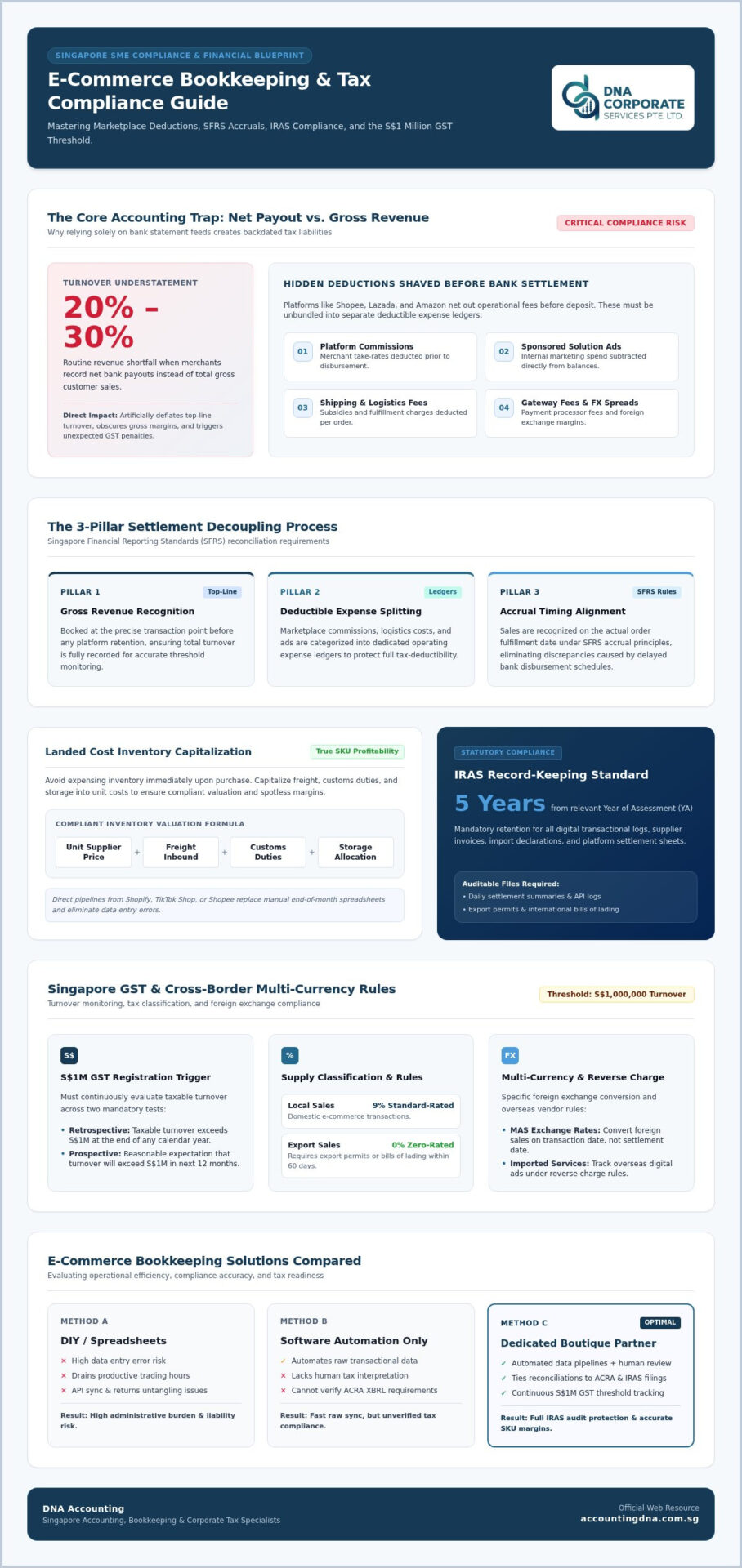
Why do so many digital merchants struggle to identify their true bottom line? Many store owners assume an automated bank feed tells the whole story. In reality, marketplaces like Shopee, Lazada, and Amazon deduct platform commissions, sponsored solution ad fees, and logistics fees before wiring funds to your corporate account. Sound bookkeeping for e-commerce sellers Singapore stores rely on must look beyond these condensed deposits. When you book only the net settlement, you artificially deflate reported turnover, obscure true gross margins, and overlook hidden foreign exchange spreads quietly shaved off by payment gateways.
Decoupling Gross Sales from Marketplace Net Payout Settlements
Resolving this visibility gap requires separating gross order receipts from backend merchant deductions using official periodic settlement summaries. Grounded in the foundational principles of bookkeeping, this process splits each payout correctly:
- Gross Revenue: Recognized at the transaction point before any platform retention to ensure turnover tracking remains completely accurate.
- Deductible Expenses: Marketplace commissions, shipping subsidies, and platform ads booked into dedicated expense ledgers to protect deductible operational costs.
- Accrual Timing: Matching sales to the actual order fulfillment date under Singapore Financial Reporting Standards (SFRS) rather than delayed bank disbursement schedules.
Partnering with dedicated bookkeeping and accounting services protects your online store from unrecorded sales liabilities while keeping financial records completely IRAS-ready.
How to Build an IRAS-Compliant E-Commerce Bookkeeping Process
Clean ledgers require direct pipelines between sales channels and your cloud software. Relying on manual end-of-month spreadsheets invites costly data entry errors. Instead, connect Shopify, TikTok Shop, or Shopee through automated data feeds to log daily summaries cleanly. Pair these pipelines with landed cost formulas for inventory, capitalizing freight, customs duties, and storage into unit costs rather than expensing stock immediately. Under strict IRAS record keeping requirements, all transactional logs, supplier invoices, and settlement sheets must be preserved for at least five years from the relevant Year of Assessment.
Managing Multi-Currency Settlements and Singapore GST Obligations
Cross-border selling introduces complex tax considerations that require rigorous ongoing tracking. Effective bookkeeping for e-commerce sellers Singapore brands implement must continuously monitor the S$1 million turnover threshold across retrospective and prospective bases:
- Exchange Rates: Convert foreign currencies using acceptable market rates or published MAS monthly rates on transaction dates rather than settlement dates.
- Supply Classification: Separate 9% standard-rated local sales from 0% zero-rated exports, retaining international bills of lading or export permits to justify zero-rating within 60 days.
- Imported Services: Track cross-border digital ad spend and overseas vendor supplies under reverse charge rules where applicable.
If you’re unsure whether your store meets mandatory registration triggers, you can consult our specialists to ensure your quarterly returns and tax position remain completely compliant.
Choosing the Right E-Commerce Bookkeeping Solution in Singapore
Which operational model truly protects your time and your margins? Managing online store ledgers yourself often seems economical at first glance. However, fixing broken API syncs, untangling returns, and manually adjusting payout variances quickly drains productive trading hours. Fully automated software tools solve raw data entry, but they lack human oversight. They can’t interpret nuanced tax treatments or verify compliance under official ACRA financial statement filing requirements. The most resilient bookkeeping for e-commerce sellers Singapore brands adopt combines intelligent automation with proactive professional review, tying day-to-day reconciliations directly into year-end corporate filings.
The Strategic Value of a Dedicated Singapore Accounting Partner
Working alongside an experienced, boutique accounting team transforms bookkeeping from a reactive chore into a reliable operational asset. A dedicated local specialist provides distinct advantages:
- Proactive Support: Direct access to responsive advisors available during non-traditional hours, including evenings and non-working days, to resolve urgent reconciliation questions.
- Comprehensive Compliance: Synchronized management across statutory filings, ensuring corporate tax computations, GST obligations, and annual returns align without friction.
- Strategic Insight: Accurate monthly management figures that reveal true SKU performance after netting all gateway costs and landed inventory expenses.
Ready to gain full control over your marketplace finances? Reach out to DNA Accounting to schedule a personalized consultation and streamline your store’s financial operations.
Protect Your Margins and Scale Your Online Store with Confidence
Running a successful digital storefront requires financial clarity, not guesswork. Unbundling platform deductions, accounting for landed inventory costs, and tracking your S$1 million GST turnover threshold are essential steps to avoid unexpected penalties. When executed correctly, structured bookkeeping for e-commerce sellers Singapore brands rely on transforms complex multi-channel settlements into actionable profit insights.
You don’t have to tackle regulatory compliance alone. Since 2016, DNA Accounting has supported growing Singapore SMEs and founders with director-level guidance across corporate secretarial filings, ACRA requirements, and IRAS tax submissions. Our boutique advisory stays accessible during evenings and non-working days, giving you prompt answers when decisions can’t wait. Speak with DNA Accounting for bespoke e-commerce bookkeeping support and secure the financial foundation your store deserves.
Frequently Asked Questions
Do I need to register for GST if my Singapore e-commerce business sells overseas?
Yes, if your total taxable supplies exceed S$1 million across a calendar year or are expected to do so within the next 12 months. Taxable turnover combines standard-rated domestic sales and zero-rated international exports. While eligible exports qualify for 0% GST, their revenue counts toward mandatory registration thresholds. You must also maintain valid export documentation, such as international air waybills, to justify that zero-rating.
Why is recording net marketplace bank deposits considered an accounting mistake in Singapore?
Recording net deposits hides deducted platform commissions, merchant processing costs, and local advertising spend. This underreports gross business turnover, which can distort your profit margins and breach IRAS statutory reporting thresholds. Accurate bookkeeping for e-commerce sellers Singapore brands implement must record full gross customer payments as top-line revenue while logging platform fees separately as tax-deductible operating expenses.
How should e-commerce sellers calculate Cost of Goods Sold under Singapore accounting standards?
Can cloud software like Xero handle multi-currency marketplace fees automatically for IRAS filings?
Disclaimer
The information provided on this website is for general informational purposes only and is not intended to constitute professional accounting, tax, legal, or financial advice. While we strive to ensure that the content is accurate and up to date, regulations in Singapore, including those administered by ACRA, IRAS, CPF Board, and MOM, may change from time to time and may differ depending on individual circumstances.
Readers should not act or rely on any information contained on this website without seeking specific advice from a qualified professional based on their individual situation.
DNA Corporate Services and its affiliates accept no responsibility or liability for any loss or damage arising from reliance on the information provided in this website or any linked materials.
For tailored advice relating to accounting, taxation, corporate secretarial, or compliance matters in Singapore, please contact us directly for professional consultation.



