

Could paying CPF by the 14th still leave your business liable for late-payment interest? Yes. For Singapore employers, CPF contributions are due by the last day of the month in which wages are paid. Interest starts accruing from the following day, so the 14th is not an extension of the payment deadline.
If you’re searching for how to calculate CPF contribution correctly, start by classifying each payment before applying the rates. In 2026, the Ordinary Wage ceiling is S$8,000 per month, while the annual wage ceiling is S$102,000. Rates also vary by an employee’s age and residency status, so a calculation that works for one staff member may not apply to another. This guide explains the process step by step, including Ordinary and Additional Wage ceilings, employee and employer shares, and age-based rates, so you can check payroll figures and plan for compliance.
Key Takeaways
- Classify monthly salary and less frequent payments as Ordinary Wages or Additional Wages before calculating CPF.
- Learn how to calculate CPF contribution by applying the relevant 2026 rates to eligible wages and checking the employee’s age band and residency status.
- Check the Ordinary Wage and annual wage ceilings so monthly pay and bonuses are handled within the right limits.
- Don’t rely on an old payroll template or mistake the 14th for the CPF due date. Confirm current rates and pay by the official deadline.
Classifying Wages: Ordinary vs. Additional Wage Calculations
Before working out how to calculate CPF contribution, classify each payment by when it is payable. Ordinary Wages (OW) are wages due for a specific month, such as basic salary and overtime pay. Additional Wages (AW) are payments not tied to a particular month, such as an annual bonus or a commission paid periodically rather than monthly. The distinction matters because each category has a different ceiling.
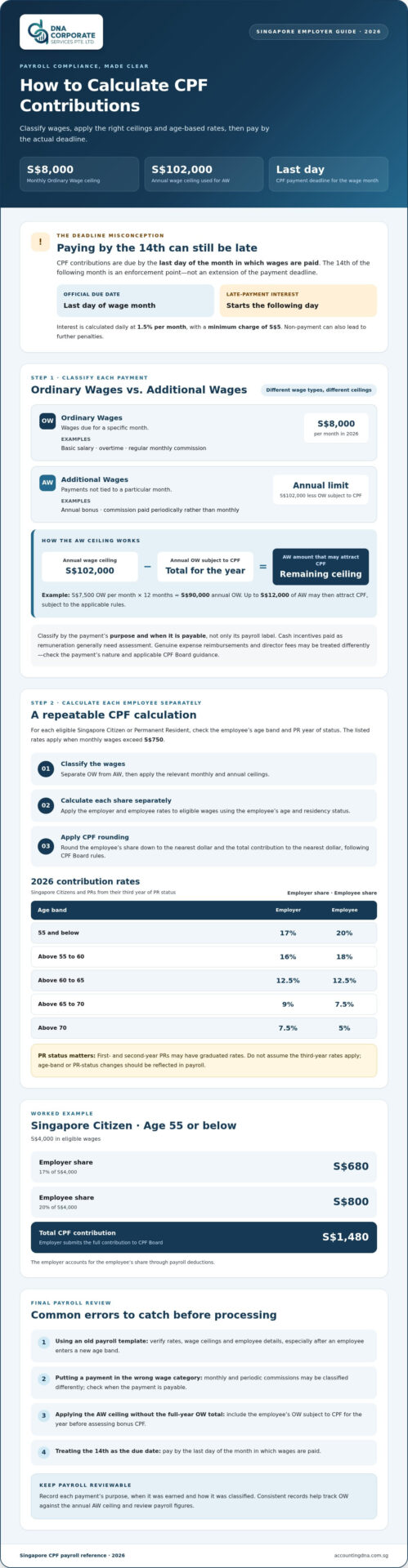
For 2026, CPF applies to OW up to S$8,000 per month. AW is subject to an annual ceiling: S$102,000 minus the employee’s total OW subject to CPF for the year. For example, if an employee earns S$7,500 in OW each month for 12 months, their annual OW totals S$90,000. Up to S$12,000 of AW may then attract CPF, subject to the applicable rules. The monthly OW ceiling does not replace the annual limit.
This wage-based contribution system is part of the wider Central Provident Fund (CPF) framework. Misclassifying a payment can mean applying the wrong ceiling, which may result in an incorrect contribution.
Identifying Payments Subject to CPF
Start with the reason for each payment, not just its payroll label. Basic pay, overtime and cash incentives paid as remuneration generally need to be assessed for CPF. Regular monthly commissions may be OW, while a non-monthly commission may be AW. Genuine expense reimbursements and director fees may be treated differently, so don’t assume every transfer to a worker is CPF wages. Check the payment’s nature and the applicable CPF Board guidance.
Keep clear records showing each payment, its purpose, when it was earned and how it was classified. Consistent bookkeeping records make it easier to review payroll and track OW against the annual AW ceiling.
How to Calculate CPF Contribution: Step-by-Step Formula for 2026
For a repeatable process, calculate CPF separately for each eligible Singapore Citizen or Permanent Resident (PR), using their age and PR year of status. The rates below apply when monthly wages exceed S$750. Check the official CPF contribution rates for the employee’s exact circumstances before processing payroll.
- Classify the wages. Separate Ordinary Wages (OW) from Additional Wages (AW), then apply the relevant monthly and annual ceilings.
- Apply each share separately. Multiply eligible wages by the employer rate and the employee rate for the employee’s age and residency status.
- Apply CPF rounding. Round the employee’s share down to the nearest dollar and the total contribution to the nearest dollar, following CPF Board rules.
For example, for a Singapore Citizen aged 55 or below earning S$4,000 in eligible wages, the employer share is 17%, or S$680. The employee share is 20%, or S$800, making the total contribution S$1,480. The employer must submit the full contribution to CPF Board first, then account for the employee’s share through payroll deductions.
Impact of Employee Age and Residency Status
For Citizens and PRs from their third year of PR status, 2026 employer and employee rates are: age 55 and below, 17% and 20%; above 55 to 60, 16% and 18%; above 60 to 65, 12.5% and 12.5%; above 65 to 70, 9% and 7.5%; above 70, 7.5% and 5%. The 2026 increases for workers above 55 to 65 support retirement savings. First- and second-year PRs may have graduated rates, so use the applicable CPF Board table rather than assuming third-year rates apply. If an employee’s age band or PR status changes, update payroll before calculating their contributions. For help reviewing a payroll calculation, speak with a Singapore payroll adviser.
Ensuring Compliance: Common Mistakes and Filing Deadlines
Can you reuse a payroll template? Only if you verify that its rates, wage ceilings and employee details are current. A spreadsheet won’t flag an outdated rate or a manually entered bonus assigned to the wrong wage category. That can leave CPF underpaid or overpaid, even if the formula itself looks right. Check the official CPF contribution rates before processing payroll, especially when an employee moves into a new age band.
Don’t mistake the 14th for the CPF payment deadline. Contributions are due by the last day of the calendar month in which wages are paid. The 14th of the following month is an enforcement point, not an extension. Late-payment interest is calculated daily from the first day after the official due date, at 1.5% per month, with a minimum charge of S$5. Failure to pay can also lead to further penalties.
Year-end bonuses need a separate check. Before calculating CPF on Additional Wages (AW), total the employee’s Ordinary Wages subject to CPF for the year and apply the AW ceiling formula. Missing earlier wages or misclassifying a bonus can produce an incorrect contribution. Knowing how to calculate CPF contribution is only part of compliance. Accurate employee records, correct wage classification and timely payment matter too.
Scaling with Professional Payroll Support
As headcount grows, payroll services can help SMEs manage rate updates, wage categories and recurring deadlines. Employee data and payroll inputs still need to be reviewed carefully. DNA Accounting provides payroll management alongside accounting and bookkeeping services for businesses in Singapore. Explore its payroll services, or contact DNA Accounting to discuss your business’s payroll needs.
Make CPF Compliance a More Confident Part of Payroll
Reliable CPF payroll starts with careful wage classification, the right age-based rates and a final check against current rules. Knowing how to calculate CPF contribution helps, but consistent records and timely submission are what turn the calculation into a dependable process. A template can support your workflow, but it shouldn’t replace checking that your payroll inputs and rates are up to date.
When payroll demands compete with running your business, support with payroll administration can help you focus on your core operations. DNA Accounting provides payroll services for SMEs, including payroll management and the handling of statutory contributions and related administrative tasks.
Contact DNA Accounting to discuss payroll support for your Singapore business.
Frequently Asked Questions
What is the maximum CPF contribution for a high-income earner in 2026?
The maximum annual CPF contribution is S$37,740, based on the 2026 annual wage ceiling of S$102,000 and the highest total contribution rate of 37% for eligible Singapore Citizens and Permanent Residents aged 55 and below. This is the combined employer and employee contribution. The actual amount depends on the employee’s age, residency status and eligible wages; the CPF annual limit also caps mandatory and voluntary contributions combined.
Do I need to pay CPF for part-time or casual employees in Singapore?
Part-time or casual status alone doesn’t exempt an employee from CPF. Employers generally need to contribute for eligible Singapore Citizen and Permanent Resident employees, including part-time staff. Check the employee’s status and which payments count as wages before calculating the amount. CPF contributions aren’t required for foreign employees on work passes, such as Employment Pass or S Pass holders.
How do I calculate the Additional Wage ceiling for my employees?
Subtract the employee’s total Ordinary Wages subject to CPF for the calendar year from S$102,000. The result is the maximum Additional Wages that can attract CPF for that year. For example, if annual OW subject to CPF is S$90,000, the AW ceiling is S$12,000. Use this figure when working out how to calculate CPF contribution on a bonus or other non-monthly payment.
What happens if I miss the CPF submission deadline?
CPF contributions are due by the last day of the calendar month in which wages are paid. The 14th of the following month is not the legal deadline; enforcement may follow if payment remains outstanding. Late-payment interest is 1.5% per month, calculated daily from the first day after the due date, with a minimum charge of S$5. Further penalties may also apply if contributions remain unpaid.
Disclaimer
The information provided on this website is for general informational purposes only and is not intended to constitute professional accounting, tax, legal, or financial advice. While we strive to ensure that the content is accurate and up to date, regulations in Singapore, including those administered by ACRA, IRAS, CPF Board, and MOM, may change from time to time and may differ depending on individual circumstances.
Readers should not act or rely on any information contained on this website without seeking specific advice from a qualified professional based on their individual situation.
DNA Corporate Services and its affiliates accept no responsibility or liability for any loss or damage arising from reliance on the information provided in this website or any linked materials.
For tailored advice relating to accounting, taxation, corporate secretarial, or compliance matters in Singapore, please contact us directly for professional consultation.



