

Could your Singapore SME qualify for Form C-S but still face IRAS penalties because of a missed deadline or an incorrect tax computation? Form C-S filing services can help you check the right filing route and prepare an accurate return, so compliance does not become a last-minute scramble.
It can be difficult to keep track of tax rules while managing customers, staff and cash flow. For YA 2026, companies must file their corporate income tax return by 30 November 2026, including companies that made a loss, unless IRAS has granted a filing waiver. This guide covers Form C-S eligibility, the records needed for a tax computation, and how professional support can help you prepare for filing. It also explains how ECI and Form C-S fit into your company’s tax responsibilities.
Key Takeaways
- Check whether your Singapore-incorporated company meets Form C-S eligibility rules, including the S$5 million revenue limit and restrictions on income and tax claims.
- Mark 30 November 2026 for the YA 2026 corporate tax return, and understand the filing risks of missing the deadline.
- Form C-S filing services can help connect bookkeeping records with tax preparation and check whether your company may qualify for available tax exemptions.
- Understand how ECI and Form C-S fit into your company’s tax filing responsibilities, even when the business reports a loss.
What is Form C-S and Is Your Company Eligible?
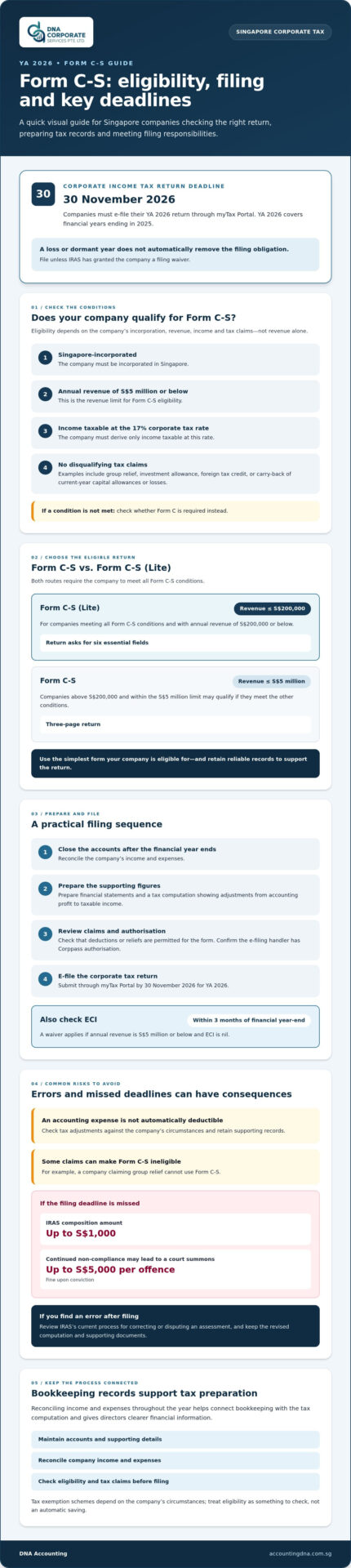
Form C-S is a simplified corporate income tax return for eligible Singapore companies. It requires less information in the return than Form C, but eligibility depends on more than company size. Your company must be incorporated in Singapore, have annual revenue of S$5 million or below, and derive only income taxable at the corporate tax rate of 17%. It must also avoid claims that make it ineligible, such as group relief, investment allowance, foreign tax credit, or carry-back of current-year capital allowances or losses.
A quiet or unprofitable year does not automatically remove the filing obligation. Companies must file even if they are dormant or making a loss, unless IRAS has granted a filing waiver. Form C-S filing services can help check eligibility and prepare the return using records that support the company’s income and expense figures. DNA Accounting also provides corporate tax and GST filing services for Singapore businesses.
Form C-S vs. Form C-S (Lite): Choosing the Right Path
Form C-S (Lite) is for companies that meet all Form C-S conditions and have annual revenue of S$200,000 or below. The return asks for six essential fields, while Form C-S is a three-page return. A company with revenue above S$200,000 but within the S$5 million limit may qualify for Form C-S if it meets the other conditions.
The Lite return requires less information, but a simpler form is not a reason to file without reliable records. Keep accounts and supporting details that substantiate the return, and confirm the tax computation requirements for your company’s circumstances before filing. If the company has income outside the qualifying category or claims a disqualifying tax item, check whether Form C is required instead. Choose the simplest form your company is eligible to use, not simply the one with fewer fields.
The Filing Process: Deadlines, Documentation, and Compliance
Start planning when your financial year ends. Close the accounts, reconcile income and expenses, and prepare financial statements and a tax computation showing adjustments from accounting profit to taxable income. For YA 2026, which covers financial years ending in 2025, companies must e-file their corporate income tax return through myTax Portal by 30 November 2026. Separately, check whether you need to file Estimated Chargeable Income (ECI) within three months of your financial year-end. A waiver applies if annual revenue is S$5 million or below and ECI is nil.
Before filing, compare the revenue and expenses in the return with the accounts. Then review whether the deductions or reliefs being claimed are permitted for the form you are filing. For a fuller overview of Singapore requirements, see this guide to corporate tax filing in Singapore.
Avoiding Common IRAS Penalties and Mistakes
Incorrect tax adjustments can lead to errors. For example, an accounting expense is not automatically deductible, and a company claiming group relief cannot use Form C-S. Check each adjustment against the company’s circumstances and keep supporting records. Also confirm that the person handling e-filing has the necessary Corppass authorisation before preparing to submit, rather than leaving access checks until the deadline.
Missing the deadline can result in an IRAS composition amount of up to S$1,000. Continued non-compliance may lead to a court summons and, upon conviction, a fine of up to S$5,000 per offence. If you spot an error after filing, act promptly. Review IRAS’s current process for correcting or disputing an assessment, and keep the revised computation and supporting documents. Form C-S filing services can help organise these steps. For tailored guidance, contact a Singapore tax adviser.
Why Professional Form C-S Filing Services are a Strategic Choice
Professional support can help with more than preparing the return. A tax adviser can review whether a new Singapore company may qualify for available tax exemption schemes and whether its records support the claims it intends to make. Eligibility depends on the company’s circumstances, so treat exemptions as something to check, not an automatic saving.
Connecting bookkeeping with tax filing can reduce the risk of using figures from incomplete or inconsistent records. When income and expenses are reconciled throughout the year, preparing the tax computation is more orderly, and directors have clearer information for decisions such as managing costs or planning expansion. Form C-S filing services can also give directors a structured opportunity to review the company’s financial position.
Bespoke Tax Support for Singapore Startups and SMEs
DNA Accounting provides accounting, tax and corporate secretarial support for Singapore SMEs and startups. This can help business owners coordinate recurring financial and administrative tasks, from maintaining accounting records to preparing tax filings. For directors, a practical starting point is to check what records are available, identify any gaps, and confirm the company’s filing route before preparing the return.
For startups, an adviser familiar with Singapore SME tax matters can clarify which information is needed, what needs review and where a potential tax relief claim requires careful checking. This support can make tax preparation more manageable while helping directors stay focused on running the business. To discuss support for your company, contact DNA Accounting.
Make Your Next Tax Filing More Manageable
Choosing the correct return starts with checking your company’s eligibility, not just its revenue. Keep accounts and supporting records organised so the tax computation is easier to review, and plan for IRAS deadlines even if the company made a loss. Professional Form C-S filing services can bring these steps together and help directors focus on business decisions.
DNA Accounting supports Singapore SMEs and startups with accounting, taxation, corporate secretarial and payroll services. Its services include accounting and bookkeeping, GST filing, and corporate tax support. For help preparing your company’s tax filing, contact DNA Accounting to discuss Form C-S filing support.
Frequently Asked Questions
Do I need to file Form C-S if my company is currently dormant?
Yes, a dormant company must still file its corporate income tax return unless IRAS has granted a filing waiver. Dormancy alone does not remove the filing obligation. The same principle applies if your company made a loss: check whether IRAS has formally granted a waiver rather than assuming no return is needed. Confirm the required return type for the relevant Year of Assessment.
What is the deadline for Form C-S filing in the Year of Assessment 2026?
The YA 2026 corporate income tax return must be e-filed by 30 November 2026 through IRAS’s myTax Portal. YA 2026 relates to a company’s financial year that ended in 2025. Allow time to close your accounts, review the tax computation and check filing access before the deadline. Form C-S filing services can help organise these steps, but directors remain responsible for timely and accurate filing.
Can I switch from Form C to Form C-S if my revenue drops below S$5 million?
Possibly, but lower revenue alone does not establish eligibility. For the relevant Year of Assessment, the company must be incorporated in Singapore, have annual revenue of S$5 million or below, derive only income taxable at the prevailing corporate tax rate, and avoid specified claims such as group relief or foreign tax credits. Review all conditions before choosing Form C-S. Do not assume a past Form C filing automatically prevents or permits a change.
What are the penalties for late filing of corporate tax in Singapore?
IRAS may impose a composition amount of up to S$1,000 for late filing. Continued non-compliance may lead to a court summons and, upon conviction, a fine of up to S$5,000 per offence. If a company fails to file for two or more years, the penalty may be twice the amount of tax assessed, alongside a fine of up to S$5,000. File promptly and respond to IRAS notices.
Disclaimer
The information provided on this website is for general informational purposes only and is not intended to constitute professional accounting, tax, legal, or financial advice. While we strive to ensure that the content is accurate and up to date, regulations in Singapore, including those administered by ACRA, IRAS, CPF Board, and MOM, may change from time to time and may differ depending on individual circumstances.
Readers should not act or rely on any information contained on this website without seeking specific advice from a qualified professional based on their individual situation.
DNA Corporate Services and its affiliates accept no responsibility or liability for any loss or damage arising from reliance on the information provided in this website or any linked materials.
For tailored advice relating to accounting, taxation, corporate secretarial, or compliance matters in Singapore, please contact us directly for professional consultation.



