

The documents for company incorporation do more than help you complete an ACRA filing. Incomplete identity records, unclear director arrangements or missing beneficial ownership details can delay registration and create extra work later. Preparing the paperwork carefully gives your company a more organised start after ACRA issues its UEN.
This 2026 checklist covers what to prepare for ACRA registration as a local or foreign founder. It explains the key identity and company details, the difference between the Constitution and director or company secretary consent forms, and what to know about disclosing ultimate beneficial owners. You’ll also find guidance on the resident director requirement and the records to check after incorporation.
Key Takeaways
- Use ACRA’s Model Constitution as a practical starting point, and review what a director confirms when signing Form 45.
- Prepare the documents for company incorporation, including NRIC or passport details and proof of residential address for KYC checks.
- Check which identity and address documents local and foreign directors or shareholders need to provide.
- After registration, retrieve your Business Profile and prepare share certificates as part of your company’s records.
Core Statutory Documents for Singapore Company Registration
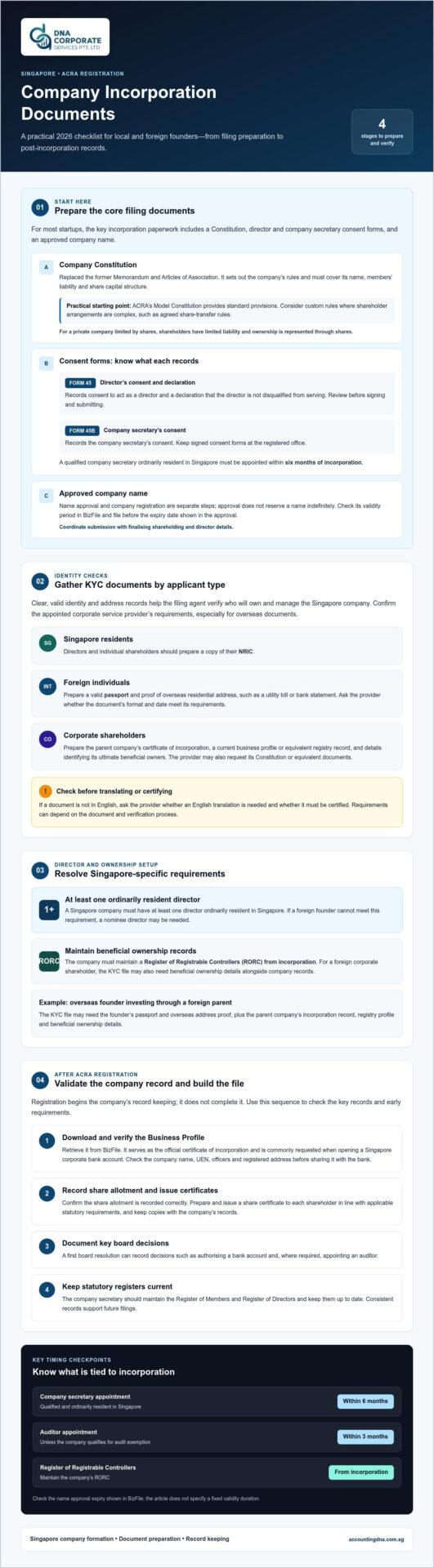
Preparing the core paperwork helps reduce avoidable delays during ACRA registration and gives your company a clearer compliance foundation. For most startups, the key documents for company incorporation include a Constitution, director and secretary consent forms, and an approved company name.
The Role of the Company Constitution
The Constitution replaced the former Memorandum and Articles of Association. It sets out the company’s rules and must cover its name, members’ liability and share capital structure. For a typical startup, ACRA’s Model Constitution is a practical starting point, as it provides standard provisions without requiring founders to draft rules from scratch. In a private company limited by shares, shareholders have limited liability and ownership is represented through shares.
Consider whether a custom Constitution is needed if your company has complex shareholder arrangements. For example, if two founders have agreed on specific share transfer rules, check that the Constitution supports those arrangements before filing.
Form 45 records a director’s consent to act and declaration that they’re not disqualified from serving. Review the declaration before signing and submitting it. Form 45B records the company secretary’s consent. A qualified company secretary ordinarily resident in Singapore must be appointed within six months of incorporation. Keep signed consent forms at the registered office.
Check the name approval’s validity period in BizFile. Name approval and company registration are separate steps, so approval does not reserve a name indefinitely. Coordinate document preparation and submission, then file before the expiry date shown in the approval. This is especially useful if founders are still finalising shareholding or director details.
For background on the company structure, see Private company limited by shares.
KYC and Identity Verification: Local vs. Foreign Requirements
Identity checks help the filing agent verify who will own and manage the Singapore company. Gather clear, valid documents early, then confirm the appointed corporate service provider’s KYC requirements. This is particularly important for overseas applicants, as the provider may need to verify foreign identity and address documents.
- Singapore residents: Directors and individual shareholders should prepare a copy of their NRIC.
- Foreign individuals: Prepare a valid passport and proof of overseas residential address, such as a utility bill or bank statement. Ask the provider whether the document’s format and date meet its requirements.
- Corporate shareholders: Prepare the parent company’s certificate of incorporation, a current business profile or equivalent registry record, and details identifying its ultimate beneficial owners. The provider may also ask for the company’s Constitution or equivalent documents.
If a document isn’t in English, ask the provider whether an English translation is needed and whether it must be certified. Requirements can depend on the document and verification process, so confirm before arranging translation or notarisation.
Special Requirements for Foreign Directors and Shareholders
For example, if an overseas founder owns shares through a foreign parent company, the KYC file may need the founder’s passport and proof of overseas address, along with the parent company’s incorporation record, registry profile and beneficial ownership details. A Singapore company must have at least one director ordinarily resident in Singapore. If the founder can’t meet this requirement, a nominee director may be needed. The company must also maintain a Register of Registrable Controllers (RORC) from incorporation.
For help with nominee arrangements, see corporate secretarial services. You can also contact the team about preparing your KYC documents.
Post-Incorporation: Validating Your Documents and Next Steps
ACRA registration starts your company’s record keeping; it doesn’t complete it. After incorporation, download the Business Profile from BizFile. It serves as the official certificate of incorporation and is commonly requested when opening a Singapore corporate bank account. Before sharing it with the bank, check that the company name, UEN, officers and registered address are accurate.
Next, confirm that the company’s share allotment is recorded correctly. Prepare and issue a share certificate to each shareholder in line with the applicable statutory requirements, and keep copies with the company’s records. A first board resolution can document key decisions, such as authorising a bank account and, where required, appointing an auditor. An auditor must be appointed within three months of incorporation unless the company qualifies for audit exemption.
The company secretary should also maintain statutory registers, including the Register of Members and Register of Directors, and keep them up to date. These records support future filings and help ensure that information is consistent across company documents.
Avoiding Initial Compliance Risks
Don’t use the incorporation date alone to work out meeting deadlines. The first AGM timeline depends on the company’s financial year-end and whether an exemption applies, so confirm the relevant requirement and diarise the date. Missing a deadline can create avoidable compliance work. Setting up accounting and bookkeeping services early can help you organise transactions and records for the first financial year-end.
The documents for company incorporation are the starting point for these ongoing records. If you’re unsure whether your registers and resolutions are complete, seek professional incorporation guidance before gaps affect later filings.
Set Up Your Singapore Company with Confidence
The right documents for company incorporation do more than support ACRA registration. They help establish accurate company records, clarify ownership and director details, and prepare your business for its next steps. Keep identity documents, consent forms and the Constitution organised, then check your Business Profile and maintain the required statutory records.
Preparing the paperwork and early compliance arrangements can feel demanding, especially for first-time and foreign founders. DNA Accounting supports Singapore startups with company incorporation and ongoing corporate secretarial duties, alongside accounting and taxation services. This can help business owners organise essential administrative and financial tasks as they set up their company.
Ready to move forward? Contact DNA Accounting for help with your Singapore company incorporation and take the next step with a clearer plan.
Frequently Asked Questions
Do I need to be physically present in Singapore to submit these documents?
Usually, you don’t need to be physically present in Singapore for the incorporation filing, which is submitted digitally through ACRA’s BizFile platform. Foreign founders generally work through a corporate service provider or filing agent for the submission. Your provider may still require identity checks or additional document verification, so confirm its process and prepare clear, valid copies before starting.
Can a foreigner be the sole director and shareholder of a Singapore company?
A foreigner can own all the shares, but the company must have at least one director ordinarily resident in Singapore. If you don’t meet that requirement, you can’t act as the only director. The company needs another eligible resident director, such as a nominee director. A foreign founder may be both sole shareholder and sole director only if they meet the local residency requirement.
What is the minimum paid-up capital required for incorporation in 2026?
The minimum paid-up capital for a standard Singapore private limited company is S$1. Some regulated industries may require a higher amount. This is the statutory minimum, not necessarily the amount that will suit your company’s operating plans. Check whether your intended business activity has sector-specific capital rules before finalising the incorporation details.
What happens if ACRA rejects my company name or incorporation documents?
If ACRA rejects your proposed name, you’ll need to choose a different name and apply again. If the incorporation filing is rejected or held up over documents, review the notice, correct the issue and resubmit as directed. Common problems include incomplete or expired identity documents and an unavailable name. Check each item carefully before filing to reduce avoidable delays.
Disclaimer
The information provided on this website is for general informational purposes only and is not intended to constitute professional accounting, tax, legal, or financial advice. While we strive to ensure that the content is accurate and up to date, regulations in Singapore, including those administered by ACRA, IRAS, CPF Board, and MOM, may change from time to time and may differ depending on individual circumstances.
Readers should not act or rely on any information contained on this website without seeking specific advice from a qualified professional based on their individual situation.
DNA Corporate Services and its affiliates accept no responsibility or liability for any loss or damage arising from reliance on the information provided in this website or any linked materials.
For tailored advice relating to accounting, taxation, corporate secretarial, or compliance matters in Singapore, please contact us directly for professional consultation.



