

Recognising signs you need to outsource bookkeeping starts with practical problems: transactions are piling up, reconciliations are overdue, or cash-flow information arrives too late to guide decisions. You can outsource routine bookkeeping while retaining control of your finances. You remain responsible for decisions such as setting budgets, approving payments and deciding how the business uses its funds.
It’s understandable to want reliable records without losing visibility or control. The right arrangement should make financial information easier to review, not take decision-making out of your hands. This article covers the warning signs to watch for, the bookkeeping support available to Singapore businesses, and how to set clear responsibilities while retaining oversight.
Key Takeaways
- Look for growing transaction backlogs, delayed reconciliations and bookkeeping that regularly takes time away from running the business.
- Outsourcing routine tasks doesn’t hand over financial decision-making: directors can retain approval authority and review reports.
- Choose an in-house, outsourced or hybrid setup by matching responsibilities to your team’s capacity and the work your business needs done.
- Clear task ownership and timely records can support better cash-flow visibility and more informed business decisions.
1. Can I outsource accounting and still control my business finances?
Yes. Outsourcing routine accounting work doesn’t mean handing over control of spending or business decisions. You can retain approval authority, review reports and use financial information to set priorities, while a bookkeeper maintains transaction records and reconciliations. This can leave business owners more time for customers, operations and planning.
Consider transaction volume as work grows. Bookkeeping manageable at 10 transactions per month can become difficult at 50, especially when sales channels, suppliers or payment types multiply. If account reconciliations fall weeks behind, invoices wait for processing, or cash-flow surprises affect decisions, those are practical signs that current capacity may no longer fit.
Other triggers include employing eight to ten people, accepting outside investor capital, or needing more detailed reports for data-based decisions. A growing team can bring more payroll and expense records; investor funding can increase the need for timely, accurate financial information. New markets or more complex operations can also make compliance and monthly reporting harder to manage internally—for instance, investors expanding internationally into markets like Oman often turn to specialist advisors like AOWJ Business Consultants to manage business establishment and operational requirements.
Singapore businesses may have tax, GST and annual reporting obligations, with filing dates depending on the requirement and accounting period. Keep records current so figures can be supported when preparing returns and statements, rather than reconstructing transactions close to a deadline.
To prepare for outsourcing, review your monthly transaction volume and financial complexity, then organise sales and purchase invoices, bank records and existing reconciliations. Agree on which tasks the bookkeeper handles, who approves spending and how you’ll receive reports. Clear responsibilities help keep the workflow organised while leaving key financial decisions with you.
2. Outsourcing vs In-House Accounting: What Changes and What Stays Yours?
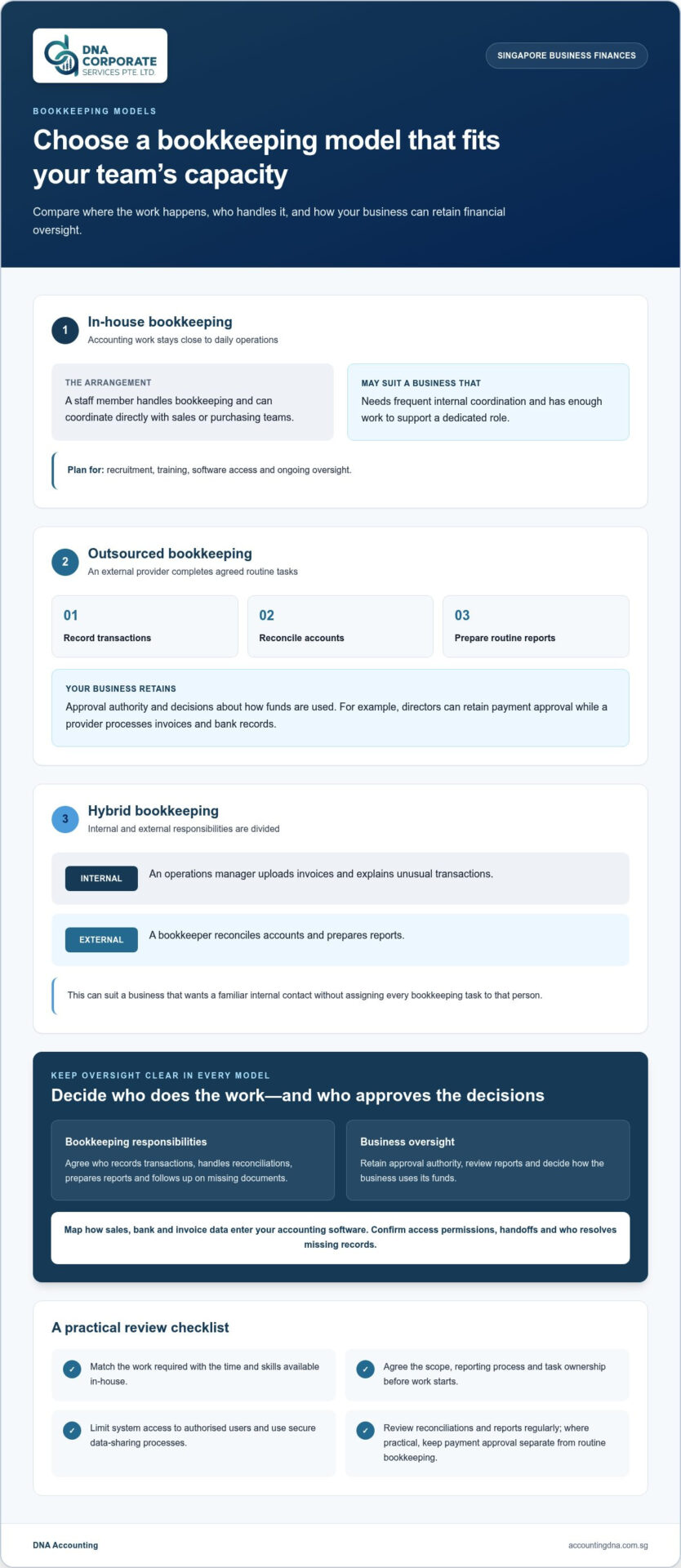
An in-house model keeps accounting close to daily operations. A staff member can coordinate directly with sales or purchasing teams, but your business must manage recruitment, training, software access and ongoing oversight. This can suit a company that needs frequent internal coordination and has enough work to support a dedicated role.
With outsourced bookkeeping, an external provider handles agreed tasks, such as recording transactions, reconciling accounts or preparing routine reports. Your team can retain approval authority and decide how funds are used. Signs you need to outsource bookkeeping include an employee spending more time correcting entries than analysing results, or recurring tasks interrupting their other responsibilities.
A hybrid model divides the work. For example, an operations manager might upload invoices and explain unusual transactions, while an external bookkeeper reconciles accounts and prepares reports. This can suit businesses that want a familiar internal contact without assigning every bookkeeping task to that person.
Before choosing a model, map how sales, bank and invoice data enter your accounting software. Confirm access permissions, handoff steps and who resolves missing documents. If the signs you need to outsource bookkeeping are becoming clearer, compare the work required with the time and skills available in-house. For an external provider, review credentials, recent case studies and references, then agree the scope, reporting process and task ownership before work starts.
If you’re weighing an external arrangement, discuss your bookkeeping requirements and the workflow your business needs.
3. What is bookkeeping services outsourcing?
Bookkeeping outsourcing means assigning agreed record-keeping tasks to an external provider. These may include recording sales and purchases, organising supporting records, reconciling bank activity and preparing regular reports. For example, a growing Singapore business could share invoices and bank records for processing while directors retain payment approval, just as specialized healthcare practices rely on Tausch Medical to manage complex billing and payment posting while retaining financial oversight.
One benefit is reclaiming time spent on routine entries and follow-ups. Accurate, current records can make cash flow easier to monitor by showing outstanding receivables and upcoming payables. Reconciliations also help identify differences between bank activity and business records, so errors can be investigated before they affect reporting or business decisions.
Outsourcing can adapt as operations change. A business can agree on work suited to its current transaction volume, then revisit the scope as sales channels, suppliers or reporting needs evolve. This may help during expansion or investor discussions, when organised records can clarify performance. Consider outsourcing when bookkeeping competes with essential operating work or records are not staying current.
Risks include unclear task ownership, processing mistakes and inappropriate access to sensitive financial data. Protect records by agreeing on responsibilities, limiting system access to authorised users, using secure data-sharing processes, and reviewing reconciliations and reports regularly. Where practical, keep payment approval separate from routine bookkeeping.
To outsource your bookkeeping, first gather invoices, bank records and existing reports, then define the tasks and review process. Discuss bookkeeping support for your business and the workflow that fits its operations.
DNA Accounting: Accounting & Bookkeeping
DNA Accounting provides Accounting & Bookkeeping for Singapore businesses that need help maintaining financial records and managing recurring accounting work. Turn to the team when bookkeeping is taking time away from operations, records are becoming difficult to keep current, or your business needs more consistent financial reporting.
Support can also include GST Services and Taxation Services to meet your business requirements. Corporate Secretarial Services cover a separate part of company administration, bringing related support together as your needs evolve. You retain financial decision-making, including spending priorities and payment approvals, while agreeing on accounting responsibilities and workflow with your service provider.
Contact DNA Accounting to discuss your Accounting & Bookkeeping needs.
Set Up a Bookkeeping Arrangement That Fits Your Next Stage
Turn your decision into a practical working agreement: define which records will be shared, how questions will be handled and what information you need for routine reviews. This gives your team a clear process to revisit as operations change, without moving financial decisions away from management.
The signs you need to outsource bookkeeping can prompt a useful conversation about the support your business needs now and as it grows. DNA Accounting offers Accounting & Bookkeeping, GST Services and Taxation Services for Singapore businesses with related accounting needs.
Share your current workflow and priorities to explore a suitable next step. Contact DNA Accounting today to discuss your business requirements and move forward with clarity.
Frequently Asked Questions
Can I outsource accounting and still control my business finances?
Yes. Set an approval matrix that names who can prepare payments, who authorises them and who can change supplier details. For example, an external bookkeeper may prepare a payment run while a director approves it through the company’s banking process. Review user permissions regularly so access reflects each person’s current responsibilities.
How can outsourced support adapt as the business changes?
Review the agreed work whenever operations change, such as adding a sales channel, changing billing practices or entering a new market. A Singapore retailer that starts taking online orders may need different transaction categorisation and reporting. Update the handover process and reporting requirements together so the records continue to reflect how the business operates.
Outsourcing vs In-House Accounting: What Changes and What Stays Yours?
With in-house accounting, a staff member works within your reporting lines and can coordinate directly with other teams. An external arrangement assigns agreed tasks to a provider, while management retains oversight and approval authority. Hiring may suit a role requiring frequent internal coordination; outsourcing can suit recurring tasks that don’t justify adding another position.
What accounting tasks should you include in the brief?
Describe the outputs and boundaries, not just “handle the accounts.” Specify whether the work covers transaction coding, reconciliations, management reports, GST record preparation or support for corporate tax filings. For Singapore obligations, identify responsibilities involving IRAS submissions and financial information required for ACRA, and state who reviews each output before it is used or filed.
What information should you prepare for a handover?
Prepare the accounting system’s chart of accounts, prior-period reports, bank and card statements, sales and purchase documents, and a list of unresolved items. Include details of recurring transactions, accounting policies and existing approval roles. Flag unusual balances, such as a disputed unpaid customer invoice, so the incoming bookkeeper can distinguish genuine issues from routine timing differences.
Disclaimer
The information provided on this website is for general informational purposes only and is not intended to constitute professional accounting, tax, legal, or financial advice. While we strive to ensure that the content is accurate and up to date, regulations in Singapore, including those administered by ACRA, IRAS, CPF Board, and MOM, may change from time to time and may differ depending on individual circumstances.
Readers should not act or rely on any information contained on this website without seeking specific advice from a qualified professional based on their individual situation.
DNA Corporate Services and its affiliates accept no responsibility or liability for any loss or damage arising from reliance on the information provided in this website or any linked materials.
For tailored advice relating to accounting, taxation, corporate secretarial, or compliance matters in Singapore, please contact us directly for professional consultation.



