

A Singapore company can manage its own bookkeeping, but it remains responsible for keeping accurate accounting records and meeting filing obligations. The choice between DIY accounting vs professional services depends on the time, skills and financial complexity involved. The Accounting and Corporate Regulatory Authority (ACRA) requires companies to keep accounting records for five years from the end of the relevant financial year.
Doing the books yourself may seem like a lower-cost option, especially when transactions are straightforward. But missed reconciliations or unfamiliar compliance tasks can take time away from running the business and make financial reports less reliable.
This guide explains when DIY bookkeeping may suit a Singapore business, when professional support can help, and how to weigh the trade-offs. You’ll also learn how to choose an approach that fits your company’s workload and changing needs.
Key Takeaways
- Match your bookkeeping approach to transaction volume, financial complexity and the time you can reliably devote to it.
- Understand that handling accounts in-house doesn’t remove your company’s responsibility to maintain records and meet its Singapore filing obligations.
- Use growing workloads, payroll needs or difficulty keeping records organised as signals to consider professional accounting support.
- Compare fully DIY, outsourced and hybrid approaches to find a practical balance between hands-on visibility and expert help.
Choosing an approach based on startup size and financial complexity
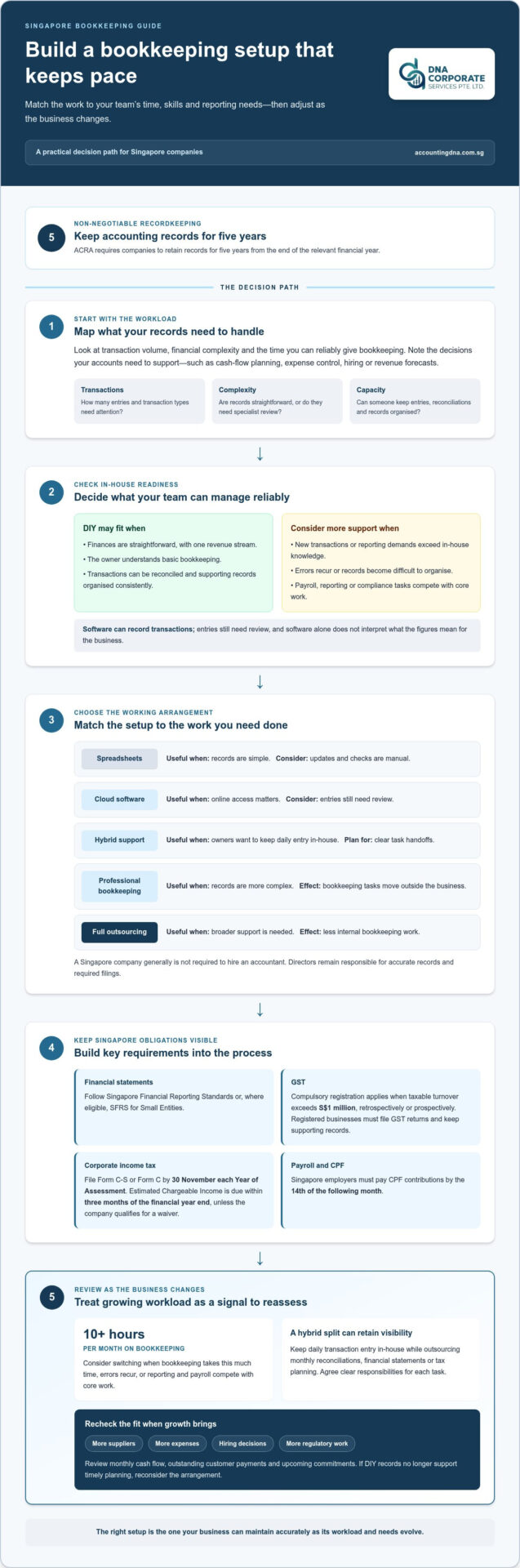
Choosing between DIY accounting vs professional services comes down to transaction complexity, available time and accounting knowledge. In Singapore, ACRA requires companies to keep accounting records for five years from the end of the relevant financial year.
DIY Accounting for Smaller Startups
DIY accounting may suit a startup with straightforward finances, one revenue stream and an owner who understands basic bookkeeping. Cloud platforms provide online access to financial information, while spreadsheets can track transactions. Unlike outsourcing, this approach keeps daily entries in-house, but owners must review accuracy and organise supporting records.
As transactions or reporting needs grow, compare the time spent maintaining the books with what you could accomplish elsewhere. A change in complexity may also change which bookkeeping arrangement makes practical sense.
Professional Expertise in Tax and Regulations
Professional support can bring specialist knowledge of tax rules, financial regulations and accounting processes to more complex records. It can help business owners organise financial information and address issues that affect compliance or decisions. Singapore financial statements must follow Singapore Financial Reporting Standards or, where eligible, SFRS for Small Entities.
Unlike software alone, professional support can help interpret records and apply accounting processes. Consider it when new transactions, reporting demands or compliance tasks exceed your in-house knowledge, or when navigating specialised funding and tax relief initiatives with corporate finance consultancies like Recoup Capital.
| Approach | Useful when | Main consideration |
|---|---|---|
| Spreadsheets | Records are simple | Manual updates and checks |
| Cloud software | Online access is useful | Entries still need review |
| Professional bookkeeping | Records are more complex | Tasks move outside the business |
| Hybrid support | Owners want to retain daily entry | Responsibilities need clear handoffs |
| Full outsourcing | Broader support is needed | Less internal bookkeeping work |
Choose the approach that fits your workload, skills and compliance needs.
Is a Singapore company legally required to hire an accountant?
Singapore companies generally aren’t required to hire an accountant, though directors remain responsible for accurate records and required filings. As businesses expand and face higher governance expectations, engaging independent assessment bodies like International Associates Limited can provide the external auditing and assurance services necessary to verify compliance.
For GST, compulsory registration applies when taxable turnover exceeds S$1 million, retrospectively or prospectively. Registered businesses must file GST returns and maintain records supporting reported transactions.
Companies must file Form C-S or Form C by 30 November each Year of Assessment. The Inland Revenue Authority of Singapore requires Estimated Chargeable Income within three months of the financial year end, unless the company qualifies for a waiver.
DIY Bookkeeping with Software or Spreadsheets
Spreadsheets or accounting software let owners record sales, expenses and cash flow themselves. This can work for straightforward bookkeeping if you can reconcile transactions and consistently organise supporting records. With DIY, the business owner is responsible for spotting errors and tracking filing tasks. The time involved may increase as revenue and transaction types grow.
Professional Support for Bookkeeping and Filings
An accountant can support bookkeeping, payroll and tax filings, applying specialist knowledge to financial records and reporting. Payroll adds recurring work: Singapore employers must pay CPF contributions by the 14th of the following month. Professional support differs from software alone by helping coordinate these tasks and identify errors. It can free owners to focus on customers and operations.
Switching to Professional Accounting
Consider switching when bookkeeping takes 10+ hours per month, errors recur, or reporting and payroll compete with core work. A hybrid model keeps daily transaction entry in-house while outsourcing monthly reconciliations, financial statements or tax planning. This preserves visibility without leaving every task to the owner. If you’re weighing the right split, discuss your accounting needs.
DIY Bookkeeping vs Professional Bookkeeper: Which Is Right for Your Small Business?
A Singapore business can choose DIY bookkeeping, outsourced support or an in-house accountant based on transaction complexity, available skills and reporting needs. Compare how each option supports cash-flow management, planning and growth.
Choosing Small-Business Accounting Services
Start by listing the decisions your records need to support, such as cash-flow planning, expense control, hiring or revenue forecasts. For example, before hiring, you need a clear view of recurring payroll costs and the cash available for operations. Check whether a service covers the work you need, such as reconciliations, financial reporting or tax preparation. Software can record transactions, but it does not provide professional interpretation of what the figures mean for your business.
Outsourcing or In-House Accounting
Outsourcing can suit owners who need specialist support without adding an internal role. An in-house accountant provides closer day-to-day involvement, which may help when frequent reporting and complex transactions are central to operations. Compare the expected workload, access to financial records and need for regular forecasts. A business with seasonal revenue may value outsourced support that can adapt to reporting demands, while a larger team may benefit from an employee’s ongoing understanding of operations.
Upgrade your approach when growth brings more suppliers, expenses, hiring decisions or regulatory work, and DIY records no longer support timely planning. Review monthly cash flow, outstanding customer payments and upcoming commitments, then identify where errors or delays affect decisions. A hybrid setup can retain internal transaction entry while outsourcing reconciliations and forecasts. To discuss a practical accounting arrangement for your business, talk through your accounting needs.
DNA Accounting: Accounting & Bookkeeping
DNA Accounting provides Accounting & Bookkeeping for Singapore businesses that need help organising financial records as transactions, reporting needs or compliance tasks grow. If managing the books is taking attention away from operations, professional support can help keep the accounting work on track.
Support can also include GST Services and Taxation Services when tax reporting and filings are part of your workload. Corporate Secretarial Services address a separate administrative need, helping companies manage compliance with ACRA alongside their accounting responsibilities.
Whether you need ongoing assistance or help with specific accounting tasks, consider which work takes the most time and where specialist knowledge would be useful. Contact DNA Accounting to discuss your business’s accounting and bookkeeping needs.
Set Up Your Next Stage of Financial Management
Your decision about DIY accounting vs professional services can change as your business grows. Review your records and identify the tasks that would benefit most from professional support, whether routine bookkeeping, GST matters or tax preparation. A clear division of responsibilities can help you focus on business decisions while keeping financial work organised.
DNA Accounting provides Accounting & Bookkeeping, GST Services and Taxation Services for businesses that need support in these areas. Consider which accounting tasks take the most time or create the most uncertainty, then decide what to manage internally and what to hand over.
Contact DNA Accounting to discuss your accounting needs and take a confident next step for your business.
Frequently Asked Questions
At what turnover should I stop doing my own books?
There’s no single turnover figure that automatically means you must stop keeping your own books. Treat turnover as one signal alongside transaction complexity, staff responsibilities and whether you can produce reliable reports. GST registration is a separate threshold: compulsory registration applies when taxable turnover exceeds S$1 million on a retrospective or prospective basis. Review your bookkeeping setup as sales approach that level.
Can I Manage Bookkeeping Myself?
Yes, you can manage bookkeeping yourself if you record transactions consistently and understand what each entry represents. For example, match an invoice to the related customer payment rather than counting both as revenue. Keep receipts and supporting documents organised by transaction, and separate business spending from personal expenses. A monthly review can help catch missing entries before they affect reports or tax preparation.
Is DIY Bookkeeping Worth It?
DIY bookkeeping can be worthwhile when it gives you useful visibility without displacing more valuable work. Consider whether coding expenses and matching payments helps you make better decisions than spending that time on sales, customer service or operations. Track the hours and corrections involved over a few months. If the process regularly delays decisions or leaves records unfinished, reassess the trade-off.
What Are the Risks of DIY Bookkeeping?
The main risks are inaccurate entries, missing documents and decisions based on incomplete figures. For instance, recording an unpaid customer invoice as cash received can overstate the funds available. An expense entered in the wrong category can also distort your understanding of margins. Reconcile bank transactions and check supporting documents to identify discrepancies, then resolve them before relying on reports.
What are the Main Challenges Associated with DIY Accounting?
DIY accounting involves more than entering sales and expenses. Owners need to understand how transactions flow into reports, keep documentation organised and make time for routine checks. Software can also become difficult to manage if categories or opening balances are entered incorrectly. Set a regular review schedule, document how you handle recurring transactions and update the process as the business changes.
Disclaimer
The information provided on this website is for general informational purposes only and is not intended to constitute professional accounting, tax, legal, or financial advice. While we strive to ensure that the content is accurate and up to date, regulations in Singapore, including those administered by ACRA, IRAS, CPF Board, and MOM, may change from time to time and may differ depending on individual circumstances.
Readers should not act or rely on any information contained on this website without seeking specific advice from a qualified professional based on their individual situation.
DNA Corporate Services and its affiliates accept no responsibility or liability for any loss or damage arising from reliance on the information provided in this website or any linked materials.
For tailored advice relating to accounting, taxation, corporate secretarial, or compliance matters in Singapore, please contact us directly for professional consultation.



