

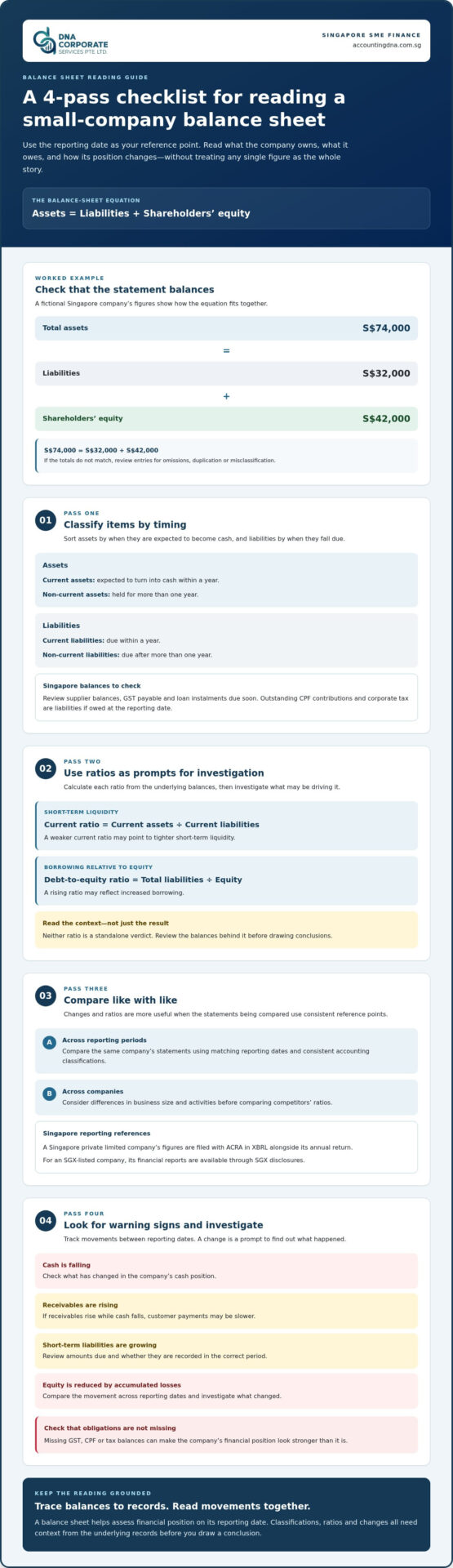
The key to understanding your balance sheet in Singapore is to read it as a snapshot on a specific date, not as a record of how your business performed over time. It shows assets, liabilities and shareholders’ equity, which must balance: assets equal liabilities plus equity. For example, a fictional Singapore company’s balance sheet at 31 December 2025 shows S$74,000 in assets, matched by S$32,000 in liabilities and S$42,000 in shareholders’ equity.
A balance sheet can be harder to interpret than a sales or profit summary. This guide explains what a small business balance sheet looks like, how to read its main sections and what the figures can tell you about cash, amounts owed and financing. You’ll also learn how it differs from a profit and loss statement, so you can use each report to answer the right financial question.
Key Takeaways
- Classify assets by how soon they can be converted into cash, then separate short-term resources from longer-term holdings.
- Sort liabilities by when they fall due and compare them with available resources to assess near-term obligations.
- Use a balance sheet to understand financial position on a date, and a profit and loss statement to assess performance over a period.
- Accurate bookkeeping helps keep these reports useful; DNA Accounting’s Accounting & Bookkeeping service can support Singapore businesses with maintaining their records.
What does a small business balance sheet look like?
Understanding your balance sheet in Singapore starts with its three parts: assets, liabilities and equity. Under Singapore Financial Reporting Standards (International) (SFRS(I)), applicable requirements determine how assets and liabilities are recognised, measured and reported as at the statement date.
-
Identify Assets and Their Categories
List each resource and classify it by when it is expected to become cash. Current assets turn into cash within a year; non-current assets are held for more than one year. In a fictional Singapore company’s statement at 31 December 2025, cash at bank is S$42,000, receivables are S$8,000, and inventory is S$6,000. Equipment, net of depreciation, is S$18,000. Check the supporting records before assigning each balance.
-
Separate Liabilities from Owner’s Equity
Record business obligations separately from the owners’ residual interest. The example lists accounts payable of S$9,000, GST payable of S$3,000, and a bank loan of S$20,000. Together, liabilities total S$32,000. Share capital of S$10,000 plus retained earnings of S$32,000 makes shareholders’ equity S$42,000. A practical way of understanding your balance sheet in Singapore is to trace each balance to its records and category.
- Check the accounting equation: assets equal liabilities plus equity. The example’s total assets of S$74,000 therefore match liabilities of S$32,000 plus equity of S$42,000. If the totals differ, review entries for omissions, duplication or misclassification. This final check helps make the statement useful for assessing the company’s position on its reporting date.
How do you read a small-company balance sheet?
Start with liabilities, compare key ratios and track changes between reporting dates. Together, these steps help you assess obligations, liquidity and financial pressure without treating any single figure as the whole story.
-
Classify Current and Non-Current Items
Classify balances by when they are expected to become cash or fall due. Current liabilities are due within a year; non-current liabilities are due after more than one year. Review supplier balances and GST payable, then identify loan instalments due soon. Outstanding CPF contributions and corporate tax are also liabilities if they are owed at the reporting date.
-
Calculate Key Financial Ratios
Divide current assets by current liabilities to calculate the current ratio. Divide total liabilities by equity to calculate the debt-to-equity ratio. Treat both as prompts for further analysis, not standalone verdicts. For example, a rising debt-to-equity ratio may reflect increased borrowing, while a weaker current ratio may point to tighter short-term liquidity. Review the underlying balances before drawing conclusions.
-
Compare Balance Sheets Over Time and Across Companies
Compare the same company’s statements across years, using matching reporting dates and consistent accounting classifications. For competitors, consider business size and activities before comparing ratios. A Singapore private limited company’s figures are filed with ACRA in XBRL alongside its annual return. For an SGX-listed company, look for its financial reports through SGX disclosures. If year-to-year movements are difficult to interpret, discuss your balance sheet questions with an adviser.
-
Check for Signs of Financial Trouble
Watch for falling cash, rising receivables, growing short-term liabilities or equity reduced by accumulated losses. Compare these movements across reporting dates and investigate what changed. For example, rising receivables alongside falling cash may indicate slower customer payments. Check, too, that obligations are recorded in the correct period: missing GST, CPF or tax balances can make the company’s financial position look stronger than it is.
Balance sheets compared with profit and loss statements
- Choose the report that answers your question. A balance sheet shows assets, liabilities and equity on one reporting date. A profit and loss statement, also called a statement of comprehensive income, reports performance over a period, such as a quarter or a year. Use the balance sheet to assess financial position and the profit and loss statement to see whether trading produced a net profit or loss.
- Read the profit and loss statement from revenue through costs, expenses and tax to the final result. Rising revenue alongside rising expenses, for example, may still leave a business with a smaller net profit. The balance sheet adds context: unpaid customer invoices may appear as receivables, while borrowing appears among liabilities. A profit figure alone does not show how much cash the company holds on the reporting date.
- Review the annual financial statements as a set, including the accompanying notes. Notes may explain significant accounting policies, break down line items and disclose contingencies, commitments, subsequent events or related-party transactions. These details can clarify balances that a single line on the balance sheet does not explain. Singapore company statements also include a cash flow statement, which tracks cash movements over a period.
- Use the cash flow statement alongside the other reports to understand cash changes from operating, investing and financing activities. For instance, a profitable period and a cash shortfall can occur together when customer payments remain outstanding. If you need help interpreting how these statements fit together, speak with an accounting adviser about your company’s financial reports.
DNA Accounting: Accounting & Bookkeeping
DNA Accounting can help you maintain accounting records and make your balance sheet more useful for business decisions. Its Accounting & Bookkeeping support can help when reconciliations, missing entries or changing balances make your company’s financial position difficult to understand.
For Singapore businesses, accurate records also help present GST and tax balances clearly. DNA Accounting provides GST Services and Taxation Services alongside bookkeeping, supporting you when those figures need attention. Its Corporate Secretarial Services can also support company administration, complementing the financial records directors use to review their business.
Contact DNA Accounting to discuss support with your company’s accounting records.
Make your financial records work for your next decision
Understanding your balance sheet in Singapore is more useful when you connect it to regular business decisions. Trace unusual movements to their supporting records and note which figures need follow-up. This turns financial statements into practical management tools rather than documents you revisit only at reporting time.
DNA Accounting offers Accounting & Bookkeeping, GST Services and Taxation Services to support businesses with their financial records and related requirements. If you’d like help deciding what support fits your situation, contact DNA Accounting to discuss your needs.
Regular, informed reviews can help you approach your company’s finances with greater clarity and confidence.
Frequently Asked Questions
Balance sheet vs profit and loss: what is the difference?
A balance sheet records a company’s financial position on a particular date, while a profit and loss statement reports activity over a period. Consider a credit sale: the sale may contribute to revenue before the customer pays, leaving cash unchanged while a receivable is recorded. Reviewing both reports helps distinguish recorded earnings from cash actually collected.
Does a sole proprietorship need a balance sheet?
A Singapore sole proprietor does not lodge financial statements with ACRA, so a formal balance sheet is optional. Preparing one can still help you track business resources and amounts owed separately from personal finances. For example, recording business equipment and unpaid supplier bills gives you a clearer view of the resources available to support operations.
What counts as a liability?
A liability is an amount or obligation the business must settle. Examples include a supplier invoice for goods already received, an accrued expense for services used but not yet billed, and a loan repayment owed to a lender. Include obligations relating to the reporting date even if the invoice arrives later, so the company’s records reflect what it owes.
What counts as an asset?
An asset is a resource the business controls that can support its operations or provide future value. Alongside cash and equipment, a business might record a prepaid expense, such as insurance paid in advance, while it represents a future benefit. Before recording a resource, check who controls it, review the supporting documents and confirm that it belongs to the business.
What is shareholders’ equity?
Shareholders’ equity is the value attributable to owners after liabilities are deducted from assets. It can include amounts invested for shares and accumulated profits retained in the business. Accumulated losses reduce retained earnings and can weaken equity. A repayable shareholder loan is distinct from share capital because the company must repay it.
Disclaimer
The information provided on this website is for general informational purposes only and is not intended to constitute professional accounting, tax, legal, or financial advice. While we strive to ensure that the content is accurate and up to date, regulations in Singapore, including those administered by ACRA, IRAS, CPF Board, and MOM, may change from time to time and may differ depending on individual circumstances.
Readers should not act or rely on any information contained on this website without seeking specific advice from a qualified professional based on their individual situation.
DNA Corporate Services and its affiliates accept no responsibility or liability for any loss or damage arising from reliance on the information provided in this website or any linked materials.
For tailored advice relating to accounting, taxation, corporate secretarial, or compliance matters in Singapore, please contact us directly for professional consultation.



