

A profitable business can still run short of cash. To understand how to improve business cash flow in Singapore, focus on the timing of money coming in and going out: keep flexible costs manageable, send payment reminders promptly and consider discounts for customers who pay early. These steps can help narrow the gap between paying expenses and receiving income.
It’s understandable to focus on sales and profit, but neither guarantees cash will be available when bills fall due. This article explains how flexible office costs, timely reminders and early-payment discounts can support cash flow, growth and resilience. You’ll also see why cash flow matters beyond day-to-day bills, and how practical cost and payment decisions can give your business more room to plan.
Key Takeaways
- Review office and equipment costs to find flexibility and preserve cash for business priorities.
- Schedule payment reminders around invoice due dates to encourage customers to pay on time.
- Consider early-settlement discounts when the cash received sooner is worth more than the discount given.
- Use clear bookkeeping records to spot cash-flow pressure and make better-informed decisions about growth.
1. Flexible office costs and capital expenditure
Protect working capital by matching fixed commitments to actual demand. Review rent, utilities, insurance and supplier agreements for potential savings. A Singapore startup with hybrid staff, for example, can reassess its office needs. If lease terms allow, negotiate less space or more flexible occupancy. Keep any reductions aligned with business needs so savings don’t disrupt daily operations.
Equipment leasing can preserve cash by avoiding an upfront purchase. Compare total lease payments with the cost of buying and maintaining the equipment. Then consider expected use, replacement needs and cash available for other priorities, such as payroll or inventory. Choose the arrangement that best fits your forecast, not just the one with the lowest initial outlay.
According to Inland Revenue Authority of Singapore, qualifying Singapore businesses can receive an Enterprise Innovation Scheme cash payout of up to S$20,000 per year. Consider whether eligible innovation activity could support your cash planning, and account for the payout only when it fits your business’s circumstances.
The amount payable depends on interest, fees and repayment terms. Eligibility depends on the scheme’s criteria and assessment of the application.
To free working capital tied up in inventory, identify slow-moving or surplus stock in your records. Adjust purchasing to match expected demand, then monitor how quickly items sell. Lower inventory can release cash tied up in stock and reduce reliance on credit.
Discuss supplier payment terms before invoices fall due. Request a longer credit period if it works for both parties, and schedule payment near the agreed due date rather than paying early. Avoid late payments: predictable payables protect supplier relationships while keeping cash available for operating needs.
2. Payment reminders and early-settlement discounts
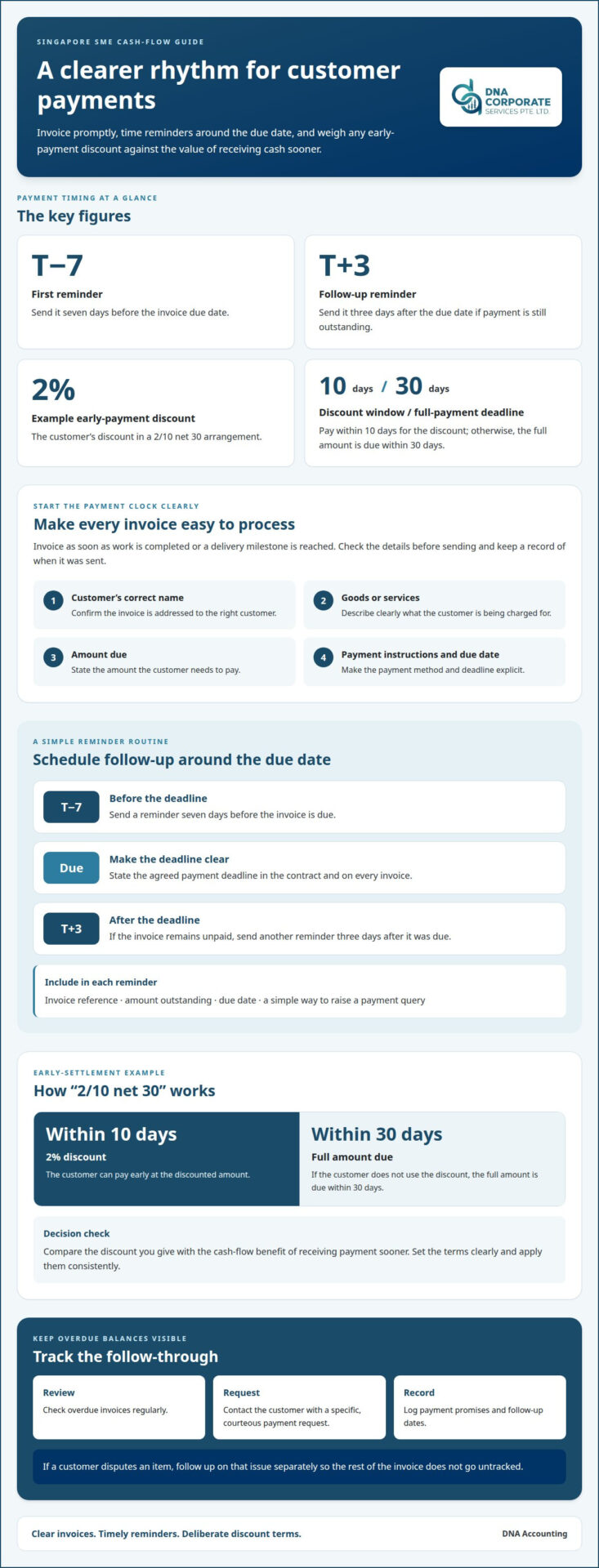
Invoice as soon as work is completed or a delivery milestone is reached. Prompt invoicing starts the payment clock sooner and gives customers less reason to delay processing. Check each invoice for the customer’s correct name, a clear description of the goods or services, the amount due, payment instructions and an explicit due date. Keep a copy and record when you sent it.
Build reminders into your accounts receivable routine, or streamline the process using dedicated receivable management platforms such as smartar.com. Schedule one at T-7 days, seven days before the due date, and another at T+3 days, three days after it. Include the invoice reference, amount outstanding, due date and a simple way to raise a payment query. If a customer disputes an item, follow up on that issue separately instead of letting the entire invoice go untracked.
What are typical payment terms and invoice requirements for businesses in Singapore? Terms are agreed between a business and its customer, so state the payment deadline clearly in your contract and on every invoice. Include enough detail for the customer to identify the transaction and arrange payment.
An early-settlement discount can encourage customers to pay sooner, but weigh the discount against the cash-flow benefit. For example, a 2/10 net 30 structure gives a customer a 2% discount for paying within 10 days; otherwise, the full amount is due within 30 days. Set terms clearly and apply them consistently.
Review overdue invoices regularly, then contact the customer with a specific, courteous payment request. Record promises and follow-up dates so outstanding balances don’t disappear between billing cycles. If payment tracking is difficult to manage, discuss your invoicing process and identify where a clearer routine could help.
3. Why cash flow matters for business growth and financial resilience
Cash flow shapes the choices directors can make, not just whether bills get paid. A Singapore business may have profitable contracts but too little available cash to hire staff, buy materials or accept a larger order. That can slow expansion and leave less room to absorb unexpected expenses.
For Singapore SMEs considering how to improve business cash flow in Singapore, assess whether planned growth fits the timing of available funds. Before committing to expansion, compare expected receipts with upcoming payroll, supplier commitments and tax obligations. Separate cash reserved for known liabilities from funds available for discretionary investment. This helps directors decide whether growth can be funded internally, an area where management consultants such as Marshall Solutions Group often help founder-led companies align strategic expansion with day-to-day operational performance.
GST filing and payment deadlines depend on the filing period assigned to the business. Include these obligations in cash planning so funds needed for payment aren’t mistaken for money available to spend.
Set aside spare cash for emergencies or future investment. Keeping some reserves in an interest-bearing account may earn interest while preserving access to funds for business needs.
Invoice financing, factoring and overdrafts can provide access to cash, but financing costs and repayment terms affect future liquidity. Before committing, assess the total cost, repayment triggers and how customer payment delays could affect your ability to repay.
For YA 2026, Singapore’s Corporate Income Tax Rebate is 50% of tax payable, capped at S$40,000. Businesses should check whether they qualify for any available tax support before including it in cash-flow plans. Plan around these measures without treating support as cash already received.
Review your funding needs with an accounting professional to clarify upcoming cash commitments.
DNA Accounting: Accounting & Bookkeeping
DNA Accounting’s Accounting & Bookkeeping services can support your cash-flow decisions by helping you maintain clear records of income, expenses, receivables and payables. Consider this support when late customer payments, unclear cost patterns or incomplete records make it harder to understand your business’s cash position.
Accurate records also provide a firmer basis for reviewing forecasts and identifying upcoming commitments. Where GST reporting or tax obligations factor into your cash planning, DNA Accounting also provides GST Services and Taxation Services. These services can help clarify your financial tracking and filing needs, supporting informed decisions about spending and growth.
Contact DNA Accounting for support with your business’s accounting and bookkeeping needs.
Turn cash-flow insight into a steady business habit
A healthier cash position comes from making deliberate decisions before pressure builds. Make cash-flow reviews part of your regular management routine, and use what you learn to guide spending, investment and growth. A practical approach to how to improve business cash flow in Singapore starts with records that show what the business can afford and when.
When financial information is difficult to interpret or reporting tasks distract from managing the business, structured support can bring the details into focus. DNA Accounting offers Accounting & Bookkeeping, GST Services and Taxation Services to support clear financial records and reporting.
Take the next step at a pace that suits your business. Contact DNA Accounting to discuss your cash-flow needs, and move forward with a clearer view of your finances.
Frequently Asked Questions
What is Cash Flow?
Cash flow is the movement of money into and out of a business. It shows whether available cash can meet obligations, not simply whether sales are profitable. For example, a company may record a sale as revenue before receiving payment, while still needing cash for payroll or supplier bills. Reviewing receivables, payables and financing repayments helps explain changes in the bank balance.
What are the fastest ways for Singapore SMEs to improve cash flow?
Start with actions that can release or protect cash in the near term: pause discretionary purchases, collect payment for completed work and agree on staged billing for active contracts. Before approving new spending, compare the bank balance with upcoming obligations. Prioritise overdue amounts by value, likelihood of collection and expected timing, then focus follow-up where it can make the clearest difference.
How can Singapore businesses speed up customer payments and reduce late invoices?
Make invoices easy for a customer’s finance team to approve. Include the relevant purchase order reference and evidence of delivery or completion, and send the invoice to the correct billing contact. Check whether the customer has a submission cut-off or required format, then resolve queries promptly. Recording the reason for each delay can reveal recurring approval bottlenecks and improve future billing.
What cash flow forecasting methods and tools are suitable for Singapore SMEs?
Singapore SMEs can use a 13-week rolling cash flow forecast and compare forecast figures with actual cash every Friday. Regular weekly, monthly or quarterly tracking of receipts and payments can help identify upcoming cash needs.
Disclaimer
The information provided on this website is for general informational purposes only and is not intended to constitute professional accounting, tax, legal, or financial advice. While we strive to ensure that the content is accurate and up to date, regulations in Singapore, including those administered by ACRA, IRAS, CPF Board, and MOM, may change from time to time and may differ depending on individual circumstances.
Readers should not act or rely on any information contained on this website without seeking specific advice from a qualified professional based on their individual situation.
DNA Corporate Services and its affiliates accept no responsibility or liability for any loss or damage arising from reliance on the information provided in this website or any linked materials.
For tailored advice relating to accounting, taxation, corporate secretarial, or compliance matters in Singapore, please contact us directly for professional consultation.



