

For 2026, employers with 5 or more employees must submit employment income information electronically under the IRAS Auto-Inclusion Scheme in Singapore, according to the Inland Revenue Authority of Singapore. The records include Form IR8A income details, benefits-in-kind reported in Appendix 8A and gains from employee share schemes reported in Appendix 8B. This gives IRAS the employment income information needed for employees’ tax records.
It’s easy to think of the IRAS Auto-Inclusion Scheme in Singapore as just another filing requirement, but it also enables employment income to appear automatically in employees’ tax forms. This guide explains how the scheme works, what employee records employers need to submit and when the obligation applies, so you can prepare your business.
Key Takeaways
- Understand which eligibility triggers require your business to participate, including the employee-count threshold and an IRAS notice to file.
- Learn how Form IR8A, Appendix 8A and Appendix 8B cover different types of employee income and compensation.
- See how electronic submission helps employment income appear in employees’ tax forms and can support the No-Filing Service.
- Find out how accounting and bookkeeping support can help keep employee income records organised for reporting.
What Are the Employee Records That Must Be Submitted to the Auto Inclusion Scheme?
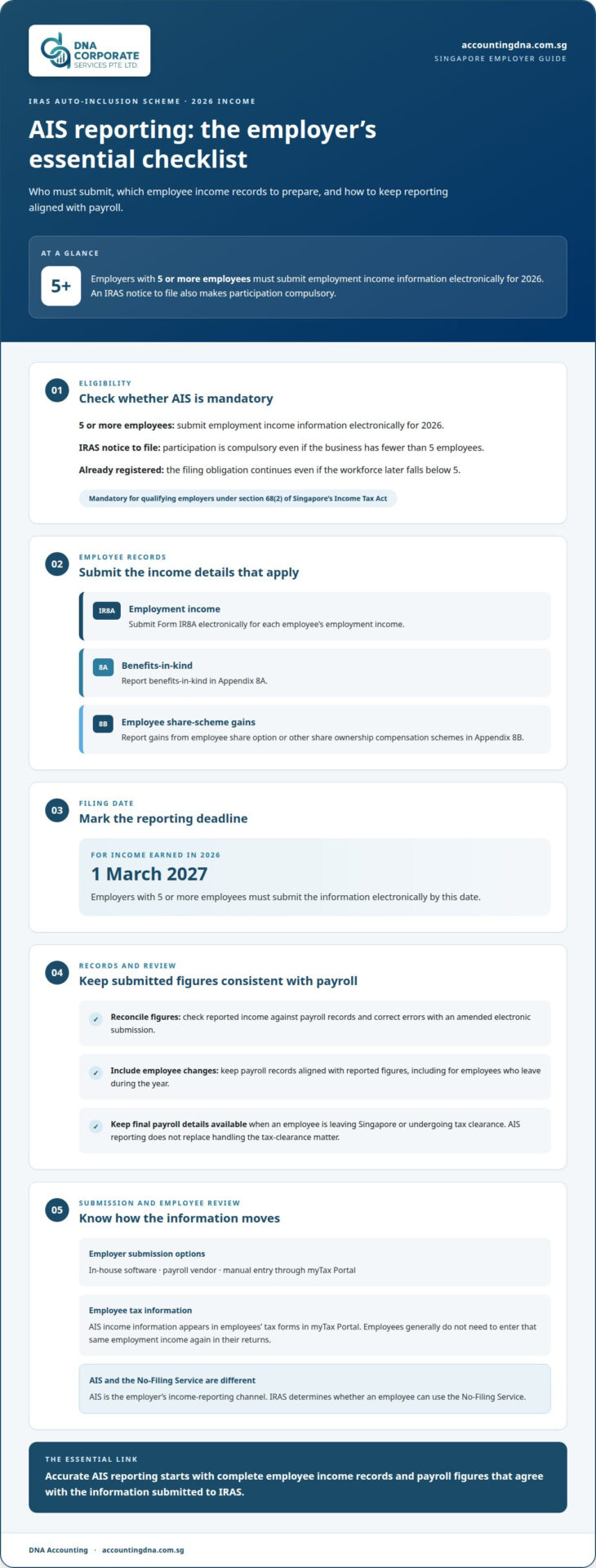
For 2026, employers with 5 or more employees must submit employment income information electronically, according to the Inland Revenue Authority of Singapore. Employers must also participate if they receive an IRAS notice to file. Already registered? The obligation continues even if the workforce later falls below five employees.
Submit Form IR8A electronically for each employee’s employment income. Use Appendix 8A for benefits-in-kind and Appendix 8B for gains from employee share option or other share ownership compensation schemes. These records help IRAS include relevant income information in employees’ tax forms.
Registration is separate from annual filing. For Year of Assessment 2024, registration was open from 1 Apr 2023 to 31 Dec 2023. An IRAS notice to file also makes participation compulsory.
For income earned in 2026, employers with 5 or more employees must submit the information electronically by 1 March 2027. Keep payroll records aligned with the reported figures, including for employees who leave during the year.
If an employee is leaving Singapore or undergoing tax clearance, keep final payroll details available for the relevant reporting. AIS reporting does not replace handling the employee’s tax-clearance matter.
Employees can view AIS income information in myTax Portal, where it appears in their tax forms. They generally don’t need to enter that employment income again in their returns.
If reported income is incorrect, reconcile it against payroll records and amend the electronic submission so the information held by IRAS aligns with the employee’s tax return.
Section 68(2) of Singapore’s Income Tax Act makes submission mandatory for qualifying employers. Over 11,000 new employers joined the Auto-Inclusion Scheme in 2026, submitting employees’ income data to IRAS for the first time.
Purpose of the Auto Inclusion Scheme
The scheme aims to make employment income reporting more consistent between an employer’s payroll records and the information used for an employee’s income tax assessment. Employees may not need to enter salary details manually, while employers have a structured way to report information that employees can review against their own records.
This shared record can help employees spot differences, such as a bonus that does not match a payslip or an employment change that affects recorded income. Employees should review their tax information and raise discrepancies with their employer. AIS does not replace checking other income or personal tax details that may affect an individual return.
For example, if payroll records show a salary adjustment but an employee’s tax information appears inconsistent, both sides have a clear reference for resolving the difference. Accurate records also help the employer explain how reported employment income was compiled, rather than reconstructing figures from scattered documents later.
For a business, the purpose is therefore practical as well as administrative: maintain dependable employment income records and make them easier to review during tax filing. A consistent process linking payroll data with accounting records can help a director identify gaps early. If your business needs support keeping those records organised, discuss your reporting needs.
What is IRAS’s Auto-Inclusion Scheme (AIS) in Singapore?
The Auto-Inclusion Scheme is IRAS’s electronic channel for employers to report employees’ employment income. Instead of relying on each employee to transcribe salary details, the employer submits income records to IRAS, and those records can appear in the employee’s tax forms. AIS changes how employment income reaches IRAS, not what an employee has earned.
For employees, pre-filled employment income provides a reference when reviewing tax information. Employees generally don’t need to enter that same income again in their returns. Some may be selected for the No-Filing Service when their employers use AIS. The services are distinct: employers report income, while IRAS determines whether an employee can use the No-Filing Service.
For employers, AIS links payroll reporting with individual income tax assessment. Reported figures should reflect the employee’s employment income records, including relevant benefits or share-scheme gains. For example, a salary change recorded in payroll should also be reflected accurately in the employee’s submitted income information. Clear records help explain differences during review.
Employers can submit AIS information using in-house software, a payroll vendor or manual entry through myTax Portal. Each method serves the same reporting purpose, but the process differs. The priority is to ensure employee data is complete and consistent. Employees should review the income shown by IRAS and raise discrepancies with their employer, who can correct errors through an amended submission.
If AIS reporting is difficult to coordinate with your company’s payroll records, discuss your reporting requirements.
DNA Accounting: Accounting & Bookkeeping
DNA Accounting helps businesses organise accounting and bookkeeping alongside payroll records used for employment income reporting. This support is useful when payroll changes, benefits or employee departures make records harder to keep consistent. Clear records give your team a stronger basis for reviewing figures before tax reporting.
For broader compliance support, DNA Accounting also provides Payroll Services and Taxation Services. These services help connect payroll information with your business’s accounting records and tax work. For example, a director preparing for AIS filing can organise employee income information alongside the company’s wider financial records.
For support with your business records and tax requirements, contact DNA Accounting.
Make AIS part of your regular records process
Reliable AIS reporting starts before filing season. Keep payroll changes, employee benefits and accounting records aligned, and assign clear responsibility for reviewing income information. This makes it easier to spot gaps when staff join, leave or receive changes to their compensation.
For a Singapore business, managing the IRAS auto inclusion scheme is one part of keeping tax records in order. DNA Accounting offers Accounting & Bookkeeping, GST Services and Taxation Services to support related business records and tax work. If you’d like to discuss how this support could fit your needs, contact DNA Accounting about AIS support.
With a clear process and the right support, your team can approach reporting with greater confidence.
Frequently Asked Questions
How Can I Sign Up for the AIS?
Register with IRAS to participate, then decide how your business will prepare and submit its records. You can use in-house software, a payroll vendor or manual entry in myTax Portal. Choose a method that fits your payroll process and ensure the responsible staff member can access the necessary employee income information.
Is AIS compulsory for all Singaporean businesses?
No. Incorporating a company in Singapore does not by itself mean it must participate. The requirement depends on whether the employer meets IRAS’s applicable conditions or receives a filing notice. Keep this employer reporting obligation separate from the distinct tax responsibilities that apply to the company and its employees.
Is AIS mandatory for income tax?
AIS covers employers’ reporting of employees’ employment income to IRAS. It is separate from a company’s corporate income tax return, which reports the company’s taxable income. Treat AIS reporting and corporate tax filing as distinct compliance tasks, and prepare records for each relevant filing.
Need Help with AIS?
DNA Accounting provides Payroll Services and Accounting & Bookkeeping. This support can help connect payroll information with accounting records, such as clarifying how employee-related entries appear in the books. Contact the team to discuss the records and reporting work your Singapore business needs to organise.
What Do Employers Need to Know About the AIS?
Keep a record of the information submitted and the submission confirmation, so your business can refer to the same figures if questions arise. Store these alongside the relevant payroll documentation and assign someone to maintain them. This creates a clear trail for internal follow-up and helps whoever handles a later amendment understand what was originally reported.
Disclaimer
The information provided on this website is for general informational purposes only and is not intended to constitute professional accounting, tax, legal, or financial advice. While we strive to ensure that the content is accurate and up to date, regulations in Singapore, including those administered by ACRA, IRAS, CPF Board, and MOM, may change from time to time and may differ depending on individual circumstances.
Readers should not act or rely on any information contained on this website without seeking specific advice from a qualified professional based on their individual situation.
DNA Corporate Services and its affiliates accept no responsibility or liability for any loss or damage arising from reliance on the information provided in this website or any linked materials.
For tailored advice relating to accounting, taxation, corporate secretarial, or compliance matters in Singapore, please contact us directly for professional consultation.



