

Good accounting does more than keep tax paperwork in order; it helps you see whether your Singapore business is earning, spending and managing cash sustainably. An accounting guide for new business owners in Singapore starts with the essentials: recording income and expenses, organising supporting documents, and using financial statements to understand performance. According to IRAS, Singapore companies must retain business records for at least 5 years from the relevant Year of Assessment.
Bookkeeping can feel like an administrative chore when you’re focused on customers and operations. But reliable records help you understand what your business can afford and prepare for tax obligations. This accounting guide for new business owners in Singapore explains what small-business accounting involves, how cash and accrual methods differ, and why separating business finances and setting aside funds for corporate tax and GST can support sound decisions. It also shows how regular reviews fit into a practical accounting routine.
Key Takeaways
- Keep income, expense and supporting records organised so you can review performance and prepare for tax obligations.
- Understand how cash and accrual accounting record income and expenses differently, and how that affects your view of business finances.
- Separate business and personal spending, and plan for corporate tax and GST to help manage cash flow.
- Use regular accounting reviews to spot cash-flow gaps and make more informed decisions about spending and growth.
1. What is small business accounting?
Small-business accounting records income, expenses and other transactions so owners can understand their finances. For example, a retailer can separate stock purchases from delivery costs to see where money goes. These records also support financial reporting and tax filings in Singapore.
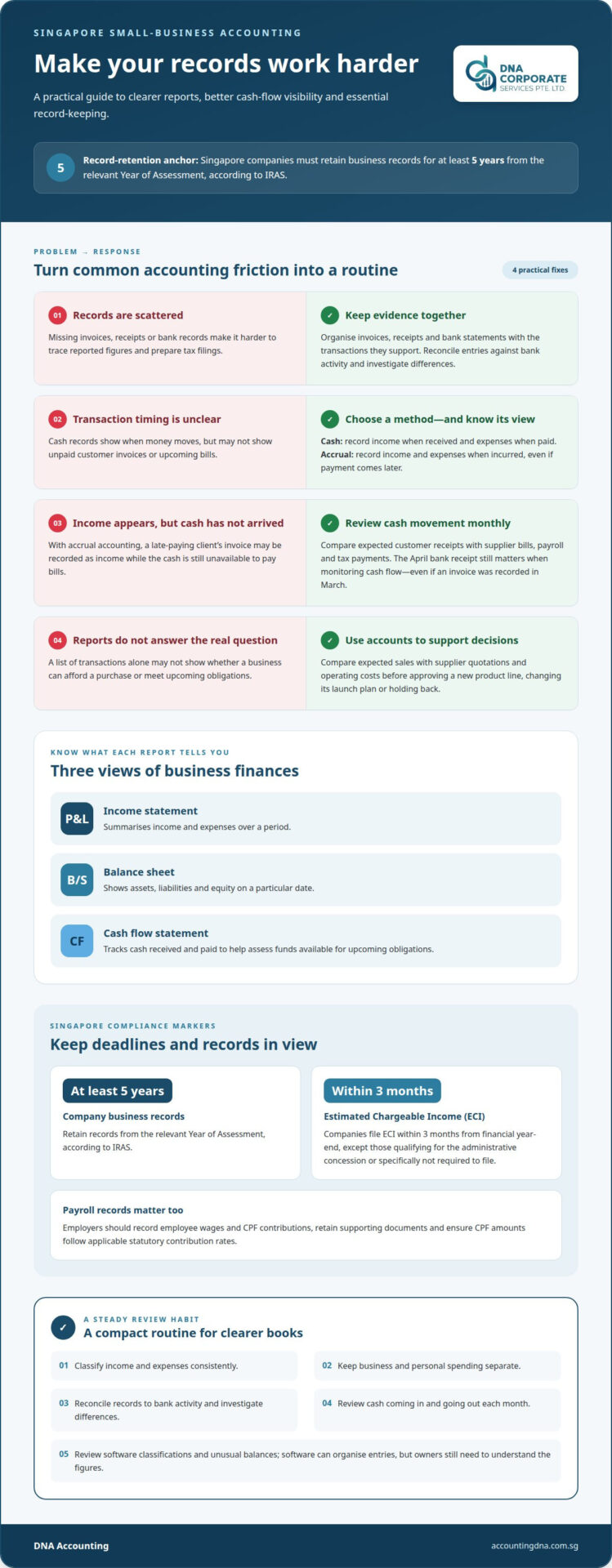
An income statement, also called a profit and loss statement, summarises income and expenses over a period. A balance sheet shows assets, liabilities and equity on a particular date. A cash flow statement tracks cash received and paid, helping owners assess whether funds are available for upcoming obligations.
Sole proprietors and self-employed individuals prepare statements of accounts using their business income and expenses. Revenue categories for statement preparation are less than S$500,000 and S$500,000 or more. Invoices, receipts and bank statements help support the figures reported.
Singapore companies must keep accounting records and prepare financial statements. They must retain business records for at least 5 years from the relevant Year of Assessment, according to the Inland Revenue Authority of Singapore (IRAS). Organised records help directors trace reported figures to supporting documents.
Companies must file Estimated Chargeable Income (ECI) within 3 months from financial year-end, except those qualifying for the administrative concession or specifically not required to file. Companies should check the applicable filing requirements for their annual income tax returns.
Employers should record employee wages and CPF contributions in payroll records, retain supporting documents, and ensure CPF amounts follow applicable statutory contribution rates.
2. Cash and accrual accounting methods
Cash and accrual accounting record transactions at different times. Under cash accounting, income is recorded when money arrives, and expenses when money is paid. For example, a customer’s payment counts as income once it reaches the business bank account. This method helps owners track available cash, but may not show unpaid customer invoices or upcoming bills.
Accrual accounting records income and expenses when they are incurred. An invoice date can determine when income or an expense is recorded for tax calculations, even if payment comes later. If a Singapore design firm invoices a customer in March and receives payment in April, accrual records reflect the March transaction. The April bank receipt still matters when monitoring cash flow.
Neither method removes the need to manage cash flow. Review money coming in and going out each month. Compare expected customer receipts with supplier bills, payroll and tax payments. If a client pays late, the income may appear in accrual records while the cash remains unavailable. That gap can affect the business’s ability to pay bills on time.
Keep invoices, receipts and bank records consistent with your chosen method. Reconcile entries against bank activity, and investigate differences rather than carrying them forward. Accounting software can organise transactions, but owners still need to understand what the figures mean. Choosing cash or accrual accounting does not remove penalties or filing obligations, so keep supporting records and deadlines in view.
If transaction timing makes your reports hard to interpret, discuss your bookkeeping needs and how the records can support clearer cash-flow decisions.
3. Why accounting matters to Singapore business owners
Useful accounts help owners judge whether a business decision is affordable and commercially sound. For example, a startup considering a new product line can compare expected sales with supplier quotations and existing operating costs. This analysis gives directors a clearer basis for approving the purchase, adjusting the launch plan or holding back.
A startup can manage straightforward bookkeeping in-house if a team member has the time and skills to classify transactions consistently. As reporting needs grow more complex, professional Accounting & Bookkeeping support can help owners maintain accurate accounts while focusing on operations.
Accounting software is useful when its features match how a new business invoices customers, records expenses and prepares reports. Compare functions, user access and transaction limits, as these affect which plan fits and its cost. Software can organise entries, but owners still need to review classifications and investigate unusual balances.
Common mistakes include mixing personal and business transactions, misclassifying purchases and overlooking filing obligations. Keep business spending separate and review entries before using them for tax reporting. GST filing must also be accurate and on time; failure to do so results in penalties.
If bookkeeping demands are making it harder to assess business decisions, discuss your accounting support needs.
DNA Accounting
DNA Accounting helps Singapore business owners organise financial records and understand their accounts. If bookkeeping is falling behind, reports are difficult to interpret, or tax and GST matters need attention, professional support can bring these tasks into a clearer process.
DNA Accounting’s Accounting & Bookkeeping, GST Services and Taxation Services cover connected parts of a business’s financial administration. Corporate Secretarial Services also support company compliance, including maintaining proper registers and minute books and filing required documents with ACRA. The right support depends on your needs, whether you want clearer books, help with tax reporting or assistance with GST requirements.
Getting help can be especially useful when business activity grows and financial administration becomes harder to manage alongside daily operations. You can discuss your accounting needs and the records involved before deciding on a suitable next step.
Contact DNA Accounting to discuss support for your business.
Build a stronger financial routine
Use this accounting guide for new business owners in Singapore as a starting point, then shape your accounting routine around how your business operates. Clear processes for recording transactions and reviewing reports give you a firmer basis for decisions as the company grows. DNA Accounting can help keep financial administration manageable while you focus on customers and operations.
DNA Accounting offers Accounting & Bookkeeping, GST Services and Taxation Services to support these needs. If you’d like to discuss how that support could fit your business, contact DNA Accounting to discuss your accounting needs. A practical next step can make managing your business finances feel more straightforward.
Frequently Asked Questions
What is small business accounting?
Accounting turns day-to-day business activity into information owners can use to make decisions. For instance, if recorded sales rise but the bank balance falls, reviewing customer payment timing and supplier commitments can reveal the cause. Comparing actual results with business plans regularly helps owners decide whether to adjust spending, pricing or operations.
What accounting records must a new business in Singapore keep?
Keep records that explain each transaction, including customer contracts, supplier statements, credit notes, expense claims and asset purchase documents. A business with stock can also maintain inventory records that support its reported figures. Organise documents by transaction and accounting period, and make sure entries can be traced to their source if a director needs clarification.
What are the accounting and financial reporting requirements for Singapore sole proprietorships, partnerships, and companies?
Requirements depend on the legal structure. A sole proprietor’s business accounts relate to the owner’s business activity, while partnership accounts should make each partner’s share of results understandable. A company is a separate legal entity and must maintain accounting records and prepare financial statements. Identify the structure first, then set up records and reporting that reflect it accurately.
When must a Singapore company prepare and file financial statements with ACRA?
Companies, unless exempted, must hold an Annual General Meeting within 6 months after the financial year end, so prepare statements in time for that meeting. The annual return must be filed with ACRA within 7 months after the financial year end. Annual return filing is distinct from IRAS income tax filing; keep both obligations on the company’s compliance calendar.
What steps should a new Singapore business take to set up bookkeeping and a chart of accounts?
Start by listing the business’s actual activities, such as consulting, product sales or delivery. Create account categories that distinguish income from direct costs, then add categories for recurring overheads and assets where relevant. Assign someone to enter transactions, document how unusual items are classified, and review reports with the director so the categories remain useful as operations change.
Disclaimer
The information provided on this website is for general informational purposes only and is not intended to constitute professional accounting, tax, legal, or financial advice. While we strive to ensure that the content is accurate and up to date, regulations in Singapore, including those administered by ACRA, IRAS, CPF Board, and MOM, may change from time to time and may differ depending on individual circumstances.
Readers should not act or rely on any information contained on this website without seeking specific advice from a qualified professional based on their individual situation.
DNA Corporate Services and its affiliates accept no responsibility or liability for any loss or damage arising from reliance on the information provided in this website or any linked materials.
For tailored advice relating to accounting, taxation, corporate secretarial, or compliance matters in Singapore, please contact us directly for professional consultation.



