

Business finances are easier to manage with a simple routine: review the numbers each week, separate personal and business transactions, and organise receipts and invoices. To learn how to get business finances organized, start by checking your cash position, then create a realistic budget and automate repeat tasks such as bookkeeping, cash-flow tracking, and invoicing.
When records are scattered or cash seems to disappear between payments, it can be hard to know what to do next. Clear, current financial information gives you a sound basis for planning expenses and deciding what the business can afford. This guide covers a practical financial check-in, a budget you can update as conditions change, and automation that supports daily tracking without replacing regular reviews. It focuses on Singapore businesses and the role orderly records play in managing finances.
Key Takeaways
- Start with a weekly financial check-in to spot cash-flow concerns and missing records before they build up.
- Set a realistic budget around expected income and expenses, then revisit it as business performance changes.
- Use automation for routine bookkeeping, invoice tracking, and expense records, while reviewing the information regularly.
- When financial administration becomes difficult to manage, accounting and bookkeeping support can help keep business records organised.
Automating bookkeeping, cash-flow tracking, and invoicing
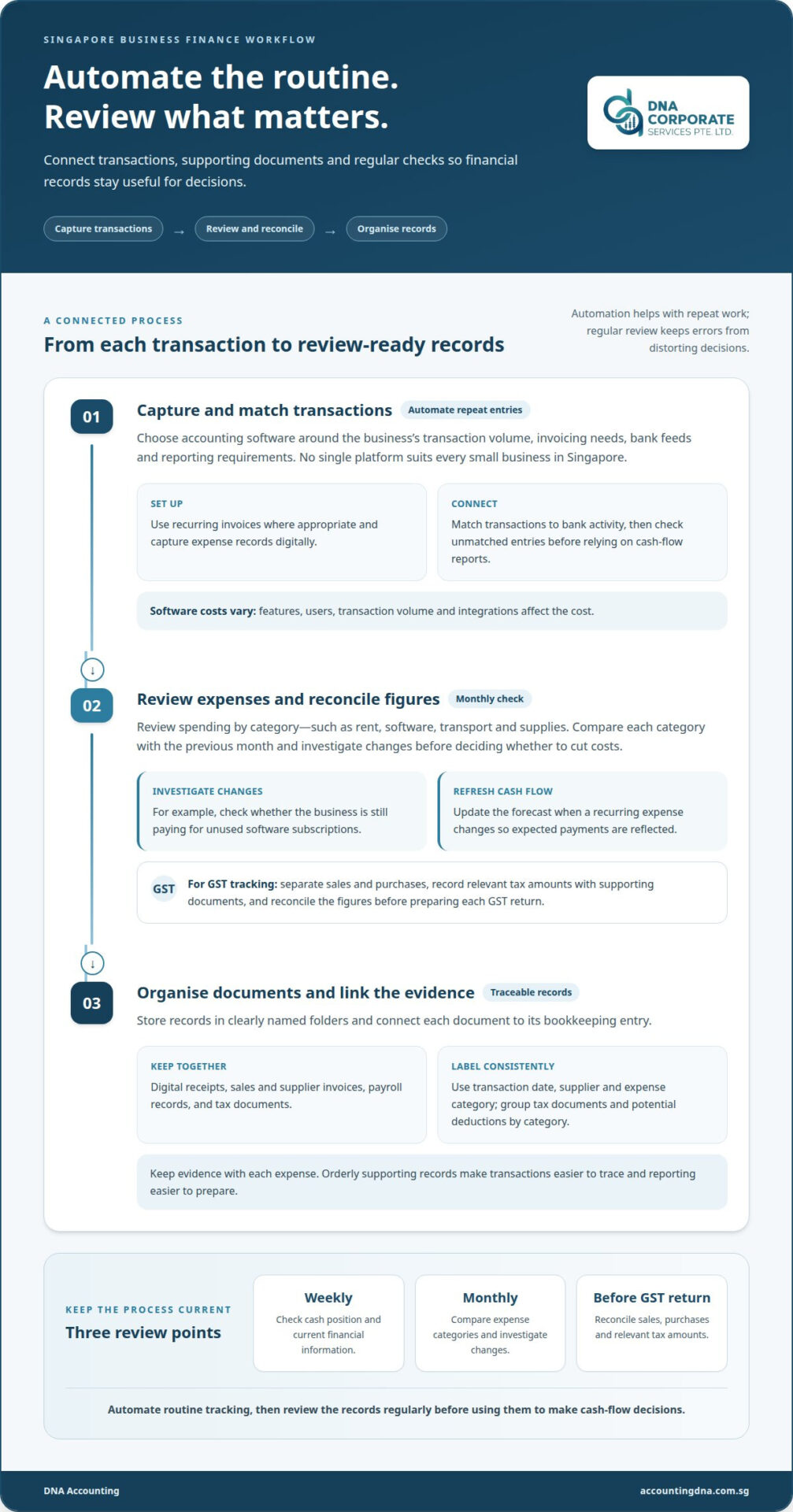
Automate repeat entries, but review the records regularly so errors do not distort cash-flow decisions. Use the steps below to connect transactions, supporting documents, and tax preparation.
-
Automate Invoicing and Expense Tracking
Choose accounting software based on transaction volume, invoicing needs, bank feeds, and reporting requirements. No single platform suits every small business in Singapore. Costs depend on features, users, transaction volume, and integrations. Set up recurring invoices where appropriate, capture expense records digitally, and match transactions to bank activity. Review unmatched entries before relying on cash-flow reports.
-
Track and Reduce Monthly Expenses
Review expenses monthly by category, such as rent, software, transport, and supplies. Compare each category with the previous month and investigate changes before cutting costs. For example, check whether you are still paying for unused software subscriptions. Update cash-flow tracking when a recurring expense changes so forecasts reflect expected payments and support informed decisions.
-
Organize Receipts, Invoices, Payroll, and Tax Documents
Store digital receipts, sales and supplier invoices, payroll records, and tax documents in clearly named folders. Use consistent labels, such as transaction date, supplier, and expense category, then link each document to its bookkeeping entry. For Singapore businesses, orderly invoices, receipts, and supporting records make transactions easier to trace and reporting easier to prepare.
For GST tracking, separate sales and purchases and record the relevant tax amounts alongside supporting documents. Reconcile the figures before preparing each GST return. Group tax documents and potential deductions by category, and keep evidence with each expense so entries can be reviewed during tax preparation.
Creating and reviewing a realistic budget
Singapore businesses should retain accounting records for the period required under applicable tax and company-record rules, keeping supporting documents with the relevant entries. Build a budget from expected income and expenses, then compare it with actual performance.
-
Build a Business Budget
List expected income, fixed expenses, and variable costs in your accounting records. Separate recurring commitments, such as rent, from costs that change with sales, such as inventory. Use past transactions as a starting point, then adjust your assumptions for known changes. Do not treat projected sales as guaranteed cash. Base spending decisions on realistic revenue expectations.
-
Map Monthly Cash Flow
Prepare a monthly cash-flow budget showing when money is expected to arrive and leave. Record customer payment dates alongside rent, payroll, supplier invoices, and inventory restocking. A profitable month can still bring a cash shortfall if customer payments arrive after major bills are due. Use the forecast to spot tight periods early and plan discretionary purchases accordingly.
-
Review the Budget
Compare actual income and expenses with the budget each month, then explain material differences. If sales fall below forecast or a supplier cost rises, update the projection instead of carrying forward outdated assumptions. Review business goals and spending plans quarterly and yearly to assess what is working. For support interpreting accounting records and refining your budget, discuss your accounting needs.
Keep detailed income and expense records and set a realistic budget to support informed decisions and help avoid liquidity problems. Schedule monthly reviews of financial statements, account reconciliations, and progress. Revisit your goals and budget in light of business performance.
Assessing the current state of business finances
Use a weekly check-in to assess whether the figures support your next business decisions. For businesses in Singapore, include GST reporting information where relevant, but do not mistake a bookkeeping balance for a completed tax filing.
-
Gather Financial Records
Bring together the general ledger, bank activity, contracts, payroll summaries, and transaction documents for the review period. If your Singapore business is GST-registered, include records showing the GST treatment of sales and purchases so figures can be traced during return preparation. Make the purpose and accounting period clear for each entry. A sound approach to how to get business finances organized starts with records that explain what each figure represents.
-
Prepare Cash Flow Reports and Financial Statements
Use reports to assess whether available cash can cover upcoming commitments, then compare that view with the business’s reported performance. A profitable period, for example, may still involve delayed customer receipts or a large payment falling due. Separate one-off movements from recurring trends before deciding whether to delay spending, follow up on receivables, or revise a forecast.
-
Identify Bookkeeping Mistakes and Organization Risks
Check whether transactions are assigned to the correct accounting period and whether GST treatment is consistent across similar entries. Watch for owner funds recorded as sales or a GST balance mistaken for money available to spend. These errors can distort decisions even when totals look complete. If you are wondering how to get business finances organized, use the weekly review to flag unusual balances for investigation.
If you need help interpreting your accounts, discuss your bookkeeping support needs.
DNA Accounting
DNA Accounting helps Singapore businesses turn organised records into clearer financial reporting and practical next steps. Its Accounting & Bookkeeping services support transaction records, while GST Services and Taxation Services address related reporting needs. Corporate Secretarial Services also support company administration.
Consider professional support if invoices, expenses, tax documents, and financial reports are difficult to keep aligned, or if reviewing the figures takes time away from running the business. Accurate records help directors make informed decisions about cash flow and business priorities.
Contact DNA Accounting to discuss support for organising your business finances.
Make Financial Clarity Part of Your Routine
Assign someone to own the finance process, including reviewing automated entries and following up on missing documents. This keeps the system useful as your Singapore business changes instead of letting it become another unattended tool. Set a regular time to check whether the reports still support the decisions you need to make.
The lasting answer to how to get business finances organized is to make financial upkeep part of normal operations, rather than postponing it until a report is urgently needed. Clear responsibility and consistent follow-through turn organised records into a dependable basis for planning.
If you’d like support putting that structure in place, start a conversation with DNA Accounting. Take the next step at a pace that works for your business, and build a financial routine you can maintain with confidence.
Frequently Asked Questions
Ready to Turn Chaos Into Clarity?
Yes. Choose one business account as the source for incoming and outgoing transactions, then assign someone to review exceptions. For example, flag a supplier payment that appears twice instead of letting it go unnoticed. A short, consistent review routine turns scattered financial activity into useful information for your next business decision.
How to set up a bookkeeping system for a small business?
Set up a system that records each sale, purchase, payment, and receipt under consistent categories. Decide how to capture documents and who will approve unusual transactions. For example, a freelance designer could label software subscriptions separately from client project expenses. Reconcile recorded transactions against bank activity to make missing entries and duplicates easier to identify.
How to separate business and personal finances in Singapore?
Use a dedicated business bank account for company income and operating payments, and keep personal spending in a separate account. If you pay a business expense personally, record it clearly and retain the receipt instead of mixing it with private purchases. Schedule personal drawings regularly and document each transfer consistently in the accounts.
How often should a business reconcile bank accounts and review its finances?
Reconcile bank accounts monthly and schedule a brief financial check-in at the end of each week. A weekly review can catch unrecorded payments or overdue customer receipts; monthly reconciliation confirms recorded transactions against bank activity. Add quarterly and yearly check-ins to assess whether financial plans still fit business performance, and investigate discrepancies as they appear.
Disclaimer
The information provided on this website is for general informational purposes only and is not intended to constitute professional accounting, tax, legal, or financial advice. While we strive to ensure that the content is accurate and up to date, regulations in Singapore, including those administered by ACRA, IRAS, CPF Board, and MOM, may change from time to time and may differ depending on individual circumstances.
Readers should not act or rely on any information contained on this website without seeking specific advice from a qualified professional based on their individual situation.
DNA Corporate Services and its affiliates accept no responsibility or liability for any loss or damage arising from reliance on the information provided in this website or any linked materials.
For tailored advice relating to accounting, taxation, corporate secretarial, or compliance matters in Singapore, please contact us directly for professional consultation.



