

Falling behind on bookkeeping can turn routine tax and compliance work into a scramble. Monthly accounting services in Singapore help startups and SMEs keep financial records current, monitor cash flow and prepare for recurring filing obligations.
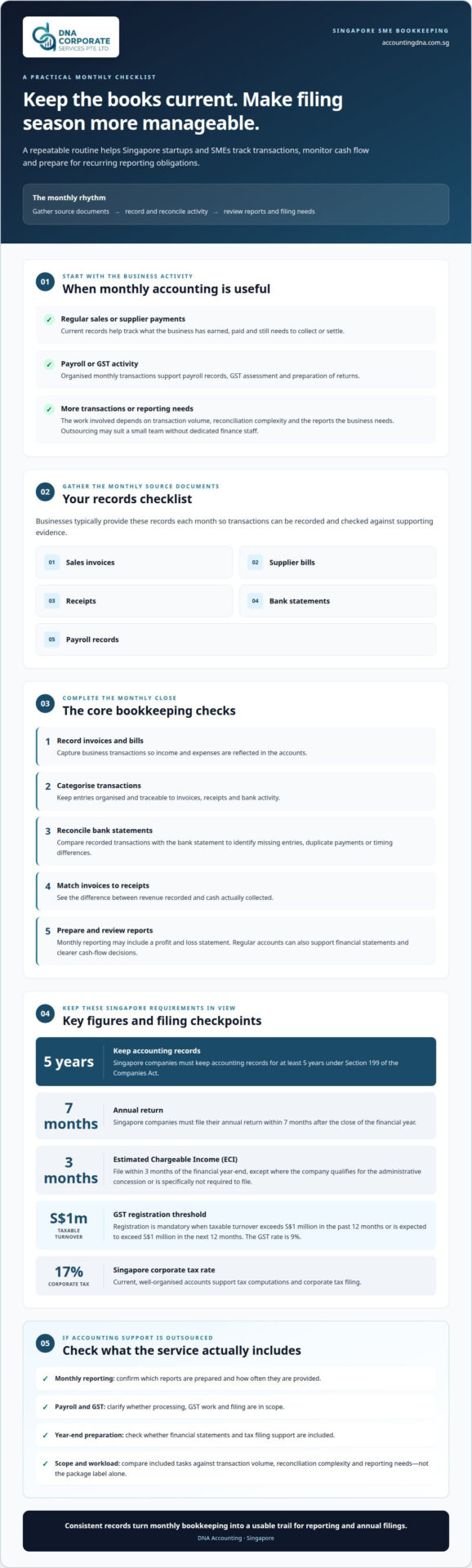
That’s especially useful for active businesses with regular sales, supplier payments, payroll or GST activity. The Inland Revenue Authority of Singapore requires companies to file Estimated Chargeable Income within three months of their financial year-end, except companies qualifying for the administrative concession and those specifically not required to file.
This guide explains who benefits from monthly accounting, how poor bookkeeping can contribute to IRAS compliance problems, and what startups and SMEs can expect from accounting support. You’ll also learn which records and routine tasks may be involved, so you can assess what fits your business.
Key Takeaways
- Assess whether your transaction volume, payroll, GST obligations and reporting needs make regular accounting support practical for your business.
- Keep accounting records organised and up to date to reduce the risk of errors, missed filing deadlines and IRAS compliance issues.
- Understand how bookkeeping, financial statements, tax filing and payroll support can help startups and SMEs make informed decisions about cash flow.
- Consider how DNA Accounting’s accounting, GST, taxation and corporate secretarial services can support your compliance needs as your business grows.
Who needs accounting services in Singapore?
Singapore companies face corporate tax at a rate of 17%, according to the Inland Revenue Authority of Singapore. Startups, owner-managed firms and SMEs with regular sales, supplier payments or payroll may need bookkeeping to track obligations and understand cash flow. Transaction volume and reporting needs determine the work involved.
GST registration is mandatory when taxable turnover exceeds S$1 million in the past 12 months or is expected to exceed S$1 million in the next 12 months, according to the Inland Revenue Authority of Singapore. The GST rate is 9%, according to the Inland Revenue Authority of Singapore. Clear sales records help businesses assess registration and prepare returns.
Monthly bookkeeping can include recording invoices and bills, categorising transactions, reconciling bank statements and preparing reports such as a profit and loss statement. Businesses typically provide sales invoices, supplier bills, receipts, bank statements and payroll records each month. Consistent records also support accurate financial statements.
Monthly bookkeeping fees depend on transaction volume, reconciliation complexity and reporting scope. Compare providers by the tasks included and reporting frequency, rather than the headline fee alone. Outsourcing can suit a small business without dedicated finance staff, while accounting software helps organise records for review. Regular reports also give directors a clearer view of cash flow and support annual financial statements and filings.
Can poor bookkeeping result in IRAS penalties?
Yes. Incomplete records can lead to inaccurate tax computations, missed submissions and difficulty substantiating figures reported to the Inland Revenue Authority of Singapore (IRAS).
Financial Record-Keeping Requirements
Singapore companies must keep accounting records for at least 5 years under Section 199 of the Companies Act, according to Singapore Statutes Online, Attorney-General’s Chambers. Keep transaction evidence organised so entries can be traced to invoices, receipts and bank activity. Missing records can make annual reporting and tax calculations less reliable. A clear filing system helps directors respond to questions about reported figures.
Bank Reconciliation and Financial Statements
Bank reconciliation compares recorded transactions with bank statements to identify missing entries, duplicate payments or timing differences. Resolve discrepancies before preparing financial statements or a year-end tax computation. Reports can then support budgeting and forecasting by showing income, expenses and cash movement. For example, a supplier payment recorded late may distort cash planning.
Monthly Records and Annual Filings
Monthly records create a usable trail for annual filings, rather than forcing the finance team to reconstruct transactions at year-end. Singapore companies must file their annual return within 7 months after the close of the financial year, according to ACRA. Timely records also support GST filing and tax submissions. For help organising the process, discuss your bookkeeping records with an accounting professional.
Accounting services for startups and SMEs
Singapore startups often begin with founder-managed records, then add accounting support as sales, supplier bills and payroll become harder to track. A useful service combines transaction recording, account reconciliation and financial reporting, giving directors a clearer view of cash flow. Matching customer invoices to receipts, for example, helps distinguish recorded revenue from cash actually collected.
Monthly accounting can turn records into a general ledger, profit and loss statement, balance sheet and cash flow statement. These reports help founders spot rising expenses before planning a new hire or purchase. For a GST-registered company, organised sales and purchase records also support accurate, timely GST filing. Corporate tax work uses the underlying accounts to prepare tax computations and filing information.
Outsourcing suits a small team that needs accurate records but has no dedicated finance employee. The scope can include bookkeeping, payroll processing, financial statements and tax filing, with responsibilities agreed around transaction volume and reporting needs. A startup hiring its first employee, for instance, may need payroll records coordinated with its wider accounts.
Choose support by matching included tasks to actual needs, not by package labels alone. Confirm whether monthly reporting, payroll, GST work and year-end preparation are in scope. A defined submission routine helps keep source documents moving and supports deadline planning. To discuss accounting support for your startup or SME, get in touch with an accounting adviser.
DNA Accounting
DNA Accounting supports Singapore startups and SMEs that need help coordinating accounts, tax work and corporate administration. Its Accounting & Bookkeeping service covers transaction recording, reconciliations and preparation of financial statements, giving directors clearer information for business decisions. For a founder catching up on overdue records or an SME preparing year-end reports, this support can make routine accounting more manageable.
When a company meets the GST registration criteria, DNA Accounting’s GST Services support registration and filing. Its Taxation Services assist with tax computations and corporate tax filing, using organised financial records to prepare submissions. Corporate Secretarial Services support corporate administration and ACRA compliance alongside financial work, not in place of it.
Consider seeking support when monthly transactions increase, payroll begins, records become difficult to reconcile, or filing deadlines approach. A discussion can clarify which tasks belong in the regular accounting routine and which arise at year-end. Directors can describe their reporting cycle, outstanding transactions, GST status and upcoming filing needs to keep the conversation focused. Support can be shaped around the business’s workload and compliance requirements, without taking on every service at once. For a no-pressure discussion about your business’s accounting and compliance needs, contact DNA Accounting.
Set Up a Steadier Accounting Routine
Turn regular bookkeeping into a routine that supports better business decisions. Consider which reports you need, how often records can be shared, and which tasks should be managed together. Monthly accounting services in Singapore are most useful when the process fits your transaction flow and provides information you can act on.
DNA Accounting provides Accounting & Bookkeeping, GST Services and Taxation Services to help businesses manage their records and related compliance work. If your accounting process feels fragmented or your reporting needs have changed as the business grows, contact the team to discuss suitable support. You don’t need to have every detail worked out before taking that step.
Contact DNA Accounting to discuss your accounting needs and take a clear next step with confidence.
Frequently Asked Questions
How much does bookkeeping typically cost for a small business in Singapore?
There is no single standard fee for every Singapore business. A clear quote should distinguish routine bookkeeping from separate work such as year-end accounts or tax submissions. Before requesting one, outline your business structure, accounting period and reporting needs. This helps define the scope clearly and compare packages covering similar work. DNA Accounting provides transparent pricing with no hidden costs.
Can a foreign-owned Singapore company outsource its bookkeeping?
Yes. A foreign-owned company operating in Singapore can outsource its bookkeeping to DNA Accounting. Set a regular handover process, including how records are shared, who answers transaction questions and how directors review reports. This keeps work organised when owners are overseas. The accounting team processes the financial information, while company leadership remains responsible for business decisions.
Can you handle GST filing and other tax-related tasks?
Yes. DNA Accounting provides GST Services and Taxation Services for Singapore companies. To scope tax work, identify the relevant filing type and gather supporting documents such as sales and purchase records, prior submissions and IRAS correspondence. Organising these materials connects reported figures to their underlying transactions and helps address questions during preparation.
Do bookkeeping services handle GST filing?
Bookkeeping and GST filing are distinct tasks, although organised books support an accurate return. For example, a credit note may affect the sales record and GST figures used in a filing. A clear process captures adjustments and keeps supporting documents with the relevant transactions, making the bookkeeping trail more useful when preparing a GST return.
What monthly accounting services are available for Singapore businesses?
Cash-basis bookkeeping may be used for internal tracking where appropriate, but it does not replace accrual-basis financial statements required under applicable Singapore accounting standards. Other options include a fixed-asset register, supplier payment tracking, customer ageing reports or accounting system setup. These tools organise operational information and help directors choose support around the records their business uses.
Disclaimer
The information provided on this website is for general informational purposes only and is not intended to constitute professional accounting, tax, legal, or financial advice. While we strive to ensure that the content is accurate and up to date, regulations in Singapore, including those administered by ACRA, IRAS, CPF Board, and MOM, may change from time to time and may differ depending on individual circumstances.
Readers should not act or rely on any information contained on this website without seeking specific advice from a qualified professional based on their individual situation.
DNA Corporate Services and its affiliates accept no responsibility or liability for any loss or damage arising from reliance on the information provided in this website or any linked materials.
For tailored advice relating to accounting, taxation, corporate secretarial, or compliance matters in Singapore, please contact us directly for professional consultation.



