

Bookkeeping software can organise the numbers, but it isn’t automatically the right choice for a foreign-owned Singapore company. Yes, foreign-owned companies in Singapore can outsource bookkeeping, and companies must retain accounting records for at least 5 years. The right setup for startup bookkeeping in Singapore depends on transaction volume, the level of financial oversight founders need and whether tax, GST and statutory filings are managed alongside the books.
It’s reasonable to start with software: it can organise transactions and keep records together. But bookkeeping also requires accurate coding, reconciliations and reliable information for compliance. This article compares software-only, outsourced and combined approaches, explains what foreign-owned companies can delegate, and shows how to choose support for tax, GST and statutory filings without adding unnecessary complexity.
Key Takeaways
- Foreign-owned Singapore companies can outsource bookkeeping; choose a service model that matches transaction complexity and the compliance support needed.
- Build tax and statutory deadlines into your finance process, including the Estimated Chargeable Income filing timeline set by IRAS.
- Use software for organising records, and weigh professional support when reconciliations, reporting or compliance require more oversight.
- When bookkeeping needs to connect with tax, GST or corporate secretarial support, DNA Accounting offers services that can bring these needs together.
Can a foreign-owned Singapore company outsource its bookkeeping?
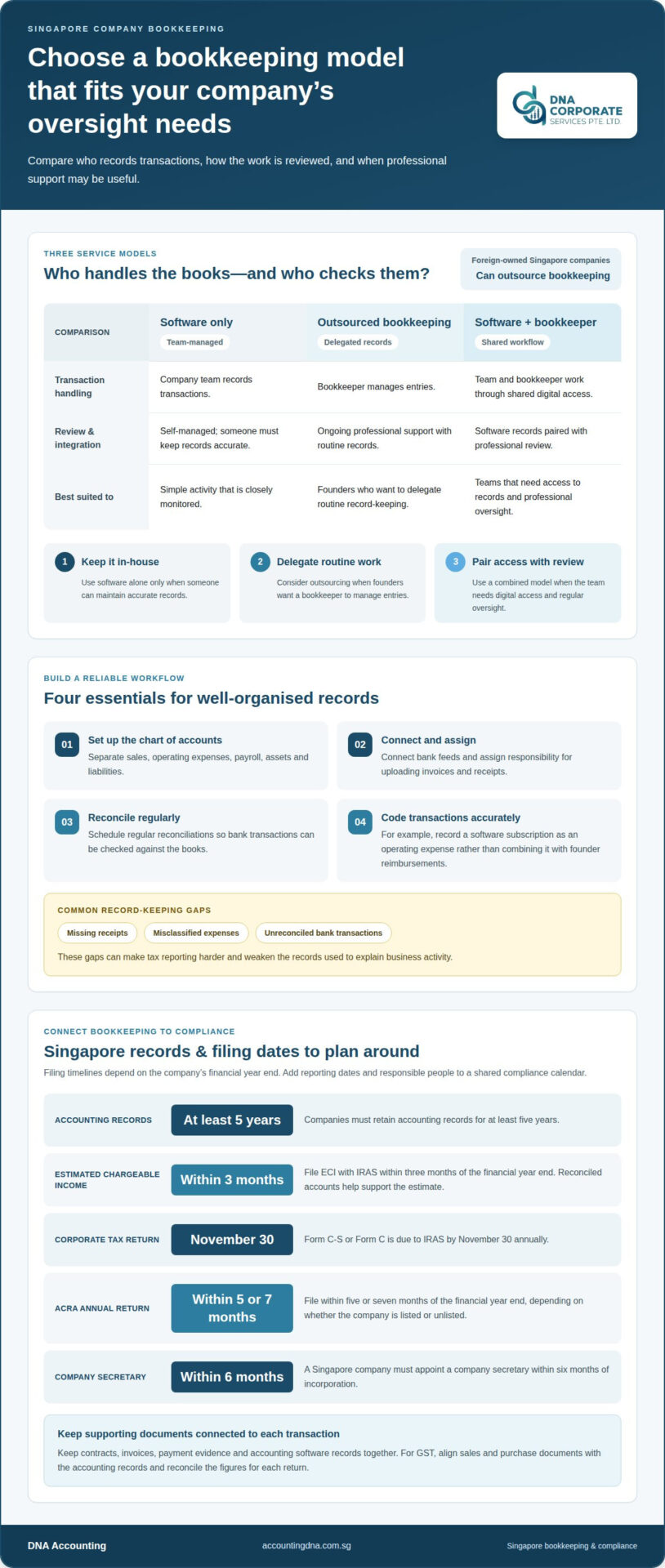
Yes. A foreign-owned Singapore company can outsource bookkeeping while directors retain responsibility for maintaining proper accounting records. Companies must keep those records for at least 5 years, and appoint a company secretary within 6 months of incorporation.
Choose a model by matching transaction complexity with the oversight you need. Cloud accounting software can capture invoices and expenses, while an outsourced bookkeeper can manage regular coding and reconciliations. A combined model pairs software access with professional review, helping connect bookkeeping to annual reporting. For a foreign team, clear document access and regular reporting also make it easier to track the company’s Singapore position.
Set up the chart of accounts around actual business activity, separating sales, operating expenses, payroll, assets and liabilities. Connect bank feeds, assign responsibility for uploading invoices and receipts, and schedule regular reconciliations. For example, record a software subscription under operating expenses rather than combining it with founder reimbursements.
Common risks include missing receipts, misclassified expenses and unreconciled bank transactions. These gaps make tax reporting harder and weaken the records needed to explain business activity.
| Service model | Transaction handling | Review and integration | Best suited to |
|---|---|---|---|
| Software only | Company team records transactions | Self-managed | Simple, closely monitored activity |
| Outsourced bookkeeping | Bookkeeper manages entries | Ongoing professional support | Founders delegating routine records |
| Software plus bookkeeper | Shared digital workflow | Software records with professional review | Teams needing access and oversight |
Choose software alone only if someone can keep the records accurate. Consider outsourced or combined support when transaction reviews, tax coordination or corporate-service integration need regular attention.
Corporate tax, GST and statutory filing
Tax and statutory deadlines depend on your company’s financial year end, so connect monthly bookkeeping to a filing calendar. Singapore companies must file Estimated Chargeable Income within 3 months of their financial year end, according to the Inland Revenue Authority of Singapore. ECI reports the company’s estimated taxable income to IRAS; timely, reconciled accounts help support that estimate.
Corporate tax filing also requires complete income and expense records. Singapore corporate tax returns, Form C-S or Form C, are due to IRAS by November 30th annually. Missing receipts or invoices can leave expenses unsupported during a tax query, and IRAS may disallow deductions when documentation is missing. Keep contracts, invoices, payment evidence and accounting software records together for each transaction.
GST filing needs a clear supporting record. Keep sales and purchase documents aligned with the accounting records, then reconcile the figures for each return. If sales and expenses are recorded in separate systems, transactions can be missed or duplicated. A consistent monthly close helps identify gaps before filing deadlines.
ACRA annual returns are a separate obligation from corporate tax returns. Singapore companies must file Annual Returns with ACRA within 5 or 7 months of their financial year end, depending on whether they are listed or unlisted. At incorporation, add the company’s reporting dates and responsible person to a shared compliance calendar, then update it when the financial year changes.
For example, a startup closing its books monthly can prepare income and expense records before year-end rather than reconstructing them at filing time. Discuss support for tax and GST filing if your team needs help coordinating accounts, supporting documents and deadlines.
Bookkeeping software versus professional support
When comparing startup bookkeeping in Singapore, look beyond software features or the number of included tasks. Ask how each approach handles exceptions, such as a supplier credit, a foreign-currency charge or a transaction that does not match its supporting document. Software can display an entry, but someone still needs to determine what it means for the company’s records.
Assess the workflow against practical needs before choosing a package. Can the finance team retrieve supporting documents alongside entries? Can directors review useful reports without relying on a separately prepared spreadsheet? Is there a clear process for correcting an entry while preserving its history? These details affect how easily the company can understand its figures and explain unusual items later.
Professional review can improve how financial information is interpreted. A bookkeeper may spot a recurring cost coded inconsistently, while software may simply repeat the category selected by the user. That difference matters when founders use monthly figures to assess cash commitments or identify operating costs that need attention.
Use these criteria to compare the actual working experience:
- Exception handling: who investigates entries that don’t fit the usual pattern?
- Document access: how quickly can the team connect an entry to its supporting paperwork?
- Decision support: do reports answer the director’s questions about cash flow and spending?
A startup bookkeeping process in Singapore should suit the team’s ability to review exceptions and use its reports. If routine entries are clear but unusual items keep accumulating, professional review can help without changing how staff record everyday transactions.
Discuss bookkeeping support for your startup if you want to consider which approach fits your workflow.
DNA Accounting: Accounting & Bookkeeping
DNA Accounting supports Singapore startups with bookkeeping and coordination between financial records and compliance work. Its Accounting & Bookkeeping service organises business transactions, while GST Services and Taxation Services address related filing needs. Corporate Secretarial Services can support company administration alongside the finance function.
Consider professional support when transaction reviews are falling behind, records are difficult to use for tax preparation, or bookkeeping and filing processes need to work together. A coordinated approach can give founders a clearer view of operating expenses and keep records useful throughout the year.
Contact DNA Accounting to discuss bookkeeping support for your Singapore company.
Set up a finance process that can grow with your startup
Your bookkeeping setup should support future decisions, not just record past activity. As your Singapore company adds customers, hires staff or changes how it operates, revisit who manages transaction records, how financial information reaches decision-makers and when professional review is useful. A startup bookkeeping arrangement in Singapore should fit your current workflow while leaving room to adapt.
DNA Accounting provides Accounting & Bookkeeping, GST Services and Taxation Services for related financial and filing needs. A clear process for managing these tasks can reduce the time founders spend coordinating records and help them use reliable financial information to plan business activity.
Discuss your bookkeeping needs with DNA Accounting and take a considered next step for your company’s finances.
Frequently Asked Questions
How much does bookkeeping typically cost for a small business in Singapore?
There is no single fee for every Singapore small business. The scope of bookkeeping depends on transaction volume, the condition of the records, reporting frequency and whether the work includes tasks such as payroll or tax coordination. DNA Accounting offers affordable, transparent pricing with no hidden costs. Request a quote to understand the scope for your business.
What are bookkeeping services for startups?
Bookkeeping records and organises a startup’s financial transactions so its business activity can be reviewed clearly. This can include entering sales and expenses, matching bank activity to records and preparing organised information for reporting. For example, a customer invoice, its later payment and the related bank entry can be tracked as connected parts of one transaction.
What is the difference between bookkeeping and accounting in Singapore?
Bookkeeping records and organises day-to-day transactions; accounting uses those records to interpret financial performance and prepare reports. For a Singapore startup, bookkeeping might capture supplier invoices and customer payments, while accounting uses that information to assess income, expenses and financial position. Accurate bookkeeping gives accounting work a dependable starting point.
What bookkeeping records must Singapore startups keep under ACRA and IRAS rules?
Singapore startups should keep records that explain their transactions, including sales and purchase invoices, receipts, bank statements and supporting documents for expenses. These records help substantiate tax figures and clarify how entries were recorded. For example, keep the supplier invoice and payment evidence together so the expense can be traced from the original document to the company’s accounts.
How long must Singapore companies retain accounting and tax records?
Singapore companies must retain accounting records for at least 5 years. Keep tax-related supporting documents with the relevant accounting entries, such as records explaining a claimed business expense. An organised digital filing structure can help directors retrieve documents for a tax query or reporting review. Retention applies to the underlying evidence, not just the final accounting reports.
Disclaimer
The information provided on this website is for general informational purposes only and is not intended to constitute professional accounting, tax, legal, or financial advice. While we strive to ensure that the content is accurate and up to date, regulations in Singapore, including those administered by ACRA, IRAS, CPF Board, and MOM, may change from time to time and may differ depending on individual circumstances.
Readers should not act or rely on any information contained on this website without seeking specific advice from a qualified professional based on their individual situation.
DNA Corporate Services and its affiliates accept no responsibility or liability for any loss or damage arising from reliance on the information provided in this website or any linked materials.
For tailored advice relating to accounting, taxation, corporate secretarial, or compliance matters in Singapore, please contact us directly for professional consultation.



