

Your company’s tax bill depends on more than Singapore’s headline corporate tax rate. For Singapore corporate tax filing, the key is understanding how deductible expenses, capital allowances and tax reliefs affect chargeable income, while meeting filing requirements on time. According to the Inland Revenue Authority of Singapore (IRAS), companies generally must file Estimated Chargeable Income (ECI) within three months after the end of the financial year, unless annual revenue is below S$5,000,000 and ECI is zero; the standard corporate income tax rate is 17%.
It’s understandable to focus on Singapore’s corporate tax rate, but deductible business expenses and reliefs also affect how much a company owes. This guide explains how tax rates, eligible costs, allowances and reliefs fit together, as well as what the ECI requirement means for filing. Use it to understand the process and discuss your company’s tax position with greater confidence.
Key Takeaways
- Separate ordinary business costs from capital purchases to understand which expenses may reduce taxable income and which may qualify for capital allowances.
- Check whether your company meets the conditions for start-up or partial tax exemptions before estimating its tax payable.
- Qualifying donations to approved IPCs may receive a 250% tax deduction, so the recipient and supporting records matter.
- Professional tax support can help align your accounts, tax calculations and ECI filing, especially when reliefs or exemptions apply.
Singapore corporate income tax rate
Singapore’s standard corporate income tax rate is 17%, according to the Inland Revenue Authority of Singapore (IRAS). The rate applies to chargeable income after tax adjustments, not automatically to gross revenue. Accounting records help separate taxable income from deductible costs and reliefs before the company’s tax position is calculated.
Eligible new companies may receive a 75% tax exemption on the first S$100,000 of normal chargeable income under SUTE for their first three years of assessment, according to IRAS. Eligibility conditions apply, so incorporation alone does not establish entitlement. A professional reviews the company’s structure, activities and income when assessing whether the exemption applies.
Singapore companies generally need to file an annual income tax return. A company generally must file ECI within three months after its financial year-end, unless its annual revenue is below S$5,000,000 and its ECI is zero, according to IRAS. A tax professional can prepare the tax computation, review applicable reliefs and submit the relevant filings. Personal income tax is separate; individual e-filing usually runs from 1 March to 18 April each year.
Companies in Singapore must file an annual corporate income tax return with IRAS. GST filing is separate: it reports GST collected and claimed, while the corporate tax return concerns the company’s taxable income.
Late corporate tax filing is punishable. Directors may be fined up to S$10,000 or prosecuted. Accurate records and timely filing help the company meet its reporting obligations.
Business expenses, allowances and reliefs
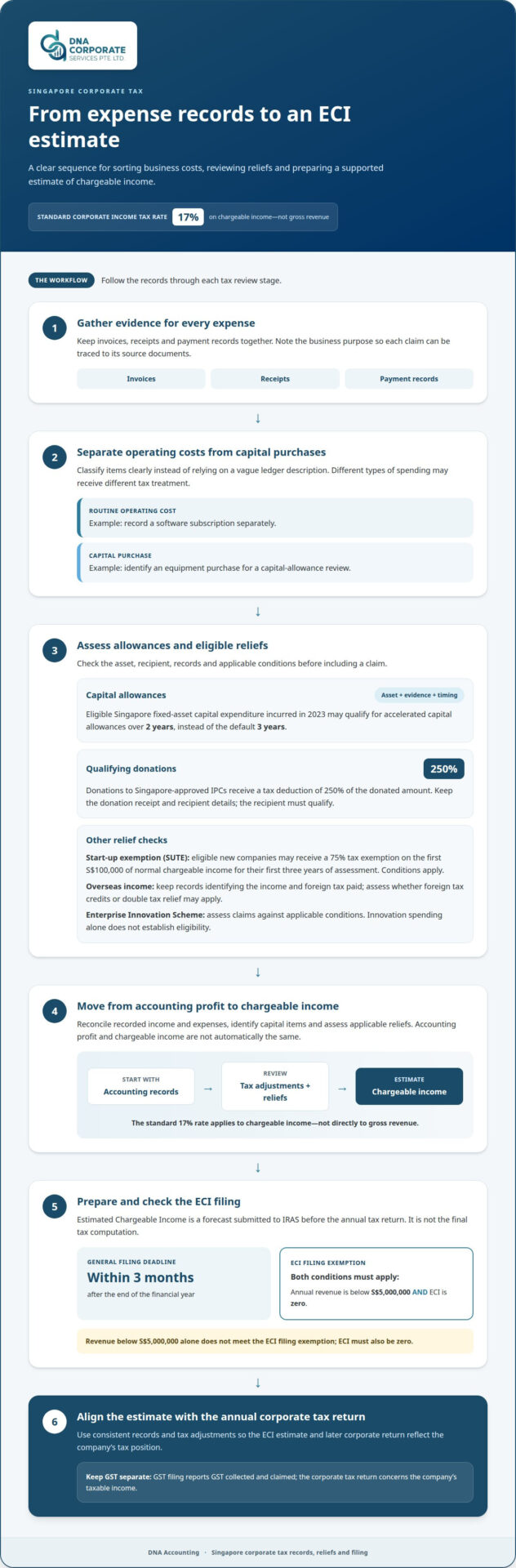
Start tax preparation with records that explain each expense. Keep invoices, receipts and payment records, and note the business purpose. Record a software subscription separately from an equipment purchase so the tax preparer can assess each item’s treatment instead of relying on a vague ledger description. Consistent bookkeeping also makes it easier to trace expense claims back to source documents.
Capital purchases may qualify for capital allowances instead of being treated like routine operating expenses. Eligible Singapore fixed-asset capital expenditure incurred in 2023 may qualify for accelerated capital allowances over two years instead of the default three years. The asset, purchase evidence and timing of expenditure are relevant when assessing the claim.
Qualifying donations to Singapore-approved IPCs receive a tax deduction of 250% of the donated amount. Keep the donation receipt and recipient details with the company’s tax records. The recipient matters: a donation should not be treated as qualifying solely because it supports a charitable cause.
For income taxed overseas, keep records that identify the income and foreign tax paid. A tax preparer can assess whether foreign tax credits or double tax relief may apply under the relevant rules. Assess Enterprise Innovation Scheme claims against the applicable conditions before claiming relief. Innovation spending alone does not establish eligibility.
For help organising expense records and assessing reliefs, discuss your company’s tax requirements.
Estimated Chargeable Income (ECI) filing and exemptions
An ECI filing gives IRAS an estimate of chargeable income before the annual tax return. It is a forecast, not the final tax computation. A tax professional starts with the company’s accounting records and reviews adjustments that affect taxable profit.
The review links the estimate to supporting evidence. A professional may reconcile recorded income and expenses, identify capital items, and assess applicable reliefs. This helps distinguish accounting profit from chargeable income and gives directors a clearer basis for the estimate submitted to IRAS.
ECI is generally due within three months after the financial year-end. A Singapore company with annual revenue below S$5,000,000 and zero ECI is exempt from filing it, according to the Inland Revenue Authority of Singapore. Revenue alone does not establish this exemption: the ECI must also be zero. A professional can assess both conditions using the company’s records.
Exemptions affect the final tax calculation, so the ECI estimate should reflect relevant adjustments rather than simply applying the corporate rate to accounting profit. The standard rate is 17%, but chargeable income and applicable reliefs shape the resulting tax position. Professional review can also align the ECI estimate with the later corporate return, reducing inconsistencies between submissions.
For an estimate based on your company’s records and reliefs, discuss your ECI filing.
DNA Accounting
DNA Accounting supports businesses in Singapore with accounting records and corporate tax filings. Turn to the team when expense classifications, tax reliefs or ECI estimates need professional review, or when filing responsibilities are taking time away from running your business.
Accounting and bookkeeping support helps maintain the records used for tax calculations, while taxation services cover corporate tax filing and related compliance. GST services address a separate filing requirement, and corporate secretarial services support company administration. Coordinating these responsibilities helps you prepare accurate filings from reliable business records.
If you’d like support with your company’s tax and accounting needs, contact DNA Accounting.
Make your next tax decision with clarity
For a Singapore company, accurate bookkeeping gives directors a reliable basis for corporate tax reporting. Keep invoices, expense records and accounting entries aligned, and review changes in business activity or spending before preparing the tax return. This helps identify missing information early and reduces the risk of inconsistent reporting.
Where finance staff are stretched or a transaction is unclear, arrange a review before filing. A professional can help check whether the records support the company’s tax position and flag items that need further attention.
If you need help reviewing your company’s records, contact DNA Accounting for tax support.
Frequently Asked Questions
What are the Singapore corporate income tax rates, exemptions, and rebates for the current tax year?
The standard rate and SUTE relief are explained above; for the current filing, identify the relevant Year of Assessment (YA) and apply only incentives available for that YA. Don’t assume a Budget 2024 rebate carries into another YA. A tax professional can assess the company’s eligibility and taxable-income basis against the rules applicable to its return.
What are the deadlines for filing Form C-S, Form C-S (Lite), or Form C in Singapore?
The annual e-filing deadline is the date stated in the main section. Form C-S (Lite) is for companies with annual revenue of S$200,000 or less. Form C-S may suit eligible companies with annual revenue of S$5,000,000 or less; Form C is used for other cases, including companies with more complex deductions. The right form depends on the company’s circumstances.
How can a tax professional estimate and pay a Singapore company’s corporate income tax, including ECI requirements?
A tax professional reconciles the company’s accounting records with its tax computation, then compares the ECI estimate with the completed return and IRAS assessment. This helps identify changes in taxable income and reliefs before payment is arranged. Directors should also review the assessment and payment status to address any difference between the estimate and final amount promptly.
What documents and financial statements are needed to prepare a Singapore corporate tax return?
Provide the signed financial statements, trial balance, general ledger, bank statements, sales records and expense invoices. Where relevant, include supporting schedules for fixed assets, shareholder or director transactions, donations and overseas tax paid. An equipment invoice, for example, helps explain an asset entry, while a donation receipt identifies the recipient and amount when assessing a deduction.
How can a tax professional file a Singapore company’s corporate income tax return through myTax Portal?
The professional prepares the tax computation, confirms the return details and selects the applicable form before submitting it electronically through myTax Portal. The company provides accurate financial information and the authorization needed for filing. After submission, retain the acknowledgement and review later IRAS correspondence, including any assessment or request for clarification, so follow-up is not overlooked.
Disclaimer
The information provided on this website is for general informational purposes only and is not intended to constitute professional accounting, tax, legal, or financial advice. While we strive to ensure that the content is accurate and up to date, regulations in Singapore, including those administered by ACRA, IRAS, CPF Board, and MOM, may change from time to time and may differ depending on individual circumstances.
Readers should not act or rely on any information contained on this website without seeking specific advice from a qualified professional based on their individual situation.
DNA Corporate Services and its affiliates accept no responsibility or liability for any loss or damage arising from reliance on the information provided in this website or any linked materials.
For tailored advice relating to accounting, taxation, corporate secretarial, or compliance matters in Singapore, please contact us directly for professional consultation.



