

The lowest quote may leave important work outside its scope. 新加坡会计服务收费, or Singapore accounting service fees, depend on the support required, including bookkeeping volume, reporting frequency, payroll processing, and whether GST or corporate tax work is needed.
It’s reasonable to want a clear picture of what you’re paying for before choosing support. This guide explains how service scope and business activity affect fees, and how to distinguish bookkeeping from related tax, GST, and payroll work. It also outlines what to consider when assessing support for your Singapore business, so you can focus on the services your records and reporting actually require.
Key Takeaways
- Match the provider’s scope to your company’s activity and reporting needs, not just the headline fee.
- Separate bookkeeping from tax filing, GST returns and payroll so you can see which work your business requires.
- Understand how transaction volume and service frequency shape bookkeeping support and the records it covers.
- Use a clear view of your reporting needs to decide when professional accounting support can simplify compliance.
Choosing an accounting service provider in Singapore
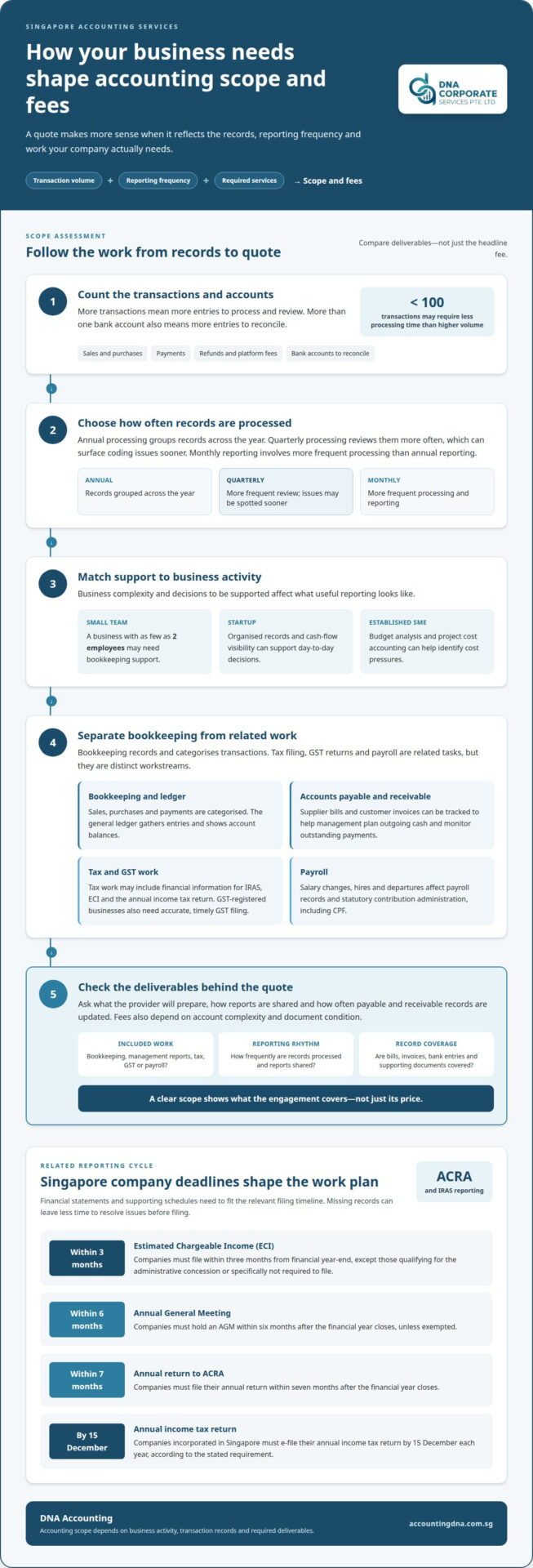
新加坡会计服务收费 depends on transaction volume, reporting frequency, business complexity, and the work included. More transactions mean more entries to review, while monthly reporting involves more frequent processing than annual reporting. A provider’s scope may also include tax work or payment tracking. Compare the deliverables, not just the quote label, and ask how reports are prepared and shared.
Start with your operating needs. Businesses with as few as 2 employees may need bookkeeping support. A startup may need organised records and cash-flow visibility. An established SME may need budget analysis and cost accounting by project. These services help directors understand spending, compare actual results with plans, and identify cost pressures. Choose a provider whose reporting answers the decisions your team makes.
Outsourcing can suit startups, SMEs, and foreign entrepreneurs without an in-house finance team. It gives them access to accounting support while internal staff focus on sales or operations. It can also help keep records consistent across reporting periods. Scope still matters: decide whether the arrangement covers bookkeeping, management reports, or both. Singapore’s ACRA and IRAS requirements make clear records useful for company reporting and tax work.
Check whether accounts payable and receivable are included. For example, a retailer may need supplier bills recorded and customer invoices tracked. Payable records help management plan outgoing cash, while receivable tracking shows which customer payments remain outstanding. These records can inform cash-flow planning. Ask how often the provider updates them and shares reports, then assess whether that arrangement suits your operations.
Tax filing, reporting, and payroll processing
Yes, Singapore filing deadlines shape the work and timing. All companies must file Estimated Chargeable Income (ECI) within three months from financial year-end, except those qualifying for the administrative concession or specifically not required to file. Companies incorporated in Singapore must e-file their annual income tax return by 15 December each year, according to the stated requirement.
Annual reporting also involves ACRA. Companies must file their annual return within 7 months after the financial year closes. Unless exempted, they must hold an Annual General Meeting within 6 months after that close. These dates affect how financial statements and supporting schedules fit into the reporting cycle. Late preparation can leave less time to resolve missing records before filing. For SMEs that require statutory audit services to meet their annual reporting obligations, auditfirm.sg helps businesses complete their audit requirements.
Tax work may include preparing financial information for IRAS, the ECI submission, and the annual income tax return. GST-registered businesses also need accurate, timely GST filing. For example, a retailer’s sales records and credit notes help support the figures reported for a GST period. The records and filing tasks are related, but each submission has its own requirements.
Payroll processing has a separate recurring workflow. Salary changes, new hires, and departures affect payroll records and statutory contribution administration, including CPF. A consistent process helps keep employee information aligned with each pay period. For support with filing or payroll requirements, contact DNA Accounting.
Bookkeeping and general ledger services
Bookkeeping records sales, purchases, and payments, assigning each transaction to an account category. The general ledger gathers these entries and shows balances across accounts, such as rent and inventory. Clear categories help explain operating results and support financial reporting for directors. They also make it easier for Singapore businesses to trace transactions and understand what each balance represents. Accurate entries matter.
Transaction volume affects processing effort. For example, a business with fewer than 100 transactions may need less processing time than one with higher volume. Annual and quarterly schedules differ. Annual processing groups records across the year. Quarterly processing reviews them more often. More frequent reviews can surface coding issues sooner. Sales channels also shape ledger work. An online seller may process refunds, platform fees, and sales. Each transaction needs proper categorisation. Multiple bank accounts also mean more entries to reconcile.
Bank reconciliation compares ledger entries with bank statements. If a statement shows a payment missing from the ledger, the bookkeeper identifies the difference and records it appropriately. This helps keep reported balances aligned with account activity. Supplier invoices and customer receipts need similar attention: recording an invoice as paid too early can distort cash balances. Consistent documentation supports accurate records for reporting to IRAS and ACRA.
Fees reflect transaction volume and account complexity. Reporting frequency and document condition also matter. Pricing depends on the case. A quote can be provided after reviewing your requirements. For a service scope built around your records, explore bookkeeping and accounting support. To discuss your bookkeeping needs, contact DNA Accounting.
DNA Accounting
DNA Accounting supports Singapore businesses with accounting, tax, GST, and corporate secretarial work. Turn to the firm when transaction records, filing tasks, or company administration need professional attention. Accounting & Bookkeeping services help organise financial records, while GST Services and Taxation Services support related filing work. Corporate Secretarial Services cover statutory registers, minute books, and required filings with ACRA.
The right scope depends on your business activity, transaction records, and required deliverables. Fees are quoted based on the case, with factors such as transaction volume, reporting frequency, and required services shaping the scope. A transparent quote with no hidden costs gives directors a clear basis for understanding what the engagement covers.
For support suited to your company’s accounting needs, contact DNA Accounting.
Set a Clear Scope for Your Next Step
As your Singapore business grows, its finance needs may change with new markets, funding plans, or shifts in revenue. Revisit your accounting arrangements when those changes arise. Understanding 新加坡会计服务收费 can help frame that discussion, but the key is having reliable financial information to support planning.
DNA Accounting provides Accounting & Bookkeeping, GST Services, and Taxation Services for businesses in Singapore. Contact the firm to discuss your company’s needs and get a transparent quote with no hidden costs.
Frequently Asked Questions
What are typical accounting service fees in Singapore for small businesses?
There isn’t one standard fee for every Singapore small business. A quote depends on the work required, whether support is recurring or limited to a particular reporting task, and the company’s accounting needs. Treat a quoted fee as the cost of defined deliverables, rather than a universal rate. Fees are provided after a quote request.
How much do Singapore accountants charge for monthly bookkeeping?
Monthly bookkeeping fees depend on the engagement and accounting method. Cash-basis records recognise transactions when money moves; accrual-basis records recognise income and expenses when they arise. Because the methods organise activity differently, they affect the bookkeeping work required. For a monthly engagement, the agreed scope should specify the accounting method and the period covered.
What are the costs of annual financial statements and tax filing in Singapore?
There is no single fee for every company’s annual statements and tax return. The quote depends on the requested deliverables and reporting needs. Preparation of unaudited financial statements and tax return preparation are distinct services, even when they use the same financial records. DNA Accounting provides affordable, transparent pricing with no hidden costs.
How much do GST registration and GST return filing cost in Singapore?
GST registration and return filing are separate services. Registration concerns the application process; return filing concerns reporting GST for a period. A business seeking support with both should treat them as separate deliverables in the requested scope.
What are typical payroll processing fees per employee in Singapore?
Payroll processing fees depend on the agreed payroll scope and employee information handled. A service may cover a monthly payroll summary, payslips, and CPF contributions, with additional reporting such as IR8A or IR21 where applicable. These deliverables help define what processing includes.
Disclaimer
The information provided on this website is for general informational purposes only and is not intended to constitute professional accounting, tax, legal, or financial advice. While we strive to ensure that the content is accurate and up to date, regulations in Singapore, including those administered by ACRA, IRAS, CPF Board, and MOM, may change from time to time and may differ depending on individual circumstances.
Readers should not act or rely on any information contained on this website without seeking specific advice from a qualified professional based on their individual situation.
DNA Corporate Services and its affiliates accept no responsibility or liability for any loss or damage arising from reliance on the information provided in this website or any linked materials.
For tailored advice relating to accounting, taxation, corporate secretarial, or compliance matters in Singapore, please contact us directly for professional consultation.



