

Even a small team has real accounting responsibilities. A Singapore business with only two employees still needs proper bookkeeping and record-keeping. Outsourced accounting in Singapore can help keep financial records organised as the business grows.
It’s understandable to focus on day-to-day operations, but missed entries, sensitive-data concerns, and tax or payroll tasks can quickly add pressure. This article explains how outsourced support can cover bookkeeping, handle financial data carefully, and coordinate tax filing and payroll in Singapore. You’ll also learn what information an accounting professional needs and what to consider when choosing support, so you can make a clear decision while keeping compliance and your team’s time in view.
Key Takeaways
- Understand how outsourced bookkeeping keeps business transactions organised and gives directors clearer financial records.
- Learn what confidentiality and careful data handling mean when sharing financial information with an accounting professional.
- See how tax filing and payroll support can help coordinate recurring finance tasks within Singapore’s regulatory environment.
- Find out when DNA Accounting’s bookkeeping, GST, taxation or corporate secretarial services may fit your business needs.
Bookkeeping and general ledger services
Outsourced bookkeeping records transactions and organises ledger balances. A clear scope keeps reporting focused.
Service Setup and Scope
Setup starts with transaction volume, business activity, and reporting needs. The provider maps tasks before work begins. Typical work includes recording sales and expenses, reconciling bank entries, and maintaining ledger accounts. Even a Singapore business with two employees needs proper bookkeeping. Agree on deliverables, reporting frequency, responsibilities, and record access in the contract. Fees depend on scope and transaction complexity. Bookkeeping is not an audit. Statutory audit work is separate.
Outsourced Versus In-House Accounting
An in-house accountant works within your organisation and handles assigned finance tasks. Outsourcing gives your business accounting support under an agreed scope. The choice depends on transaction volume, reporting needs, and how closely directors want to oversee daily work. Outsourced support can cover ledger maintenance, account reconciliation, and reporting, with tax filing and payroll included where agreed. Compare the tasks covered, responsibilities, and how questions are handled. A startup with occasional transactions may prefer defined external support. A larger finance function may value an employee working closely with internal teams.
Accounting and Record-Keeping Requirements
Singapore’s Companies Act requires companies to keep proper accounting records. ACRA oversees company registration and statutory filing matters. Records should support the transactions behind ledger balances and financial statements. For example, a recorded supplier expense should be traceable to its invoice and payment record. An accounting provider can organise entries and identify missing documents for follow-up. Agree how records are prepared and reviewed. Directors should distinguish bookkeeping from statutory audit work, which is separate. This clarity helps prevent confusion about who prepares records and who provides an independent audit opinion.
Data security and confidentiality
Accounting files can contain sensitive information, including invoices and bank statements. Payroll records may contain employee details. For example, a Singapore retailer may share supplier invoices with its accounting provider. Agree on file-transfer methods before work starts. Define who uploads, views, and approves files, and limit access to people assigned to accounting tasks. Remove permissions when roles change.
Risks include exposed files, incorrect entries, and delayed corrections when responsibilities are unclear. Reduce these risks with written access rules. Name the contacts responsible for uploads and approvals, record corrections and incidents, and document approvals for director review. These steps clarify accountability if a file is misplaced or an entry needs correction.
AI can collect files and extract fields such as dates, totals, and supplier names. Automation can reduce manual data entry, but it does not replace review. Blurry scans can produce incorrect figures, and duplicate uploads can create duplicate entries. Require human review of exceptions, compare extracted fields with original invoices, and keep source files accessible alongside recorded entries. Record corrections and define which tasks AI performs and who approves final entries. Clarify how external processing, access, and retention are handled.
Before engagement, define file formats and reporting channels. Agree how long files remain accessible. Confirm how access ends at handover. Separate payroll and bookkeeping permissions. Log approvals and changes for traceability. Route unusual items to an authorised reviewer. A sample document can reveal extraction errors early. For a clear document-handling workflow, discuss accounting support.
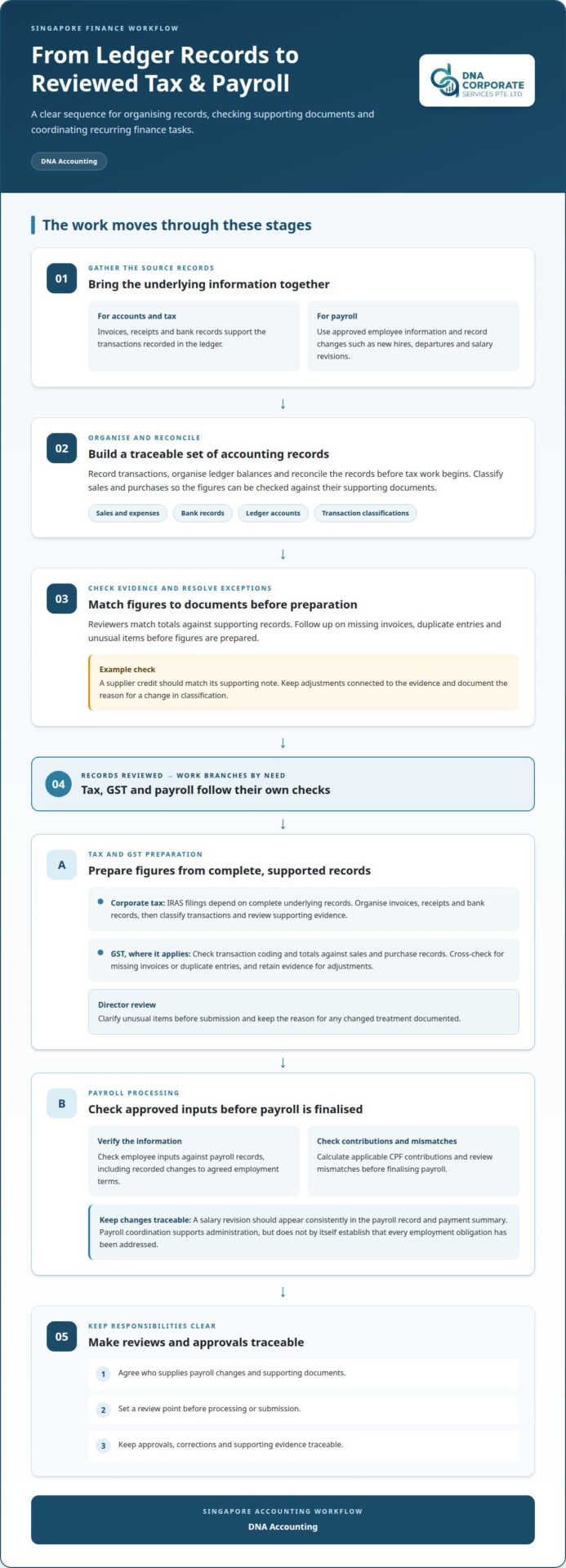
Tax filing and payroll processing
Tax work starts with reconciled ledgers. Accountants organise invoices, receipts, and bank records, then classify transactions before preparing tax figures. Reviewers match totals against supporting documents so missing invoices can be resolved before filing. For corporate tax, IRAS filings depend on complete underlying records. Flag unusual entries for review. For example, a supplier credit should match its supporting note. Traceable records help explain adjustments in the accounts.
GST work also depends on accurate sales and purchase records. Where GST applies, documents support return preparation and review. An accountant checks transaction coding and totals. Cross-checking can reveal duplicate entries or missing invoices. Keep adjustments connected to their supporting evidence. Directors can clarify unusual items before submission. A change in transaction classification may affect the figures reported, so document the reason for the treatment.
Payroll processing uses approved employee information, including changes such as new hires, departures, and salary revisions. Payroll staff check inputs against payroll records and calculate applicable CPF contributions. MOM-related employment requirements also matter: payroll inputs should reflect the employee’s agreed terms and recorded changes. For example, a salary revision should appear consistently in the payroll record and payment summary. Review mismatches before finalising payroll. This coordination supports payroll administration, but does not by itself establish that every employment obligation has been addressed.
Agree on who supplies payroll changes and supporting documents. Set a review point before processing. Keep approvals and corrections traceable. This helps directors identify unresolved items early. For support coordinating payroll and statutory contributions, discuss your payroll requirements with the team.
DNA Accounting
DNA Accounting supports Singapore businesses with accounting and related reporting needs. Turn to the team when bookkeeping, tax work, or company administration is taking focus away from running the business. Its Accounting Services, GST Services, Taxation Services, and Corporate Secretarial Services can address related finance and compliance tasks through a clear scope of work.
For example, a startup may need organised bookkeeping alongside GST support, while an established company may want help coordinating tax and corporate secretarial matters. The next step is to outline your business activity, current records, and the support you need. This gives the discussion a practical starting point, without assuming every company needs the same arrangement. Contact DNA Accounting to discuss your requirements.
Set Up Support for Your Next Stage
Choose outsourced accounting in Singapore based on the decisions your business needs to make next. A growing company may need clearer financial oversight, while a founder may want more time for customers and operations. Define the work you want handled and how you’ll stay informed. That gives the discussion a practical focus without assuming every business needs the same arrangement.
DNA Accounting offers Accounting & Bookkeeping, GST Services, and Taxation Services. These can support businesses seeking coordinated help with core finance tasks. Share your current priorities and where your process feels stretched, then discuss a scope that fits your operations. A clear starting point makes it easier to plan steady support as the business develops.
Contact DNA Accounting today to discuss your accounting needs and take a confident next step.
Frequently Asked Questions
How much does outsourced accounting cost in Singapore?
There’s no single standard fee for every Singapore company. Request a written quote from DNA Accounting that identifies the proposed work and billing basis. Before accepting, review the quote’s terms, compare the scope with your reporting needs, and clarify how changes in business requirements may affect the engagement.
What factors affect bookkeeping and accounting outsourcing fees in Singapore?
The work involved can vary depending on whether the engagement includes management accounts, financial statements, or GST support. The condition of opening balances and any prior-period entries that need correction can also affect the scope. For example, a business changing accounting systems may need transition work before routine reporting begins.
What should businesses look for when choosing an accounting outsourcing provider in Singapore?
Look for relevant Singapore experience, clear engagement terms, and professional standards. DNA Accounting is registered with ACRA and adheres to the ISCA Code of Professional Conduct and Ethics. Ask how accounting questions are reviewed and escalated. A written scope should also distinguish bookkeeping and tax preparation from statutory audit work.
What are the steps to outsource accounting for a Singapore company?
First, decide which accounting tasks and reports your directors need. Next, agree on the financial year covered, starting balances, accounting categories, and who approves key reports. The provider can map existing records into the agreed process and establish recurring review points. Set a handover date that avoids gaps between the previous and new arrangements.
How does outsourced accounting support Singapore GST filing and corporate tax compliance?
An accounting provider can organise records for GST returns and corporate tax computations, while IRAS remains the relevant tax authority. IRAS requires ECI filing within three months after the financial year-end, except for qualifying companies under the administrative concession and those specifically not required to file. Singapore-incorporated companies must e-file annual income tax returns by 15 December each year. Late or inaccurate GST filing can result in penalties.
Disclaimer
The information provided on this website is for general informational purposes only and is not intended to constitute professional accounting, tax, legal, or financial advice. While we strive to ensure that the content is accurate and up to date, regulations in Singapore, including those administered by ACRA, IRAS, CPF Board, and MOM, may change from time to time and may differ depending on individual circumstances.
Readers should not act or rely on any information contained on this website without seeking specific advice from a qualified professional based on their individual situation.
DNA Corporate Services and its affiliates accept no responsibility or liability for any loss or damage arising from reliance on the information provided in this website or any linked materials.
For tailored advice relating to accounting, taxation, corporate secretarial, or compliance matters in Singapore, please contact us directly for professional consultation.



