

ACRA filing can turn a set of prepared accounts into a formatting challenge. Professional Singapore financial statement preparation applies the relevant Singapore Financial Reporting Standards (SFRS) and prepares the statements in the XBRL format required for filing. Singapore’s revised XBRL filing requirements have applied since 1 May 2021.
For a director or finance manager searching for 新加坡财务报表编制, the key is to prepare accurate statements using the right reporting framework and company records. This guide explains how a professional prepares the statements, handles the XBRL step, and supports a clear, consistent filing with ACRA. It also covers the information to provide and when accounting support can help.
Key Takeaways
- Learn how a company’s circumstances and reporting period guide the choice of financial reporting framework.
- GST filing frequency depends on the accounting period applicable to the business; keep records aligned with each IRAS F5 return. According to the Inland Revenue Authority of Singapore, the GST rate is 9%.
- Understand how financial statement information is prepared for ACRA filing in the required XBRL format.
- Find out which company filing obligations apply and what records support a clear, consistent submission.
Singapore financial reporting requirements and SFRS
Set the reporting framework first. It shapes the statements, supporting schedules, and tax review.
-
Choose the Right Financial Reporting Framework with Professional Advice
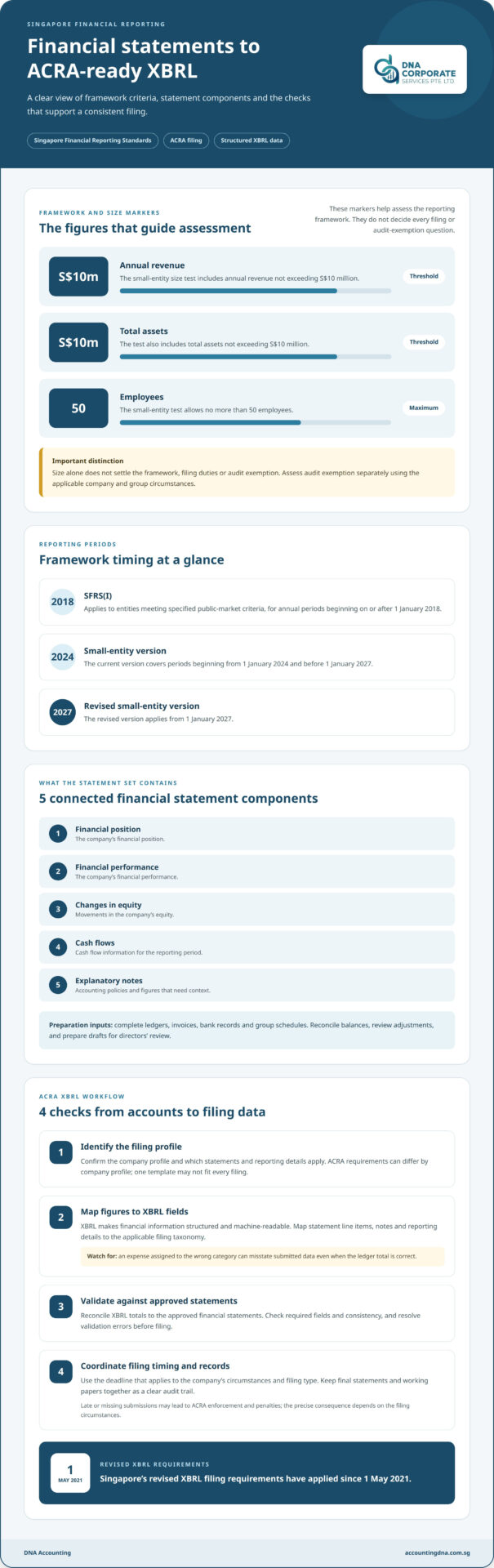
Ask a professional to assess your company’s reporting framework. Singapore companies use SFRS, including SFRS(I) for entities meeting specified public-market criteria. SFRS(I) applies to annual periods beginning on or after 1 January 2018. For small entities, the current version covers periods beginning from 1 January 2024 and before 1 January 2027; a revised version applies from 1 January 2027. Don’t treat size alone as the framework decision.
-
Assess Your Company’s Preparation and Filing Duties
Have a professional assess your company’s reporting and filing duties. The small-entity size test includes annual revenue and total assets not exceeding S$10 million each, and no more than 50 employees. These figures help assess the framework; they don’t, by themselves, answer every filing or audit-exemption question. Audit exemption must be assessed separately using applicable company and group circumstances. Avoid assuming that a small-company label automatically settles the audit question.
-
Compile the Required Financial Statement Components
Ask the preparer to assemble the statements and supporting notes. Under SFRS(I) or FRS, the set covers financial position, financial performance, changes in equity, cash flows, and explanatory notes. The notes clarify accounting policies and figures that need context. Reconcile GST records with accounting entries; according to the Inland Revenue Authority of Singapore, Singapore’s GST rate is 9%. A tax computation adjusts accounting profit for tax treatment.
-
How a Professional Prepares Annual Company Financial Statements
Provide complete ledgers, invoices, bank records, and group schedules. An accounting professional reconciles balances, reviews adjustments, and drafts statements for the directors’ review. For subsidiaries and foreign-owned companies, the preparer also aligns intercompany balances, currency records, and group reporting information. Directors review the statements and remain responsible for their company’s reporting. A professional’s draft supports that oversight but does not replace it.
ACRA financial statement filing and XBRL formats
Prepare the statements and XBRL filing as connected tasks. Singapore’s revised XBRL filing requirements have applied since 1 May 2021.
- Identify the company’s filing profile first. ACRA’s requirements determine how its financial information must be presented. Confirm which statements and reporting details apply before converting figures. Requirements can differ by company profile, so don’t assume one template fits every filing.
- Map each statement item to the appropriate XBRL data field. XBRL converts financial information into structured, machine-readable data. The preparer maps line items, notes, and reporting details to the applicable filing taxonomy. For example, recording an expense under the wrong category can misstate the submitted data, even when the ledger total is correct.
- Validate the converted filing before submission. Reconcile XBRL totals against the approved financial statements, then check required fields and consistency. Each balance-sheet total should agree with its supporting figures. Resolve validation errors before filing, and keep the final statements and working papers together as a clear audit trail.
- Coordinate submission timing with the company’s filing obligations. ACRA filing deadlines depend on the company’s circumstances and filing type, so use the relevant deadline rather than a generic calendar assumption. Late or missing submissions may lead to ACRA enforcement and penalties; the precise consequence depends on the filing circumstances. For help coordinating statement preparation and XBRL readiness, discuss your filing requirements.
When assessing an XBRL workflow, keep the stated effective date, 2021 年 5 月 1 日, in view. Use it as a reference point when interpreting the revised requirements, and check that the chosen filing approach follows the applicable presentation rules.
Which Singapore companies must prepare and file financial statements?
Assess the entity, reporting period, and filing position separately.
- Start with the company’s legal identity. Identify the Singapore-incorporated entity named in ACRA’s records, and distinguish it from overseas parent companies, branches, and related businesses. Keep each entity’s records separate. A group’s consolidated accounts do not automatically explain the Singapore company’s own reporting position.
- Assess preparation and filing separately. Financial statements support annual reporting, while filing means submitting the required documents to ACRA. These are related but distinct requirements. Establish which statements the company must prepare, then assess whether and how they must be filed. An exemption from one requirement does not automatically remove another obligation.
- Review the company’s size and circumstances. Apply the small-entity criteria discussed earlier, then consider the relevant reporting framework. Size alone does not settle every reporting obligation. A company should not assume that qualifying for a simpler framework also removes its preparation or filing duties.
- For a Singapore subsidiary, separate local accounts from group reporting. The local records should capture that entity’s transactions and balances. Then align the information needed for the overseas parent’s consolidation. Reconcile intercompany balances and document differences in reporting periods or accounting treatment before finalising the statements.
- If operations have stopped, assess the company’s status before assuming filings end. Dormancy, continued legal existence, and an application to strike off are different matters. Review outstanding reporting and filing requirements as part of the closure process. Directors can discuss their company’s filing position before taking the next step.
DNA Accounting
DNA Accounting supports Singapore businesses with accounting records and reporting requirements. Its Accounting & Bookkeeping services help organise financial information for statement preparation, while GST Services and Taxation Services address related tax and filing work. Corporate Secretarial Services support company administration alongside these responsibilities.
Professional support can help when records need reconciliation, group information must be brought together, or statements for ACRA filing are difficult to coordinate. Clear records make preparation more straightforward. A joined-up view of accounting, tax, and company administration also helps directors understand the work ahead.
Contact DNA Accounting to discuss your Singapore financial statement needs.
Make Your Next Reporting Cycle Easier to Manage
Use the completed statements to inform business decisions. Directors can review changes in revenue, expenses, and financial position to identify areas for closer attention. For example, a change in recurring costs may prompt discussion about spending priorities or business plans. This makes reporting a useful management tool, not just an annual compliance task.
Set a regular time to discuss financial performance with the people responsible for business decisions. A focused discussion helps directors and finance managers connect reported results with operational priorities and decide what to monitor next. Concentrate on the decisions the figures can inform, rather than treating the statements as an end in themselves.
For support with your company’s accounting needs, contact DNA Accounting to discuss your reporting requirements.
Frequently Asked Questions
What accounting standards apply to financial statement preparation in Singapore?
Singapore financial statements follow the applicable Singapore reporting standards. The chosen standard affects how transactions are recognised, measured, and explained in the notes. For example, changes in accounting policies can affect comparisons between reporting periods. Document the policies applied and clearly explain relevant changes in the statements.
What are the financial statement filing deadlines with ACRA in Singapore?
Check the applicable filing timeline and plan statement preparation and approval early enough to meet it. Plan statement preparation and approval early enough to support that filing. For a company whose year closes on 31 December, use the financial year end to set the filing schedule, then allow time to resolve outstanding balances before submission.
How do Singapore FRS and SFRS(I) compare with IFRS?
Singapore FRS and SFRS(I) are local reporting frameworks, while IFRS is an international framework. Their requirements may align in some areas, but not every treatment is identical. If a Singapore subsidiary reports to an overseas parent, identify differences required by the parent’s reporting policies and prepare consolidation adjustments separately from the Singapore company’s own statements.
Disclaimer
The information provided on this website is for general informational purposes only and is not intended to constitute professional accounting, tax, legal, or financial advice. While we strive to ensure that the content is accurate and up to date, regulations in Singapore, including those administered by ACRA, IRAS, CPF Board, and MOM, may change from time to time and may differ depending on individual circumstances.
Readers should not act or rely on any information contained on this website without seeking specific advice from a qualified professional based on their individual situation.
DNA Corporate Services and its affiliates accept no responsibility or liability for any loss or damage arising from reliance on the information provided in this website or any linked materials.
For tailored advice relating to accounting, taxation, corporate secretarial, or compliance matters in Singapore, please contact us directly for professional consultation.



