

Missing one tax deadline can disrupt cash flow even when the return itself is straightforward. For Singapore corporate income tax filing, companies generally need to submit Estimated Chargeable Income (ECI) within three months after their financial year ends, according to the Inland Revenue Authority of Singapore. Singapore-incorporated companies must e-file their annual income tax return by the applicable filing deadline.
It’s understandable to find 新加坡企业所得税申报 daunting: filing deadlines, exemptions and payment timing all affect tax planning. This guide explains when ECI and corporate tax returns are due, which exemptions may apply, and when to pay after receiving a tax assessment. It also shows how Singapore’s filing requirements fit together, so you can plan ahead with a clearer view of your company’s obligations.
Key Takeaways
- Map your financial year-end to the filing deadlines so ECI and the corporate tax return are planned separately.
- Check whether your company meets the eligibility conditions for the Start-Up Tax Exemption or Partial Tax Exemption.
- Understand how a tax assessment sets the amount due and when payment must be made.
- Accurate bookkeeping and tax support can help connect your company’s records with its filing obligations.
Estimated chargeable income and corporate tax return deadlines
ECI estimates a company’s taxable profit for a financial year. Companies generally file ECI with the Inland Revenue Authority of Singapore (IRAS) within three months after their financial year-end, unless they qualify for an administrative concession. This estimate helps IRAS assess tax before the final return.
Singapore-incorporated companies must e-file their annual income tax returns by the applicable deadline. Companies filing Form C or Form C-S must submit financial statements and tax computations with the return. Companies filing Form C-S (Lite) do not routinely submit these documents, but must prepare and retain them and provide them to IRAS on request. Supporting records must also be retained and provided if IRAS requests them. Late filing may result in penalties up to S$5,000. Incorrect figures can prompt IRAS queries. Reconciled calculations help explain reported amounts.
The corporate income tax rate is 17%, according to IRAS. Taxable income starts with income, then accounts for allowable deductions and exemptions. Singapore’s single-tier system means company profits are not taxed again when distributed as dividends to shareholders.
Corporate tax residency depends on where control and management take place. Directors’ strategic decisions help establish that location. The treatment of foreign-sourced income depends on its nature and the applicable Singapore tax conditions. Deductions depend on whether expenses are eligible and connected with earning income. Tax professionals assess these details alongside complete financial records.
Start-Up Tax Exemption and Partial Tax Exemption
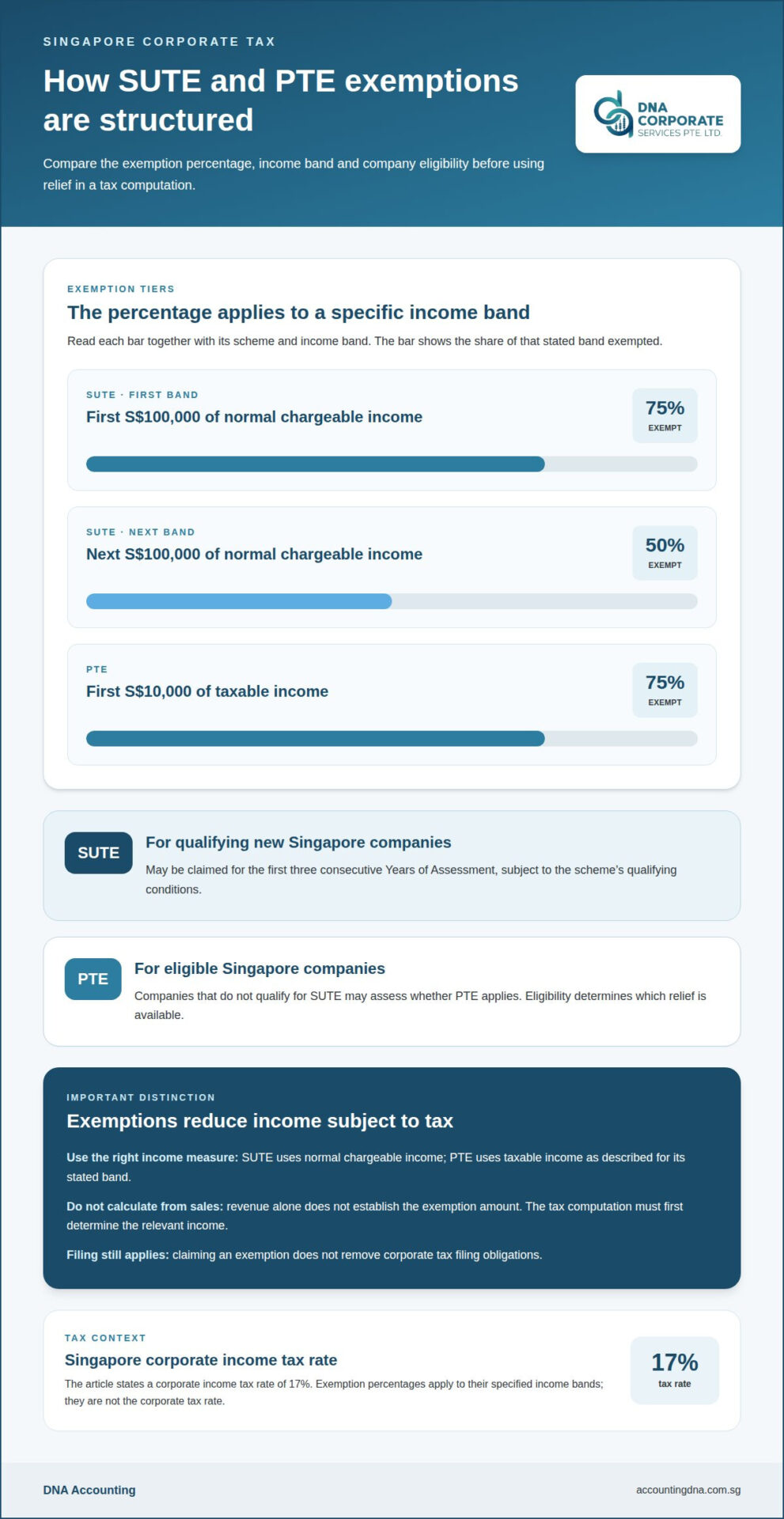
The Start-Up Tax Exemption (SUTE) supports qualifying new Singapore companies. Eligible startups may claim it for their first three consecutive Years of Assessment (YAs). Under SUTE, eligible companies receive a 75% exemption on the first S$100,000 of normal chargeable income, according to the Inland Revenue Authority of Singapore. The scheme also provides a 50% exemption on the next S$100,000 of normal chargeable income. These exemptions reduce the income subject to tax. They don’t remove corporate filing obligations.
Incorporation alone does not establish eligibility for the Start-Up Tax Exemption (SUTE). The company must meet the scheme’s qualifying conditions. Review its status before applying SUTE in a tax computation. The relevant measure is normal chargeable income, not gross revenue. Sales figures alone, for example, do not show the exemption amount. The tax computation must first determine chargeable income.
Companies that don’t qualify for SUTE may assess the Partial Tax Exemption (PTE). PTE applies to eligible Singapore companies. According to the Inland Revenue Authority of Singapore, eligible companies receive a 75% exemption on the first S$10,000 of taxable income. That is a separate exemption scheme. Don’t treat the SUTE and PTE thresholds as interchangeable. Eligibility determines which relief applies.
For a startup, check its qualifying status and calculated income, then ensure the selected exemption matches the company’s circumstances. This distinction matters when preparing the return. Applying a percentage to revenue instead of taxable income can distort the calculation. Clear records help support the figures reported to IRAS.
Tax assessments and payment deadlines
An IRAS assessment states the tax payable and the payment due date. Use that date for cash-flow planning, and don’t confuse filing deadlines with payment deadlines. Keep the assessment alongside the filed return: together, they show how IRAS calculated the amount. Compare the assessed figures with your tax computation and note any differences before arranging payment.
Late filing may result in penalties reaching S$5,000. This concerns missed filing deadlines, not every payment delay. Keep filing records, computations and IRAS correspondence together. If the assessment differs from your submitted figures, identify the affected income or deduction. A clear reconciliation helps explain the discrepancy. For example, check whether an expense appears differently in both records.
A tax professional can review the assessment against the return and trace differences to supporting records and calculations. If figures need correction, the professional can prepare an explanation and supporting documents for IRAS, and help submit an amendment or appeal through the appropriate process. The grounds for the request should match the records.
Before paying, confirm the company name, assessment period, amount and due date shown. Share the assessment, filed return and relevant records with your tax professional. These documents help distinguish a calculation issue from missing information. Keep proof of payment with the assessment. If IRAS requests clarification, consistent records can support a focused response.
DNA Accounting
DNA Accounting helps companies in Singapore coordinate corporate tax filing with financial records. Its Accounting & Bookkeeping Services organise income and expense records for tax computations. Taxation Services supports corporate tax filing, while GST Services covers related GST reporting. This coordinated approach can help when financial information is spread across separate records or schedules.
For an annual return, the work can bring bookkeeping figures, tax adjustments and supporting documents together before filing. If GST transactions affect recorded figures, GST support keeps related reporting in view. Corporate Secretarial Services can complement the process by supporting statutory administration, including maintaining proper registers and minute books and filing required documents with ACRA. Directors can coordinate tax preparation with company records and administrative responsibilities. Consistent records also help explain how reported amounts relate to business activity.
Companies may turn to DNA Accounting when internal finance capacity is limited, records need organising, or filing responsibilities overlap. A startup preparing its first return may need bookkeeping figures and tax computations brought together. An established SME may need ongoing support with tax, GST and company administration. The appropriate scope depends on the work required and the records available. Coordinated support helps directors see how these tasks fit together rather than treating each filing as an isolated exercise.
For support with your company’s accounting and tax requirements, contact DNA Accounting.
Frequently Asked Questions
What are the corporate income tax filing deadlines in Singapore?
Singapore-incorporated companies e-file annual income tax returns by 15 December each year. Treat ECI as a separate filing linked to the financial year-end, rather than assuming the annual return covers it. Assign responsibility for preparing and approving each submission. Keep filing dates distinct from the payment date shown on an IRAS tax assessment, which follows the assessment process.
How can a tax professional file a Singapore corporate income tax return, and what information must the company provide?
A tax professional prepares the tax computation and submits the return using company information. Provide details of business activities, income sources, material transactions, claimed deductions and any exemption eligibility. Flag unusual transactions, such as a one-off asset disposal, so their tax treatment can be assessed. Clear explanations help the professional reconcile tax adjustments with the company’s accounts and support the reported position.
What are Singapore’s corporate income tax exemptions and rebates for companies?
Exemptions reduce chargeable income; rebates reduce tax payable. A qualifying company may assess the Start-Up Tax Exemption or Partial Tax Exemption, depending on its circumstances. Under 2025 policy, companies may receive a corporate income tax rebate of up to 50%, capped at S$40,000. Treat each relief separately in the tax computation, since eligibility and the calculation basis differ.
What documents and financial statements are required for a Singapore corporate tax return?
Companies need financial statements and a tax computation, supported by records that explain reported figures and adjustments. Keep evidence for material transactions, including contracts or documents supporting unusual expenses. Companies filing Form C-S or Form C must retain complete tax calculations and financial records for possible checks for five years. Organised files make it easier to trace a reported amount to its source.
What are the differences between Form C, Form C-S, and Form C-S (Lite)?
Form C-S (Lite) is for companies with annual revenue of S$200,000 or less. Form C-S is for companies with annual revenue of S$5,000,000 or less. Form C applies to companies above S$5,000,000 in revenue or with complex deductions. These thresholds help identify the relevant return type, while deductions and company circumstances can also affect the choice.
Disclaimer
The information provided on this website is for general informational purposes only and is not intended to constitute professional accounting, tax, legal, or financial advice. While we strive to ensure that the content is accurate and up to date, regulations in Singapore, including those administered by ACRA, IRAS, CPF Board, and MOM, may change from time to time and may differ depending on individual circumstances.
Readers should not act or rely on any information contained on this website without seeking specific advice from a qualified professional based on their individual situation.
DNA Corporate Services and its affiliates accept no responsibility or liability for any loss or damage arising from reliance on the information provided in this website or any linked materials.
For tailored advice relating to accounting, taxation, corporate secretarial, or compliance matters in Singapore, please contact us directly for professional consultation.



