

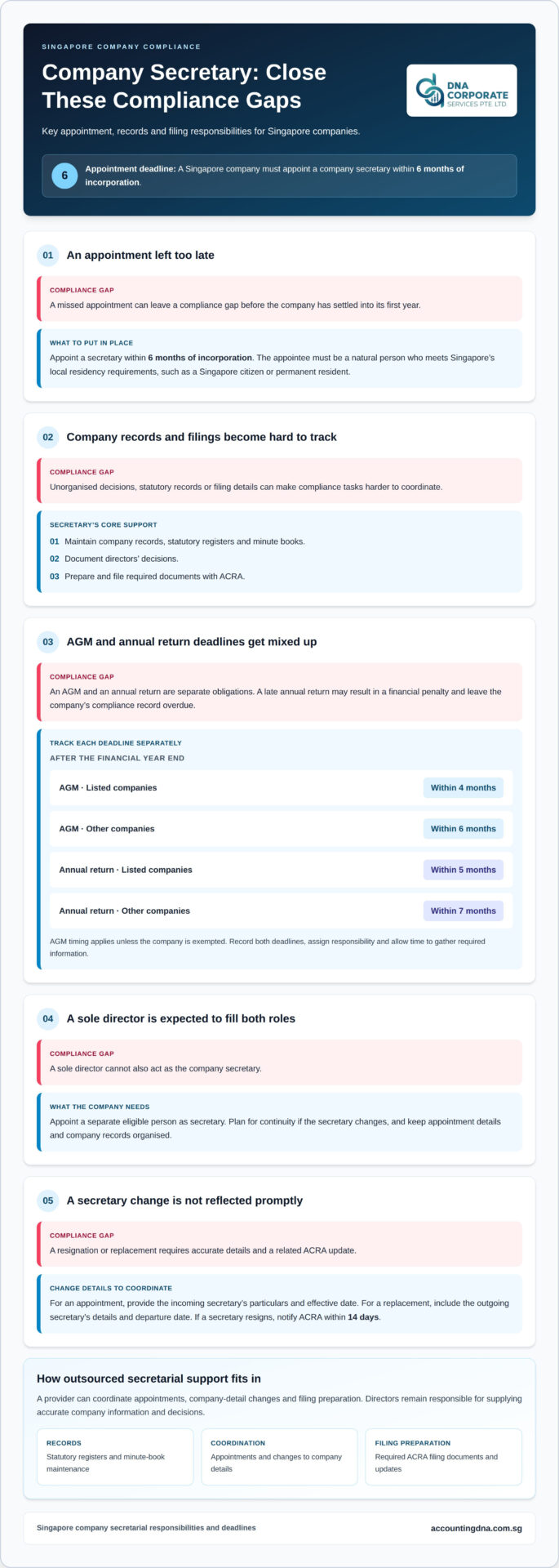
A missed company secretary appointment can create a compliance gap before a Singapore business has settled into its first year. Every Singapore company must appoint a company secretary within 6 months of incorporation. According to the Accounting and Corporate Regulatory Authority (ACRA), the secretary must be a natural person who meets Singapore’s local residency requirements.
Directors already carry plenty of responsibility, so it helps to understand what a company secretary does. This guide explains the secretary’s statutory duties in Singapore, the risks of late filings, and why a sole director cannot also serve as secretary. It also covers what 新加坡公司秘书服务 (Singapore company secretarial services) involve and how professional support can help keep company records and filing obligations on track.
Key Takeaways
- Understand when a Singapore company must appoint a secretary and the local residency requirement for the role.
- See how a company secretary supports statutory duties and keeps corporate records and filings in order.
- Learn how late annual filings can create compliance consequences and why filing deadlines need close attention.
- Find out why a sole director cannot also serve as company secretary and when professional support can help.
Company secretary roles and statutory responsibilities
A Singapore company must appoint a company secretary within 6 months of incorporation. The role supports directors with corporate records, governance administration and ACRA filing matters.
Secretary Roles and Responsibilities
A company secretary maintains company records, documents directors’ decisions and files required documents with ACRA. This support helps directors track compliance tasks and prepare the information needed for filings. The secretary must be a natural person who meets Singapore’s local residency requirements. When assessing support, look for ongoing help with statutory registers, minute books and ACRA filings, rather than assistance with the appointment alone.
Outsourced Secretary Services
With outsourced support, a provider can manage corporate secretarial administration without the company employing a secretary directly. The provider can coordinate appointments, changes to company details and filing preparation, while directors supply accurate company information and decisions. Singapore company secretary services may be useful for startups and SMEs that need a consistent point of coordination as their corporate records change. Fees depend on the scope of support, the company’s filing needs and the changes requiring attention; pricing is provided after a quote request.
Appointing or Replacing a Secretary with ACRA
A corporate secretarial provider can coordinate the appointment or replacement process and submit the relevant update to ACRA. To begin, the company supplies its identifying details, the incoming secretary’s particulars and the effective appointment date; for a replacement, it also provides the outgoing secretary’s details and departure date. The provider uses these details to prepare and lodge the change. If a secretary resigns, the company must notify ACRA within 14 days. Confirming the dates and particulars early helps the filing reflect the company’s records accurately.
Consequences of late annual filings
A late annual return can bring a financial penalty and leave a company’s compliance record overdue. Late filing may result in a financial penalty. The amount is a practical reason to treat the annual return as a scheduled company obligation, not an item to handle after other work is finished.
AGM and annual return obligations involve separate tasks, so track them independently. Unless exempted, listed companies must hold an AGM within four months after the financial year end, while other companies must hold one within six months. Listed companies must file an annual return within five months after the financial year end, and other companies within seven months. Record both deadlines, assign responsibility for each task and allow time to gather the required information. Missing financial statements or director details can delay preparation, so use a compliance calendar to flag unfinished items early.
Late filing can also create extra administration. Directors may need to address overdue records while managing routine business decisions, and an incomplete company record can make later compliance work harder. Keep a central record of filing dates, submitted information and outstanding approvals. When a company secretary coordinates the process, they can flag missing details and organise the next steps with the directors.
For practical planning, separate the annual return from the AGM in the company’s compliance calendar. Confirm who is preparing the documents, who approves the relevant information, and when the filing is ready for submission. If a deadline has already passed, address the overdue filing promptly rather than letting it remain unresolved. A discussion about annual filing support can help clarify the steps for your company.
Restrictions on sole directors serving as secretary
A sole director cannot also act as company secretary in a Singapore company. The roles must be held by different people, so a company with one director needs a separate eligible appointee. Plan this appointment as part of the company’s governance arrangements, particularly if the director is also the only shareholder and manages most administrative decisions.
Who is eligible to act as a company secretary in Singapore? The appointee must be a natural person who meets Singapore’s local residency requirements, such as a Singapore citizen or permanent resident. The company must appoint a corporate secretary within six months from its incorporation date. The appointee must also be a different person from the sole director.
For a startup with one director, consider how to maintain continuity if the secretary changes. Keep appointment details and company records organised so the change can be documented accurately. A corporate secretarial provider can coordinate the appointment and prepare the relevant ACRA filing using the company’s information. Check that the proposed appointee’s particulars are accurate before the filing is submitted.
If no other eligible person is available within the business, a professional appointment can provide a separate secretary without assigning the director both positions. Companies planning incorporation can discuss secretary appointment support as part of their setup arrangements.
DNA Accounting
DNA Accounting provides corporate secretarial services for businesses in Singapore, including appointment coordination, statutory registers, minute-book maintenance and required ACRA filings. The company must appoint a corporate secretary within six months from incorporation, and a secretary can help organise related administration. DNA Accounting is registered with ACRA and adheres to the ISCA Code of Professional Conduct and Ethics.
Where records, GST obligations or tax matters overlap, DNA Accounting also provides Accounting & Bookkeeping, GST Services and Taxation Services. The right support depends on the company’s needs, such as whether it needs help with company records alone or with connected financial and tax responsibilities. This gives directors a practical next step when compliance tasks are becoming difficult to coordinate.
Contact DNA Accounting to discuss support for your company.
Keep compliance support aligned with your next stage
As your Singapore company develops, review who is responsible for each compliance task and how those responsibilities are coordinated. Clear internal accountability helps keep decisions and records connected. Track ACRA filing and AGM deadlines alongside IRAS tax and GST obligations, and keep the company’s statutory records current.
A useful next step is to identify where administration currently takes time away from running the business, then decide what support would make that workload easier to manage. DNA Accounting can discuss your company’s situation and help you consider a practical way forward, without taking decisions away from its directors.
Contact DNA Accounting to discuss your next step. A clear plan can help you focus on growing your business with greater confidence.
Frequently Asked Questions
What does a company secretary do in Singapore?
A company secretary turns company decisions into clear administrative records and coordinates related compliance work. After directors approve a change, for example, the secretary can prepare the paperwork and update the company’s records consistently. This helps keep administration organised, while directors remain responsible for the decisions they make.
Is a company secretary required for every Singapore company, and what are the appointment deadlines?
Yes. Every Singapore company must appoint a company secretary within 6 months of incorporation. The deadline is measured from the incorporation date, so it belongs on the company’s setup timeline, not just its annual compliance calendar. This helps a new business avoid leaving the appointment until routine reporting work begins.
What are the statutory duties of a Singapore company secretary under the Companies Act?
Corporate secretarial services must maintain proper registers and minute books, and file required documents with ACRA. Keeping corporate information up to date as decisions and changes occur is more reliable than reconstructing events later. A properly maintained minute book, for example, gives the company a clear record of formal decisions.
How much do company secretary services cost in Singapore?
When arranging company secretarial support, describe the work your company needs, such as ongoing administration or help with a particular company change. DNA Accounting’s pricing is affordable and transparent, with no hidden costs. Review the proposed scope and quote together so you understand which services are included.
What is included in Singapore company secretary service packages, and what fees are charged for extra filings?
Before engaging support, clarify which recurring administrative tasks and filing work are covered. For a particular company change, provide the relevant details so the work can be scoped clearly. DNA Accounting offers affordable, transparent pricing with no hidden costs. A clear service scope helps align expectations about the work included.
Disclaimer
The information provided on this website is for general informational purposes only and is not intended to constitute professional accounting, tax, legal, or financial advice. While we strive to ensure that the content is accurate and up to date, regulations in Singapore, including those administered by ACRA, IRAS, CPF Board, and MOM, may change from time to time and may differ depending on individual circumstances.
Readers should not act or rely on any information contained on this website without seeking specific advice from a qualified professional based on their individual situation.
DNA Corporate Services and its affiliates accept no responsibility or liability for any loss or damage arising from reliance on the information provided in this website or any linked materials.
For tailored advice relating to accounting, taxation, corporate secretarial, or compliance matters in Singapore, please contact us directly for professional consultation.



