

The bookkeeping option that seems simplest can become demanding when bank records, tax reporting and payroll sit in separate workflows. Choosing 新加坡记账服务 is less about comparing labels and more about matching support to the records and compliance tasks your business needs handled.
It’s understandable to want a dependable arrangement that keeps your numbers clear without adding work for directors or finance staff. This comparison explains how in-house bookkeeping, software-supported processes and outsourced services differ in bank reconciliation, financial reporting, GST, corporate tax, payroll and CPF support. You’ll see which approach may suit a startup, a growing SME or a company with more complex payroll needs, and what to consider when choosing.
Key Takeaways
- Compare bookkeeping options by how they handle transaction matching and produce financial reports you can use to make business decisions.
- Separate routine record-keeping from the additional support needed for GST, corporate tax, payroll and CPF matters.
- Understand how transaction volume, record complexity and the scope of support can affect bookkeeping fees in Singapore.
- Consider integrated accounting, GST and taxation support when you want your bookkeeping and compliance work to fit together.
Bank reconciliation and financial reporting
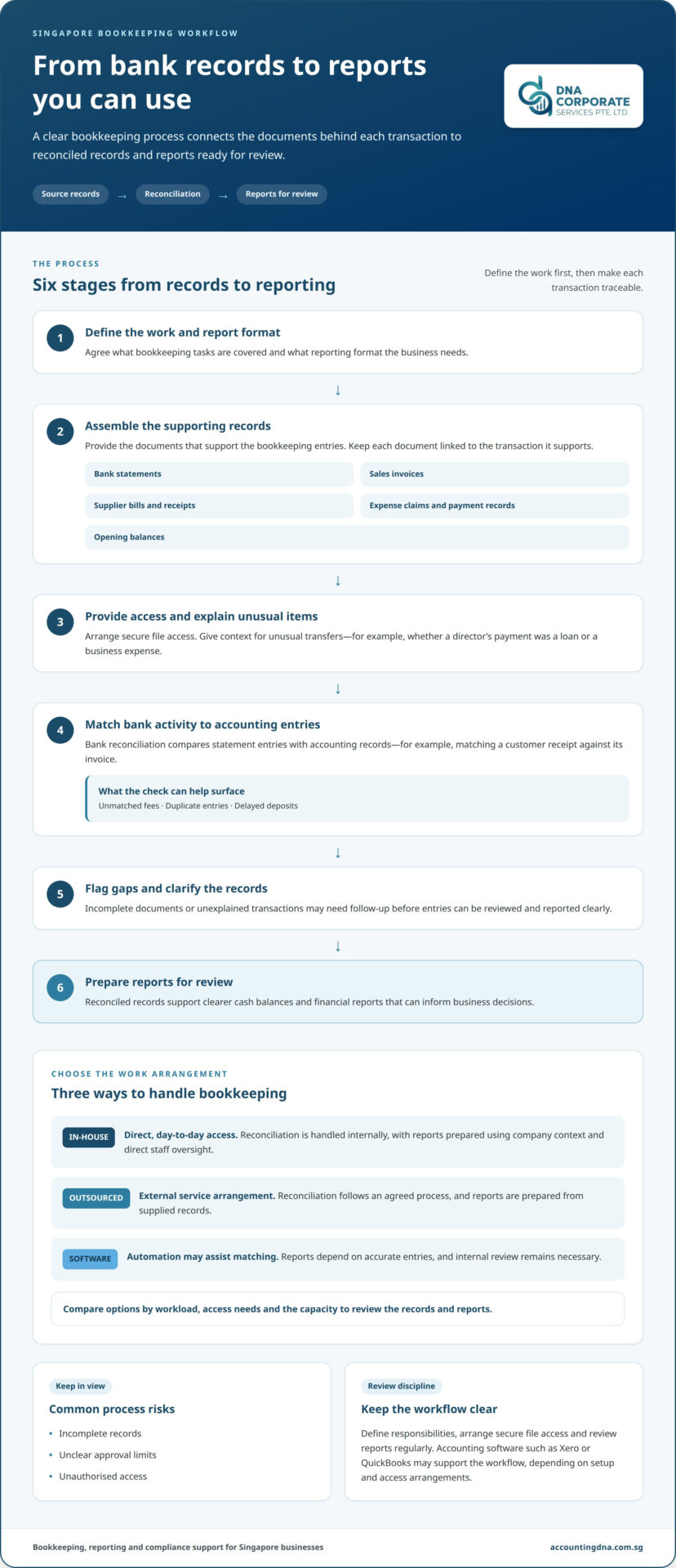
Bank reconciliation matches entries on a bank statement with accounting records. For example, a bookkeeper checks a customer receipt against its invoice. Unmatched fees, duplicate entries and delayed deposits become easier to spot, making cash balances more useful for business decisions.
Outsourced bookkeeping services in Singapore provide external support without hiring an in-house employee. An in-house bookkeeper offers direct, day-to-day access. The better fit depends on transaction volume, the level of internal oversight and how much work needs handling.
| Option | Reconciliation | Reporting | Work arrangement |
|---|---|---|---|
| In-house bookkeeper | Handled internally | Prepared with company context | Direct staff oversight |
| Outsourced bookkeeper | Handled under an agreed process | Prepared from supplied records | External service arrangement |
| Software only | Automation may assist matching | Reports depend on accurate entries | Internal review remains necessary |
Choose by matching workload, access needs, and review capacity.
Businesses in Singapore need organised records for clear reporting and tax work. A practical file set includes bank statements, sales invoices, supplier bills, receipts and payment records. Keep each document linked to the transaction it supports.
Give the bookkeeper bank statements, invoices, receipts, expense claims and opening balances. Explain unusual transfers. For example, clarify whether a director’s payment was a loan or a business expense.
Outsourcing starts by defining the work and the reporting format. Then provide the records and arrange secure file access. The bookkeeper reconciles entries, flags gaps and prepares reports for review.
Common risks include incomplete records, unclear approval limits and unauthorised access. Define responsibilities and review reports regularly. Xero or QuickBooks may support the workflow, depending on the setup and access arrangements.
GST, corporate tax, payroll and CPF support
These workstreams use shared accounting records, but each produces a different result. GST reporting tracks tax at the transaction level, while corporate tax reporting draws on company-wide financial information.
GST Support
GST support organises sales and purchase records for return preparation. It can classify transactions by GST treatment and flag missing tax invoices. For example, a supplier purchase needs supporting documents before its GST treatment can be reviewed. IRAS requires GST filing to be accurate and on time; failure to do so results in penalties. This work focuses on transaction-level GST, not company-wide taxable results.
Corporate Tax Support
Corporate tax support uses bookkeeping records to prepare tax information. It reviews income, expenses, and supporting documents, then identifies items needing clarification. According to IRAS, all companies must file Estimated Chargeable Income (ECI) within three months from the end of their financial year, except companies that qualify for the administrative concession and those specifically not required to file. Companies required to file Form C-S or Form C must submit their annual income tax return by 15 December each year (e-filing), according to IRAS.
Payroll records support employee pay and CPF processing. Approved salary, leave and deduction details help keep payroll entries consistent. For example, a pay change should be reflected in the payroll records used for CPF calculations. Connecting payroll summaries to accounting entries makes staff costs easier to trace and review.
Discuss your bookkeeping and compliance needs.
What factors affect bookkeeping fees in Singapore?
Bookkeeping costs depend on workload and scope. A quiet startup has different needs from a trading company. More transactions generally mean more processing, while multiple bank accounts add reconciliation work. Overseas sales and mixed income sources can also make the records more complex.
The quality of the documents matters too. Clear invoices and labelled receipts make review easier, while missing records require follow-up. For example, an unexplained transfer needs clarification before it can be coded. Backlogs, corrections to earlier entries and incomplete accounts can also increase the work involved.
The service scope also affects the work involved. Basic transaction recording differs from regular reporting. GST preparation, payroll entries and tax-related schedules may require separate support. Ask for the included tasks in writing to distinguish ongoing bookkeeping from related compliance services.
- Volume: Estimate monthly sales, purchases, and bank activity.
- Complexity: Note multiple accounts, currencies, or business lines.
- Records: Identify missing, late, or inconsistent documents.
- Reporting: Specify how often management reports are needed.
- Scope: Separate bookkeeping from GST or payroll work.
These factors shape the workload rather than a standard tariff. The price depends on the business’s needs and is set out in a transparent quote with no hidden costs. Transaction volume, record condition, reporting frequency and included services all affect the scope. A startup with few monthly entries may need a different arrangement from a company with frequent sales and several accounts.
Before agreeing, map the services against your actual workflow. Review bookkeeping pricing details alongside the tasks required. For a tailored assessment, request a bookkeeping quote.
DNA Accounting
DNA Accounting helps businesses in Singapore coordinate bookkeeping with related tax and compliance work. When transaction records need to support GST reporting or corporate tax preparation, connected accounting and taxation support can make the workflow easier to manage. The right scope depends on your records, reporting needs and the tasks you want handled.
This support may suit a startup setting up its finance processes or an established SME reviewing how bookkeeping connects with GST Services, Taxation Services or Corporate Secretarial Services. Discussing your current records and reporting requirements helps define a suitable scope.
Contact DNA Accounting to discuss your bookkeeping needs.
Choose support that can grow with your business
The right 新加坡记账服务 should fit your current finance workflow without adding unnecessary complexity. As your business changes, review whether the reporting and compliance support still match the records your team produces and the decisions you need to make.
For business owners considering international expansion or relocating key talent to Europe and the UK alongside their corporate setup, 360 Global Immigration provides guidance on business residency and visa pathways.
DNA Accounting offers Accounting & Bookkeeping, GST Services and Taxation Services in Singapore. These services can connect financial records with related reporting needs, providing a clear starting point when your current process feels fragmented or difficult to manage.
Bring your priorities into the conversation, such as the reports you rely on, the records that cause delays, and the support you want to coordinate. Discuss your bookkeeping needs with DNA Accounting and take a considered next step for your business.
Frequently Asked Questions
What bookkeeping services are available in Singapore for small businesses?
Small businesses can use cash-basis bookkeeping for internal tracking where appropriate, with a chart of accounts suited to their operations. However, cash-basis records do not replace the accrual-basis financial statements generally required of Singapore companies. Consistent cost classification supports clearer internal review. For example, a retailer can separate stock purchases from office expenses. Support can also include a fixed-asset register to organise equipment purchases separately from routine operating costs.
What are the GST bookkeeping and filing requirements in Singapore?
GST bookkeeping should maintain a clear trail linking recorded sales and purchases to their supporting documents. IRAS requires GST filing to be completed accurately and on time; failure to do so results in penalties. For example, a missing supplier invoice can leave a purchase entry without clear support. GST Services can include registration and return filing, connecting transaction records with GST reporting.
How do I choose a reliable bookkeeping service provider in Singapore?
Choose support that fits your records, reporting needs and related compliance work. Consider whether the scope covers the tasks your business needs, such as management accounts or fixed-asset records. Professional standing matters too: DNA Accounting is registered with the Accounting and Corporate Regulatory Authority (ACRA) and adheres to the ISCA Code of Professional Conduct and Ethics.
Disclaimer
The information provided on this website is for general informational purposes only and is not intended to constitute professional accounting, tax, legal, or financial advice. While we strive to ensure that the content is accurate and up to date, regulations in Singapore, including those administered by ACRA, IRAS, CPF Board, and MOM, may change from time to time and may differ depending on individual circumstances.
Readers should not act or rely on any information contained on this website without seeking specific advice from a qualified professional based on their individual situation.
DNA Corporate Services and its affiliates accept no responsibility or liability for any loss or damage arising from reliance on the information provided in this website or any linked materials.
For tailored advice relating to accounting, taxation, corporate secretarial, or compliance matters in Singapore, please contact us directly for professional consultation.



