

Could your choice of a financial partner be the difference between a stressful ACRA audit and a seamless year of growth? For many SME directors, the fear of missing a filing deadline or miscalculating the 9% GST is a constant weight that pulls focus away from actual business operations. Finding a reliable accountant for small business Singapore isn’t just about outsourcing your ledgers; it’s about securing a dedicated guide who understands the local landscape as well as you do.
We know that managing payroll, CPF contributions, and the new InvoiceNow requirements can feel like a full-time job on its own. You deserve to feel confident that your compliance is handled with precision. This 2026 guide promises to simplify your search by showing you how to select a partner who ensures full regulatory compliance while unlocking actionable insights for your expansion. We’ll explore the essential criteria for vetting a firm, the latest 2026 tax rebates you should claim, and how to spot the personalized care your business needs to thrive.
Key Takeaways
- Understand why modern SME accounting requires a shift from simple data entry to strategic tax planning that supports long-term growth.
- Identify the specific credentials and industry-specific experience that distinguish a truly capable accountant for small business Singapore.
- Evaluate different service models, from in-house hires to outsourced partners, to determine which provides the best balance of cost and compliance.
- Follow a practical five-step roadmap to vet potential partners based on their local track record and ability to manage ACRA and IRAS deadlines.
- Discover the benefits of a bespoke, boutique service model that prioritizes high-touch communication and personalized care for your unique business foundations.
Why Every Small Business in Singapore Needs a Dedicated Accountant
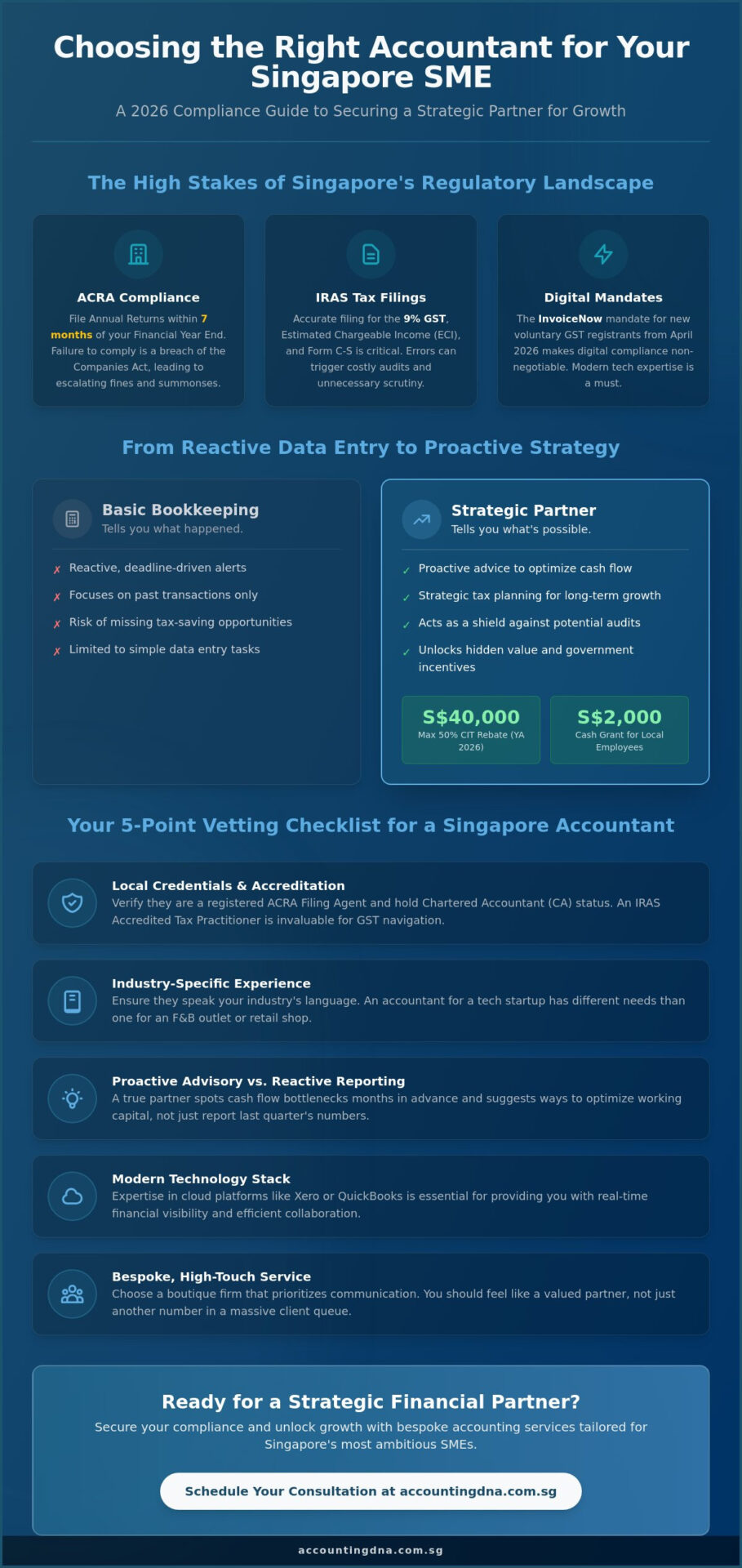
Running a business in Singapore is rewarding, but the regulatory burden can feel like a mountain to climb. In 2026, the role of an accountant for small business Singapore has evolved far beyond manual data entry. With the InvoiceNow mandate now in full effect for new voluntary GST registrants as of April 2026, digital compliance isn’t optional. It’s the law. A dedicated partner doesn’t just record transactions. They interpret the numbers to ensure your startup remains viable. While you focus on product-market fit, your accountant applies fundamental accounting principles to build a resilient financial foundation.
There’s a massive gulf between basic bookkeeping and strategic tax planning. A bookkeeper tells you what happened; a strategic accountant tells you what’s possible. For the Year of Assessment (YA) 2026, companies can tap into a 50% Corporate Income Tax rebate capped at S$40,000. If you’re managing things yourself, you might overlook the S$2,000 cash grant available to active companies with local employees. Professional oversight ensures these opportunities don’t slip through the cracks while acting as a shield against potential audits.
Navigating ACRA and IRAS Compliance Requirements
Compliance isn’t a “one and done” task. For non-listed companies, you must file your Annual Return with ACRA within seven months of your financial year end. Missing this window isn’t just an administrative slip. It’s a breach of the Companies Act. An expert partner ensures your Estimated Chargeable Income (ECI) and Form C-S filings are accurate and submitted well before deadlines. They also maintain your Statutory Registers, which are vital documents that ACRA expects you to keep updated at your registered office address.
Avoiding Costly Penalties and Late Filing Fees
DIY accounting often feels like a cost-saving measure until the first late filing penalty arrives. ACRA doesn’t just send friendly reminders; they issue fines that escalate the longer you wait. The true danger of “cheap” or automated-only services is the lack of professional human oversight. A proactive partner manages your statutory compliance Singapore calendar for you. They act as an insurance policy, protecting your directors from summonses and ensuring your company’s standing remains pristine. This level of protection allows you to sleep better, knowing your business foundations are secure.
Key Qualities to Look for in a Singapore SME Accountant
Technical certifications like ISCA or ACCA are the bare minimum. While these credentials prove an accountant understands essential bookkeeping practices, they don’t guarantee they understand your specific business model. A retail shop has vastly different needs compared to a tech startup or an F&B outlet. You need an accountant for small business Singapore who speaks your industry’s language. They should know how to handle high-volume transactions or R&D tax claims without needing a tutorial from you first.
Beyond the basics, your partner must be intimately familiar with the local tax landscape. With the GST rate currently at 9%, errors in filing can lead to unnecessary scrutiny from IRAS. A one-size-fits-all corporate model often lacks the bandwidth to catch these nuances. Choosing a boutique firm that offers bespoke care means your files aren’t just another number in a massive queue. It ensures that your specific tax exemptions are maximized rather than overlooked by a junior staffer at a larger firm.
Technical Expertise and Professional Accreditations
Always verify if your chosen firm is a registered ACRA filing agent and holds Chartered Accountant (CA) status. This isn’t just about prestige; it’s about legal accountability. For businesses approaching the S$1 million turnover threshold, having an IRAS Accredited Tax Practitioner is invaluable for navigating complex GST requirements. Additionally, check their tech stack. A modern accountant for small business Singapore must be an expert in cloud platforms like Xero or QuickBooks to provide real-time financial visibility.
Proactive Advisory vs. Reactive Data Entry
Does your current accountant only call you when a deadline is looming? That’s reactive data entry. A true growth advisor spots cash flow bottlenecks months before they become a crisis. They look at your balance sheet and suggest ways to optimize your working capital. During your initial consultation, ask them: “How would you help me prepare for a sudden 20% increase in overheads?” or “What specific tax grants am I currently missing out on?” Their answers will reveal if they are a simple “bean counter” or a dedicated guide for your SME. If you’re looking for a partner who takes this proactive approach, it might be time to start a conversation about your business goals.
Comparing Accounting Models: Which Fits Your Small Business?
Deciding how to structure your finance department is a pivotal moment for any director. Should you hire someone to sit in your office, or is a remote partner more effective? Hiring a full-time accountant for small business Singapore involves significant overheads, including a competitive monthly salary, CPF contributions, and office space costs. For many growing companies, this investment is hard to justify when the workload fluctuates throughout the year. You might find your in-house hire overwhelmed during tax season but underutilized during quieter months.
Independent freelancers are another option, but they often come with hidden risks. While their rates might be lower, they lack the collective brainpower of a full firm. If a freelancer misses an ACRA filing deadline or fails to apply for the 50% CIT rebate available for YA 2026, the liability ultimately rests on your shoulders. This is why approximately 90% of SMEs eventually move toward outsourced accounting firms. You get a dedicated team that stays updated on every IRAS policy shift without the “single point of failure” risk of an individual hire.
| Feature | In-house Hire | Freelance Bookkeeper | Outsourced Firm |
|---|---|---|---|
| Monthly Cost | High (Salary + CPF) | Low | Predictable Fixed Fee |
| Expertise | Single Perspective | Variable | Team of Specialists |
| Scalability | Limited | Low | High |
| Continuity | Risky if they resign | Low | Guaranteed |
Outsourced Accounting Firms vs. In-house Hires
The beauty of the outsourced model is its inherent scalability. An outsourced accountant for small business Singapore scales their support as your transaction volume grows. You don’t need to worry about “hiring more hands” when you launch a new product line; your partner simply adjusts their service level to match your pace. This model also provides a layer of professional indemnity that protects your business foundations in a way an individual employee simply cannot.
The Role of Cloud Accounting in Modern SME Management
The 2026 regulatory climate demands speed and accuracy. With the InvoiceNow mandate now in full effect for many registrants, manual invoicing is becoming a relic of the past. Using cloud accounting services SG ensures your data is accessible anywhere, at any time. DNA Accounting leverages these tools to automate bank feeds and receipt scanning, turning a mountain of paperwork into a streamlined digital flow. It’s about having the answers you need to make growth decisions in real-time, not weeks after the month has ended.
5 Steps to Choosing the Right Accounting Partner in Singapore
Selecting an accountant for small business Singapore is one of the most critical decisions you’ll make as a director. It’s not just about finding someone to tally numbers; it’s about finding a partner who shares your commitment to growth. How do you cut through the noise of hundreds of firms to find the right fit? You need a systematic approach that prioritizes both technical capability and communication style.
- Step 1: Define your specific compliance and operational needs. Are you a startup needing basic bookkeeping, or a growing SME requiring complex GST services and payroll management? Knowing your scope prevents you from paying for services you don’t need or, worse, missing vital support.
- Step 2: Research the firm’s reputation and local Singaporean track record. Look for firms that actively manage businesses similar to yours. A clean record with ACRA and IRAS is non-negotiable.
- Step 3: Evaluate their technology stack and integration capabilities. With the April 2026 InvoiceNow mandate in full swing, your partner must be proficient in cloud-based automation to keep your data accurate and accessible.
- Step 4: Review their pricing and fee structure for transparency. Unexpected costs can derail a small business budget. Demand a clear breakdown of what’s included.
- Step 5: Schedule a consultation to assess cultural and communication fit. You need to know that your accountant will be available when you have an urgent question on a Friday evening.
Understanding Fee Structures: Monthly vs. Yearly Packages
A “Full Compliance” package should be more than just a marketing term. It should explicitly cover your Annual Return filing, ECI submission, and Form C-S/C filings. While some firms offer lower ad-hoc rates, these often lead to higher costs over time. Comprehensive monthly retainers usually provide better value because they include ongoing advice and support. Don’t forget to ask about hidden charges for software licenses or ACRA filing fees that might not be visible in the initial quote.
Red Flags to Avoid When Selecting a Firm
Be extremely cautious of firms that offer prices that seem too good to be true. Often, these providers outsource your sensitive financial data to offshore call centers, leading to communication breakdowns and data security risks. You want a partner who is physically present in Singapore and understands the local MOM and CPF nuances. A lack of transparency in corporate secretarial services is another major warning sign. If they can’t manage your statutory registers accurately, they likely won’t manage your taxes any better. If you’re ready to find a partner who values transparency as much as you do, reach out for a detailed consultation today.
DNA Accounting: Bespoke Financial Support for Singapore Entrepreneurs
Why settle for a cold, distant service provider when your business foundations deserve a dedicated expert? At DNA Accounting, we believe that our boutique size is our greatest strength. It allows us to offer a level of bespoke care that larger, less attentive firms simply cannot match. We’ve built our reputation on being a reliable guide for the Singapore SME and startup ecosystem, understanding that every entrepreneur’s journey is unique. When you partner with us, you’re not just another file; you’re a success story we’re deeply invested in. Finding the right accountant for small business Singapore means finding a team that treats your compliance as their own.
The “DNA Advantage” is about more than just keeping your books balanced. It’s about providing a protective shield around your company’s vital foundations. We focus exclusively on local SMEs and startups because we know the specific challenges you face, from navigating CPF contributions to managing the latest IRAS requirements. Our mission is simple: we handle the heavy lifting of financial regulations so you can pour your energy into core operations and growth. By positioning ourselves as a supportive partner rather than a distant vendor, we ensure you feel secure and understood in Singapore’s complex regulatory environment.
Integrated Corporate Solutions for Every Stage of Growth
Managing multiple vendors for different corporate needs often leads to data silos and dangerous compliance gaps. We solve this by providing a centralized service model that covers everything from your initial company incorporation to ongoing ACRA compliance. Whether you need precise payroll services or timely GST filing, our integrated approach ensures that all your financial data talks to each other. This holistic care prevents errors and provides a clear, unified view of your business health, allowing for much better strategic planning as you scale.
Extreme Accessibility: Support on Your Schedule
Have you ever had a burning financial question on a Friday night or a Sunday afternoon? Most traditional firms are long gone by then, leaving you to worry until Monday morning. We’ve identified this as a major pain point for busy founders. That’s why we make an explicit promise of extreme accessibility. We are available during evenings and non-working days because we know that entrepreneurship doesn’t follow a 9-to-5 schedule. Our founders stay directly involved in every client’s journey, ensuring you always have access to seasoned expertise when it matters most.
Your business deserves a partner that is as flexible and hardworking as you are. If you’re ready to experience a more personalized, high-touch approach to your finances, it’s time for a change. We invite you to contact DNA Accounting today for a personalized 2026 health check. Let’s ensure your business foundations are rock solid for the year ahead.
Secure Your Business Foundation for 2026 and Beyond
As you’ve discovered, the right financial partner does far more than just balance your books. They act as a strategic shield, ensuring your company remains in the good graces of ACRA and IRAS while you focus on scaling your operations. By prioritizing bespoke care and digital readiness, you turn compliance from a stressful obligation into a competitive advantage. Selecting a dedicated accountant for small business Singapore is the first step toward a future where financial clarity drives every decision you make.
Since 2016, DNA Accounting has focused exclusively on the unique needs of Singaporean SMEs and startups. Our team consists of specialists in ACRA and IRAS compliance who understand that business challenges don’t always happen during office hours. That’s why we make ourselves available for evening and weekend consultations to suit your busy schedule. We’re here to provide the personalized attention your growth story deserves. Are you ready to trade compliance stress for professional confidence? Get a Personalised Accounting Quote for Your Small Business today. We look forward to building something great together.
Frequently Asked Questions
Do I really need an accountant if my Singapore company is dormant?
Yes, you still have statutory obligations even if your company has no transactions. You are required to file an Annual Return with ACRA and a Corporate Tax Return with IRAS unless you have specifically applied for and been granted a waiver from tax filing. An expert partner ensures these “zero-activity” filings are submitted correctly to avoid late fees or the risk of your company being struck off the register.
How much does an accountant for a small business typically cost in Singapore?
Fees for an accountant for small business Singapore are typically structured around the volume of your transactions and the complexity of your compliance needs. Most SMEs prefer bundled monthly packages that combine bookkeeping, tax, and secretarial duties for better cost predictability. You should look for a firm that offers a clear, fixed-fee structure to ensure you aren’t surprised by hidden charges for software licenses or ACRA filing fees later in the year.
Can I switch my accounting firm mid-way through the financial year?
You can switch your accounting partner at any point during the year without disrupting your operations. A professional firm will manage the entire transition by coordinating with your previous provider to obtain a professional clearance letter. This process ensures all your historical ledgers, statutory records, and tax working papers are transferred securely so your new team can pick up exactly where the last one left off.
What is the difference between a bookkeeper and a chartered accountant?
A bookkeeper primarily focuses on the daily recording of financial transactions and maintaining accurate ledgers. In contrast, a Chartered Accountant (CA) provides high-level oversight, strategic tax planning, and ensures your business adheres to the Singapore Financial Reporting Standards (SFRS). While bookkeepers handle the “what” of your finances, a CA helps you understand the “why” and ensures your 2026 tax rebates are fully optimized.
Is it mandatory for a small business to have an audit in Singapore?
Most small businesses are exempt from statutory audits under the “Small Company” concept introduced by ACRA. To qualify for this exemption, your company must meet at least two of the following three criteria in the last two consecutive financial years: total annual revenue not exceeding S$10 million, total assets not exceeding S$10 million, or a workforce of 50 or fewer employees. Your accountant can verify your eligibility to save you unnecessary audit costs.
How does an accountant help me with GST registration and filing?
Your accountant monitors your taxable turnover to determine if you have reached the S$1 million compulsory GST registration threshold. They manage the entire registration process with IRAS and ensure your quarterly F5 filings are submitted with 100% accuracy. This is especially vital given the current 9% GST rate, as errors in input tax claims or output tax reporting can lead to strict penalties and audits.
Can an accounting firm also handle my company secretary and payroll duties?
Full-service firms often provide integrated corporate solutions to prevent data silos and ensure total compliance. This includes managing your Statutory Registers as a Corporate Secretary and handling your monthly payroll, including CPF contributions and annual AIS submissions to IRAS. Having one accountant for small business Singapore manage these centralized tasks ensures that your MOM and ACRA records always remain perfectly synchronized.
What information should I prepare before my first meeting with a new accountant?
You should prepare your latest ACRA BizFile, your most recent set of financial statements, and a few months of bank statements. If you’re already using cloud software like Xero, providing guest access is the most efficient way for a new partner to assess your current books. It’s also helpful to list any specific pain points, such as confusion over the YA 2026 CIT rebate or concerns about the InvoiceNow mandate.
Disclaimer
The information provided on this website is for general informational purposes only and is not intended to constitute professional accounting, tax, legal, or financial advice. While we strive to ensure that the content is accurate and up to date, regulations in Singapore, including those administered by ACRA, IRAS, CPF Board, and MOM, may change from time to time and may differ depending on individual circumstances.
Readers should not act or rely on any information contained on this website without seeking specific advice from a qualified professional based on their individual situation.
DNA Corporate Services and its affiliates accept no responsibility or liability for any loss or damage arising from reliance on the information provided in this website or any linked materials.
For tailored advice relating to accounting, taxation, corporate secretarial, or compliance matters in Singapore, please contact us directly for professional consultation.



