

This guide will help you master the legal nuances of the 2026 landscape, ensuring your business remains fully compliant without disrupting your daily operations. We’ll walk you through the “fit and proper” assessments and the mandatory central register filings that now define the statutory landscape. By the end, you’ll have a clear, secure path to a professional appointment that protects your company’s future.
Key Takeaways
- Understand the mandatory residency criteria under Section 145 of the Companies Act to ensure your company meets the legal threshold for local representation.
- Learn how to navigate the 2026 nominee director Singapore requirements by engaging ACRA-registered agents for mandatory KYC and central register filings.
- Discover how a formal Nominee Director Agreement provides a secure layer of protection through clear indemnity clauses and non-executive boundaries.
- Unlock the benefits of an integrated service model that syncs your secretarial, tax, and accounting functions to eliminate compliance oversights.
Understanding the Legal Framework for Nominee Directors in 2026
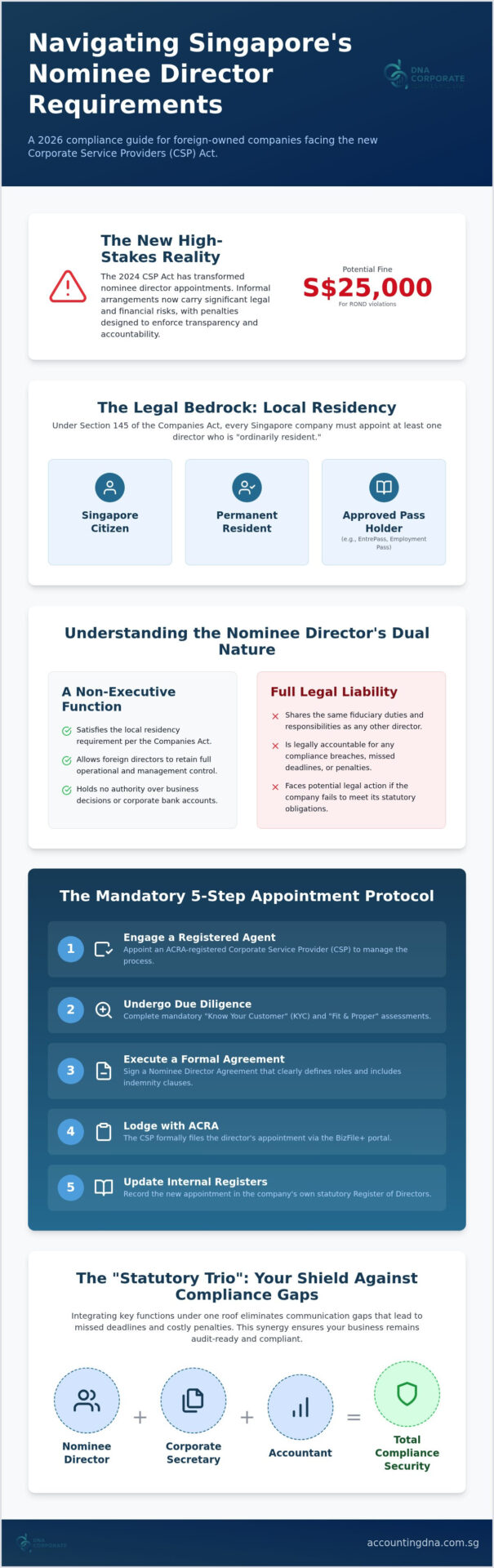
Section 145 of the Companies Act 1967 is the bedrock of your local presence. It demands that every company maintains at least one director who is “ordinarily resident” in Singapore. This means your appointee must be a Singapore Citizen, a Permanent Resident, or an EntrePass/Employment Pass holder with the necessary approvals. It’s a key aspect of corporate law that ensures accountability within the local jurisdiction.
The regulatory environment shifted significantly with the Corporate Service Providers (CSP) Act 2024, which became fully effective on June 9, 2025. You can no longer rely on informal “friend of a friend” setups without facing severe scrutiny. ACRA now requires all nominee arrangements to be vetted through registered filing agents who perform strict “fit and proper” assessments. Failing to meet these nominee director Singapore requirements can lead to heavy penalties, as the authorities have intensified their focus on anti-money laundering transparency.
The Role and Limitations of a Nominee Director
A nominee director is a resident individual appointed solely to satisfy nominee director Singapore requirements while the foreign owner retains operational control. In practice, this role is non-executive; they typically don’t participate in your daily business decisions or hold signing authority for corporate bank accounts. However, they aren’t just a name on a page. Legally, a nominee holds the same fiduciary duties and potential liabilities as any other director. If your company misses a filing deadline or breaches a regulation, they’re legally responsible. This is why professional corporate secretarial services are essential to manage these risks effectively.
Navigating Appointment Process and Statutory Obligations
Appointing a local director involves more than just a signature. It’s a procedural sequence strictly governed by the Singapore Companies Act 1967. To meet the nominee director Singapore requirements, your first step is engaging an ACRA-registered Filing Agent. They’ll conduct mandatory “Know Your Customer” (KYC) and due diligence checks. This process ensures all parties are vetted and “fit and proper” under the latest regulations.
Once vetting is complete, you’ll execute a formal Nominee Director Agreement. This document is your primary defense. It clearly defines the non-executive scope of the role and includes essential indemnity clauses. Finally, the appointment is lodged via BizFile+, and the company’s internal Register of Directors is updated. If you’re unsure about the paperwork, our team is available to guide you through the lodgment.
Maintaining the Register of Nominee Directors (ROND)
Since June 16, 2025, companies have been required to maintain a private ROND at their registered office or CSP’s office. This isn’t just a one-time filing. You must follow the “2-day rule” strictly. Any change to a nominee’s details or their nominator’s information must be updated in the internal register and filed with ACRA within 48 hours. Failing to meet these nominee director Singapore requirements can result in a fine of up to S$25,000. Learn about our corporate secretarial services to ensure your statutory registers are always audit-ready and updated within these tight windows.
Managing Compliance Risks with a Professional Nominee Service
Are you willing to risk your company’s standing on a “set and forget” digital platform? While many providers treat directorship as a simple transaction, meeting nominee director Singapore requirements in 2026 demands active, professional oversight. A professional service doesn’t just provide a name; it offers a protective layer against statutory defaults and ACRA late filing penalties. With fines for anti-money laundering breaches reaching up to S$100,000 under the CSP Act, the stakes for foreign founders have never been higher.
Our boutique model prioritizes bespoke care over generic automation. We understand that international founders often operate across different time zones. That’s why we offer extreme accessibility, including evening and weekend support, to ensure you’re never left waiting for an answer. Compliance isn’t a chore to be automated, but a foundation to be managed by experts who understand your business DNA. Explore our bookkeeping and accounting services to see how we integrate your financial health with strict nominee director Singapore requirements for a truly holistic compliance experience.
Securing Your Singapore Business Future in 2026
Your journey in Singapore should be defined by growth, not regulatory stress. We’ve explored how meeting the nominee director Singapore requirements is no longer a simple checkbox exercise; it’s a dynamic compliance obligation. From navigating the strict 48-hour ROND update rule to leveraging the synergy of the Statutory Trio, staying ahead of ACRA mandates is vital for your success. Professional oversight ensures you avoid the heavy penalties associated with statutory defaults.
As an ACRA-registered filing agent, we specialize in a boutique, integrated service model that keeps your secretarial and accounting functions in perfect sync. We’re even available for consultations during non-working hours to bridge the gap across time zones. Don’t let statutory complexity hold you back. Secure your Singapore compliance today; contact DNA Accounting for professional nominee director services. We’re here to be your protective partner in this thriving market.
Frequently Asked Questions
Can a foreigner own 100% of the shares if they use a nominee director?
Yes, foreigners can absolutely own 100% of the shares in a Singapore company while using a nominee director. The nominee’s role is strictly to fulfill the legal residency requirement. They don’t hold any equity or beneficial interest in your business. This setup allows you to maintain full control over your company’s shares and profits while staying compliant with the law.
What happens if my nominee director resigns suddenly in 2026?
If your nominee director resigns, you must appoint a replacement who meets the nominee director Singapore requirements immediately. A company cannot legally operate without at least one ordinarily resident director. You’ll need to update ACRA via BizFile+ and refresh your internal registers within the mandated timelines. Using a professional firm ensures a backup is always available to prevent such stressful compliance gaps.
Does a nominee director have access to my corporate bank account?
No, a professional nominee director typically does not have access to your corporate bank accounts or any signing authority. While they hold legal responsibility for the company’s compliance, the service agreement specifically restricts their role to non-executive functions. You retain sole control over all financial transactions and daily operations. This boundary is a standard practice to protect your business assets and privacy.
What are the penalties for failing to have a resident director in Singapore?
Failing to maintain a resident director is a serious offense that can lead to heavy fines for the company and its officers. ACRA may also take action to strike off the company from the register. Under the 2026 regulatory framework, the penalties for non-compliance with nominee director Singapore requirements can include fines up to S$25,000 or even imprisonment in extreme cases of persistent default.
Disclaimer
The information provided on this website is for general informational purposes only and is not intended to constitute professional accounting, tax, legal, or financial advice. While we strive to ensure that the content is accurate and up to date, regulations in Singapore, including those administered by ACRA, IRAS, CPF Board, and MOM, may change from time to time and may differ depending on individual circumstances.
Readers should not act or rely on any information contained on this website without seeking specific advice from a qualified professional based on their individual situation.
DNA Corporate Services and its affiliates accept no responsibility or liability for any loss or damage arising from reliance on the information provided in this website or any linked materials.
For tailored advice relating to accounting, taxation, corporate secretarial, or compliance matters in Singapore, please contact us directly for professional consultation.



