

Why does a “cheap” accounting package often end up costing you more in ACRA penalties than the service itself? It’s a common trap for many local business owners. When you search for bookkeeping fees in Singapore, you’re typically met with vague “starting from” rates that don’t account for the complexity of GST or the stricter 2026 ACRA filing requirements. You deserve a pricing structure that’s as transparent as your own ledger.
We know that managing a growing SME is demanding, and the last thing you need is the stress of a late filing notice hitting your desk. You want a reliable guide who treats your compliance as a priority, not just another transaction. This guide provides a clear breakdown of current service models to help you budget with total confidence. We’ll explore how to avoid hidden costs, ensure your IRAS and CPF filings are flawless, and find a boutique partner who’s available when you actually need them to help your business thrive in the local landscape.
Key Takeaways
- Understand the typical market range for professional services and why viewing them as a compliance insurance policy protects your business from heavy ACRA penalties.
- Learn how transaction volume and business complexity directly influence bookkeeping fees in Singapore so you can budget accurately for the 2026 financial year.
- Discover which service frequency, whether monthly, quarterly, or annual, best aligns with your GST obligations and cash flow visibility needs.
- Identify red flags in “too good to be true” accounting quotes to ensure your package includes essential ECI submissions and statutory filings.
- Find out how a boutique partner provides the personalized support and accessibility required to navigate Singapore’s strict regulatory landscape with confidence.
Understanding Bookkeeping Fees in Singapore: Why Prices Vary
Bookkeeping fees in Singapore aren’t just a monthly expense; they’re a vital investment in your company’s standing with the Accounting and Corporate Regulatory Authority (ACRA). Under the Singapore Companies Act, every director’s legally responsible for maintaining “proper books of account” that sufficiently explain transactions and financial position. These fees represent the cost of ensuring your records stay accurate and ready for statutory filing. While the market range for SMEs spans from S$150 to over S$1,000 per month, your actual bookkeeping fees in Singapore depend on the support your business model requires.
Many entrepreneurs initially view bookkeeping as simple data entry. However, professional firms utilize standard methods of bookkeeping to ensure every ledger entry aligns with the Singapore Financial Reporting Standards (SFRS). This precision differentiates a basic service from a comprehensive compliance partnership. It’s about having a clear trail for IRAS audits and a reliable foundation for your Year of Assessment tax filings.
The “Cheap” vs. “Professional” Accounting Dilemma
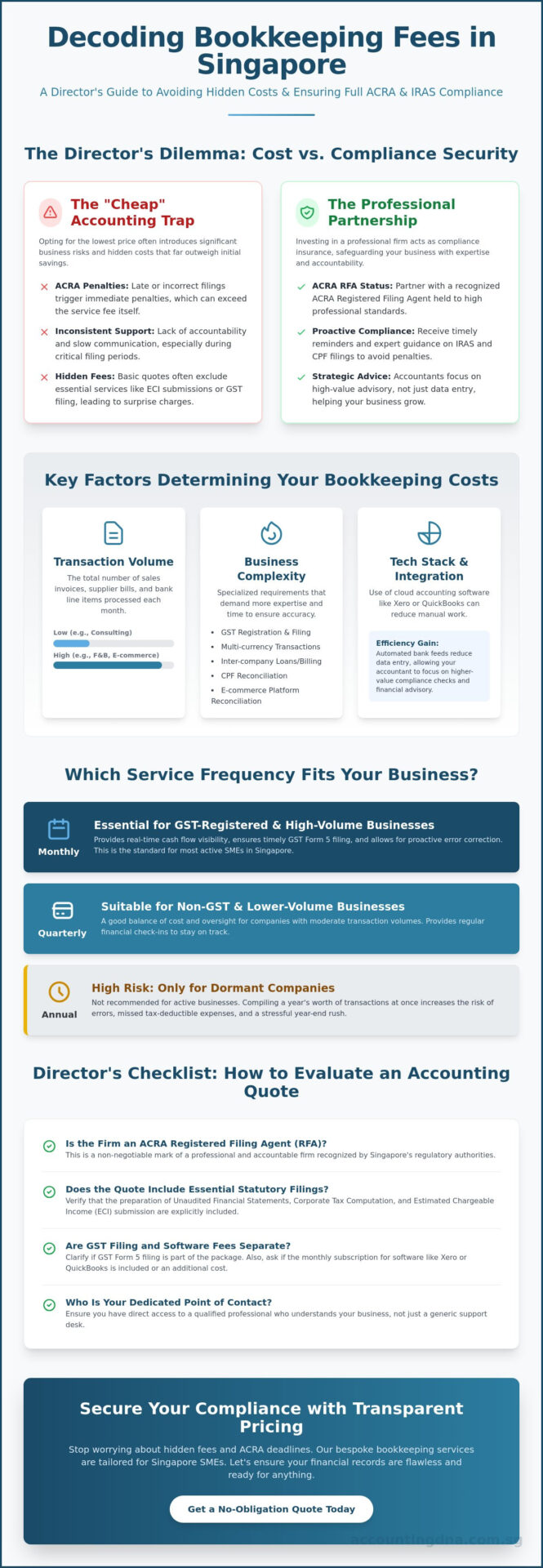
It’s tempting to opt for the lowest quote from a freelancer or a “factory-style” firm. But what happens when a deadline’s missed? Choosing a provider based solely on the lowest price often leads to inconsistent communication and a lack of accountability. Professional firms justify their rates through qualified expertise and the security of being an ACRA Registered Filing Agent (RFA). This status means the firm’s recognized by the authorities and held to high professional standards. When you partner with a dedicated team, you aren’t just paying for numbers on a screen; you’re paying for the peace of mind that comes from knowing your bookkeeping and accounting services are handled by experts who understand the local SME landscape.
Why 2026 Compliance Standards Matter for Your Budget
As we move through 2026, regulatory requirements have become significantly more stringent. ACRA’s officially removed the end of month grace period for filing deadlines. Penalties are now triggered the very day after a deadline passes. IRAS also expects businesses to maintain digital records that can be easily integrated into the evolving XBRL filing formats. These technical requirements increase the complexity of the work involved. Your service fee should reflect a proactive approach where your partner provides deadline reminders and ensures your software’s compliant with the latest government standards. In this high stakes environment, a partner who understands these nuances is a protective asset for your business growth.
Key Factors Determining Your Bookkeeping Costs
Understanding what drives your quote is the first step to avoiding hidden surprises. Most bookkeeping fees in Singapore are structured around the time it takes to reconcile your accounts and the level of technical oversight required to keep you compliant with IRAS. It’s not just about the number of sales invoices you issue; it’s a calculation of risk, volume, and the complexity of your financial ecosystem.
A common mistake many directors make is assuming that “low activity” equals “low cost.” While general resources like a guide to small business bookkeeping offer a global perspective, the Singapore context adds layers like the 9% GST and specific CPF reconciliation requirements. If you’re unsure how your current volume translates to a monthly fee, you can speak with our team for a transparent assessment of your needs.
Transaction Volume and Complexity Breakdown
In the Singapore context, a “transaction” includes every sales invoice, supplier bill, and bank statement line item. For F&B or e-commerce businesses, high transaction volumes are the norm. These industries require meticulous matching of merchant statements (like GrabFood or Shopify) against bank deposits. If your business deals with multi-currency transactions or inter-company loans, the complexity increases. Tracking GST-taxable supplies versus zero-rated exports also requires higher level expertise to ensure your Form 5 filings are accurate and don’t trigger an IRAS audit.
Software and Cloud Accounting Integration
Modern bookkeeping fees in Singapore are heavily influenced by your choice of software. Tools like Xero and QuickBooks Online have revolutionized how we manage data. While you’ll typically pay a separate monthly subscription fee for the software, the automation it provides can actually lower your service costs. Automated bank feeds reduce manual data entry, allowing your accountant to focus on high value advisory work instead of just punching in numbers. However, the quality of your source documents still matters. Organized digital files processed through apps like Dext are far more cost effective to manage than a “shoebox” of faded thermal receipts delivered at the end of the financial year. If you’re weighing your options, our detailed comparison of SME accounting services Singapore businesses rely on, including Xero vs. QuickBooks, can help you identify the right platform for your compliance needs in 2026.
Monthly vs. Quarterly vs. Annual: Which Model Fits You?
Choosing the right frequency for your record-keeping is a strategic decision that impacts both your operational clarity and your total annual spend. While some firms push a standard monthly subscription for every client, your choice should reflect your company’s specific transaction volume and statutory obligations. When evaluating bookkeeping fees in Singapore, you’ll find that providers typically offer three main models: monthly, quarterly, or annual. Each has its own merits depending on your business stage and whether you’re navigating GST requirements or simple annual compliance.
For many active businesses, the quarterly model is dictated by GST obligations. If your taxable turnover exceeds S$1 million, or if you’ve opted for voluntary registration, you must file GST returns every three months. This makes quarterly bookkeeping a mandatory baseline. Waiting until the end of the year to “catch up” on twelve months of data is a risky and often more expensive strategy. This approach usually results in higher fees due to the intensive labor required to reconstruct accounts under tight deadlines. The rush to meet a July 31 deadline for a December year-end can lead to avoidable penalties and higher service premiums from providers who have to prioritize your urgent request.
Monthly Bookkeeping: The Gold Standard for Growth
Do you know your exact profit margins for last month? Monthly maintenance provides the real-time financial health checks necessary to make informed business decisions. Beyond simple compliance, having up-to-date management accounts is a prerequisite for most SME bank loan applications in Singapore. By engaging professional bookkeeping and accounting services on a monthly basis, you ensure that your financial data’s always investor-ready. This proactive model eliminates year-end stress and allows for a more predictable pricing structure that spreads your bookkeeping fees in Singapore across the fiscal year.
Annual Compilation for Small and Dormant Firms
If your company’s an Exempt Private Company (EPC) with very low activity or is currently dormant, an annual compilation model might be the most cost-effective choice. To qualify as an EPC, your company must have no corporate shareholders and fewer than 20 members. For businesses with fewer than 10 transactions a year, paying a monthly retainer isn’t always necessary. A smart cost-saving strategy is to prepare your annual accounts in January or February rather than waiting for the July filing peak. This early preparation gives your accountant more time to identify tax-saving opportunities under the Start-Up Tax Exemption (SUTE) or the 2026 CIT Rebate before the IRAS November 30 filing deadline. Before finalizing your approach, it’s worth conducting a small business financial health check to ensure your chosen model truly reflects the state of your company’s cash flow and compliance standing.
How to Evaluate an Accounting Quote: A Director’s Checklist
How do you know if a quote is genuinely competitive or just incomplete? Comparing bookkeeping fees in Singapore can be frustrating because many providers don’t list their exclusions. As a company director, the legal responsibility for accurate filings stays with you, even if you outsource the work. This makes it vital to look beyond the monthly dollar amount and scrutinize the scope of service. A quote that seems like a bargain might actually leave you vulnerable to ACRA penalties or IRAS audits if essential tasks are omitted.
When you review a proposal, start by checking for the firm’s Registered Filing Agent (RFA) status. This qualification isn’t just a badge; it’s your assurance that the firm is authorized by ACRA to handle your statutory filings. You should also verify if the quote includes the submission of your Estimated Chargeable Income (ECI) within three months of your financial year end. If these “add-ons” aren’t explicitly mentioned, you might find yourself facing surprise admin fees or, worse, missed deadlines that trigger automatic fines starting at S$300.
Red Flags in Cheap Bookkeeping Packages
If you encounter unusually low fees, proceed with caution. Many “budget” packages exclude bank reconciliations, which are the backbone of any reliable set of accounts. Without matching your ledger to your bank statements, your financial reports are essentially guesswork. Another common red flag is the lack of a dedicated account manager. Larger, impersonal firms often treat SMEs like a number in a factory line, leading to inconsistent communication and slow response times. In a regulatory environment where ACRA has removed the end of month grace period, you can’t afford to wait three days for an email reply when a deadline is looming.
Hidden Value: What Your Fee Should Actually Buy
A professional service should provide more than just data entry; it should offer a layer of protection for your business. This includes proactive tax planning advice before your financial year ends, ensuring you maximize the 2026 CIT Rebates and other available incentives. Your fee should also cover basic assistance with ACRA and IRAS correspondence so you don’t have to navigate complex government letters alone. You can view our DNA Accounting Pricing for transparent examples of how we bundle these essential services to support local growth.
Are you tired of hidden costs and impersonal service? Our boutique team is here to provide the dedicated, accessible support your business deserves. You can request a customized quote today to see how we can simplify your compliance for 2026.
Bespoke Bookkeeping with DNA Accounting: Professional Support
Finding the right partner is about more than just comparing bookkeeping fees in Singapore. It’s about finding a team that treats your company’s success as their own. While larger, “factory-style” firms might offer lower entry prices, they often lack the personalized attention that a growing SME requires. You aren’t just a client number to us. We understand the unique challenges of the local landscape, from managing 9% GST compliance to meeting the strict 2026 ACRA filing deadlines. Our boutique approach ensures that your financial foundation is solid, allowing you to focus on what you do best: building your business.
We provide a centralized service model that integrates your accounting, corporate secretarial, and tax requirements. This holistic approach eliminates communication gaps and ensures that your filings are consistent across all government portals. When your bookkeeper and corporate secretary work in tandem, you don’t have to worry about mismatched dates or forgotten resolutions. It’s a seamless experience designed to provide you with total confidence in your regulatory standing.
Personalized Care for Singapore Startups and SMEs
What sets us apart is our commitment to being there when you actually need us. We know that as a founder, your most important questions often arise after the standard workday ends. That’s why we pride ourselves on being accessible during evenings and weekends. You get direct access to experienced advisors who understand the nuances of your specific industry. We don’t just hand over a standard profit and loss statement; we provide customized reporting that gives you a clear view of your cash flow and margins. This level of detail is essential for making informed decisions in a competitive market like Singapore. If you’re unsure where your business currently stands, our small business financial health check for Singapore SMEs offers a practical starting point to assess your key metrics before your next advisory session.
Get a Transparent Quote Today
Are you currently struggling with inconsistent communication or hidden costs in your current accounting package? Transitioning to a professional firm is simpler than you might think. Whether you’re moving from a DIY spreadsheet or an impersonal larger firm, we handle the handover process with care and precision. We invite you to have a no-obligation conversation with us to discuss your transaction volume and specific compliance needs. We’ll provide a clear, transparent breakdown of bookkeeping fees in Singapore that reflects the true value of professional support. You can contact DNA Accounting today for a bespoke fee proposal and take the first step toward a stress-free financial future.
Secure Your Business Foundation for 2026
Managing a business in Singapore is a rewarding journey, but the weight of statutory compliance shouldn’t rest solely on your shoulders. You’ve seen how transaction volume, GST requirements, and the need for digital record-keeping influence the market range for bookkeeping fees in Singapore. By choosing a partner who prioritizes transparency over “cheap” entry rates, you protect your company from the rising costs of ACRA late-filing penalties and ensure your financial data is always investor-ready.
Since 2016, we’ve dedicated ourselves to helping local SMEs navigate these complexities with bespoke, hands-on support. As an ACRA Registered Filing Agent (RFA), we provide the authoritative expertise you need, balanced with a level of accessibility that larger firms simply can’t match. Whether you have an urgent query on a weekend or need a deep dive into your tax planning during the evening, our team is ready to assist. Don’t let accounting stress distract you from your growth goals. Take the first step toward a more organized, compliant, and stress-free financial year today.
Get a Transparent Bookkeeping Quote for Your SME
Frequently Asked Questions
How much does monthly bookkeeping cost for a small business in Singapore?
Monthly costs for small businesses typically depend on your specific transaction volume and the complexity of your financial operations. For a low activity startup, you might find entry level support starting at a few hundred dollars; however, active SMEs with GST and payroll needs should budget for more comprehensive packages. It’s essential to ensure your fee includes bank reconciliations and proper ledger maintenance to meet ACRA requirements.
Are bookkeeping fees tax-deductible in Singapore?
Yes, bookkeeping fees are generally tax-deductible as they’re considered expenses incurred “wholly and exclusively” in the production of income. These professional costs can be used to reduce your company’s chargeable income before applying the flat 17% corporate tax rate. Keeping accurate records of these payments is necessary for your Form C-S or Form C submission to IRAS during the tax season.
Do I need to pay for bookkeeping if my company is dormant?
Even a dormant company has statutory obligations that require professional oversight. While you won’t have daily transactions to record, you must still prepare a dormant statement and file an Annual Return with ACRA. Most firms offer a reduced annual fee for dormant companies to handle these specific compliance filings and maintain your company secretary records without the cost of monthly maintenance.
Is GST filing usually included in bookkeeping fees?
GST filing is often treated as a separate add-on service rather than being bundled into basic bookkeeping fees in Singapore. Because GST-registered businesses must file quarterly and maintain specific tax invoices, the workload is significantly higher. You should check if your quote includes the preparation of Form 5 and the necessary reconciliation between your accounting software and the IRAS MyTax Portal.
Why do some firms charge based on transaction volume instead of a flat fee?
Transaction-based pricing ensures you only pay for the actual labor required to process your accounts. A business with 200 monthly invoices takes much longer to reconcile than one with 20; therefore, volume-based tiers prevent low-activity firms from subsidizing larger ones. This model provides a fair pricing structure for bookkeeping fees in Singapore that scales naturally as your SME grows and your financial data becomes more complex.
What happens if my bookkeeper makes a mistake that leads to an IRAS penalty?
The legal responsibility for accurate filings ultimately rests with the company directors under the Singapore Companies Act. If a mistake occurs, you’re liable for the penalty; however, a professional firm with Registered Filing Agent status will typically assist in drafting an appeal to IRAS. This is why it’s crucial to choose a partner with professional indemnity and a proven track record of accuracy in local compliance.
Can I switch bookkeeping providers in the middle of the financial year?
You can switch providers at any time; it doesn’t have to be at the end of the financial year. A smooth transition involves handing over your current year-to-date trial balance, general ledger, and previous bank reconciliations to the new firm. Professional providers are used to this process and will work to ensure your 2026 filing deadlines are met without any disruption to your business operations.
Disclaimer
The information provided on this website is for general informational purposes only and is not intended to constitute professional accounting, tax, legal, or financial advice. While we strive to ensure that the content is accurate and up to date, regulations in Singapore, including those administered by ACRA, IRAS, CPF Board, and MOM, may change from time to time and may differ depending on individual circumstances.
Readers should not act or rely on any information contained on this website without seeking specific advice from a qualified professional based on their individual situation.
DNA Corporate Services and its affiliates accept no responsibility or liability for any loss or damage arising from reliance on the information provided in this website or any linked materials.
For tailored advice relating to accounting, taxation, corporate secretarial, or compliance matters in Singapore, please contact us directly for professional consultation.



