

What if your bank balance is lying to you about the actual strength of your company? Many Singapore directors find themselves in a frustrating position where the profit and loss statement shows growth, yet the bank account feels dangerously thin. It’s a common struggle to distinguish between paper profit and real-world cash flow, especially when you’re also worried about missing an ACRA filing deadline or miscalculating the latest IRAS requirements. You aren’t alone in feeling that a small business financial health check is long overdue to clear the fog and secure your firm’s future.
We understand that interpreting complex financial statements can feel like learning a second language. That’s why we’ve designed this guide to provide you with a clear, actionable roadmap for 2026. You’ll gain peace of mind by mastering the specific metrics that indicate true stability while ensuring you stay on the right side of Singapore’s statutory regulations. We’ll preview the essential checklist for the year ahead, covering everything from the 9% GST rate to the updated S$8,000 CPF Ordinary Wage ceiling and the YA 2026 Corporate Income Tax rebate. This ensures you can focus on strategic growth instead of worrying about late filing penalties.
Key Takeaways
- Discover how a comprehensive financial review serves as a diagnostic tool for both your company’s profitability and its standing with ACRA.
- Perform a small business financial health check to stay ahead of 2026 digital tax updates and ensure your bookkeeping aligns with the latest IRAS standards.
- Master the art of analyzing your Statement of Comprehensive Income to protect your margins from rising operational costs.
- Learn to interpret your balance sheet to maintain the solvency required for securing future financing from Singaporean banks.
- Recognize early warning signs like negative cash flow and high debt levels before they impact your ability to scale in the local market.
Understanding the Small Business Financial Health Check in Singapore
Think of a small business financial health check as a vital diagnostic tool. It measures your company’s pulse across both profitability and regulatory standing. Entering 2026, this isn’t just a yearly chore; it’s a proactive necessity. With IRAS moving toward more integrated digital tax requirements, staying ahead of the curve protects your growth. This review is a reassuring process. It’s about identifying hidden opportunities for efficiency rather than just hunting for mistakes. We focus on three core pillars: liquidity, profitability, and your statutory compliance.
Why “Cash in Bank” is Often a Deceptive Metric
Your current bank balance doesn’t tell the whole story. You might see a comfortable sum, but have you accounted for the 9% GST you’ve collected or the upcoming CPF contributions for your team? A healthy bank balance today can mask a looming compliance debt tomorrow if GST and tax provisions are not set aside. For startups, understanding your burn rate within the high-cost Singapore market is critical. It’s about how long your actual cash reserves last after stripping away future liabilities. Founders who invest in proper bookkeeping services for startups gain a clearer picture of their true runway from day one. This requires a foundation in understanding financial analysis to truly gauge your runway.
The Role of ACRA and IRAS in Your Business Vitality
Financial health isn’t just about numbers. It’s about your legal right to operate. If your company falls into “Defaulter” status with ACRA, the consequences are severe. Your corporate bank account can be frozen, halting your operations instantly. Maintaining statutory compliance Singapore is as important as your sales figures. Even if you qualify for an audit exemption, being audit-ready ensures your records are transparent and trustworthy for future investors or bank loans. We see this as a protective shield for your hard work.
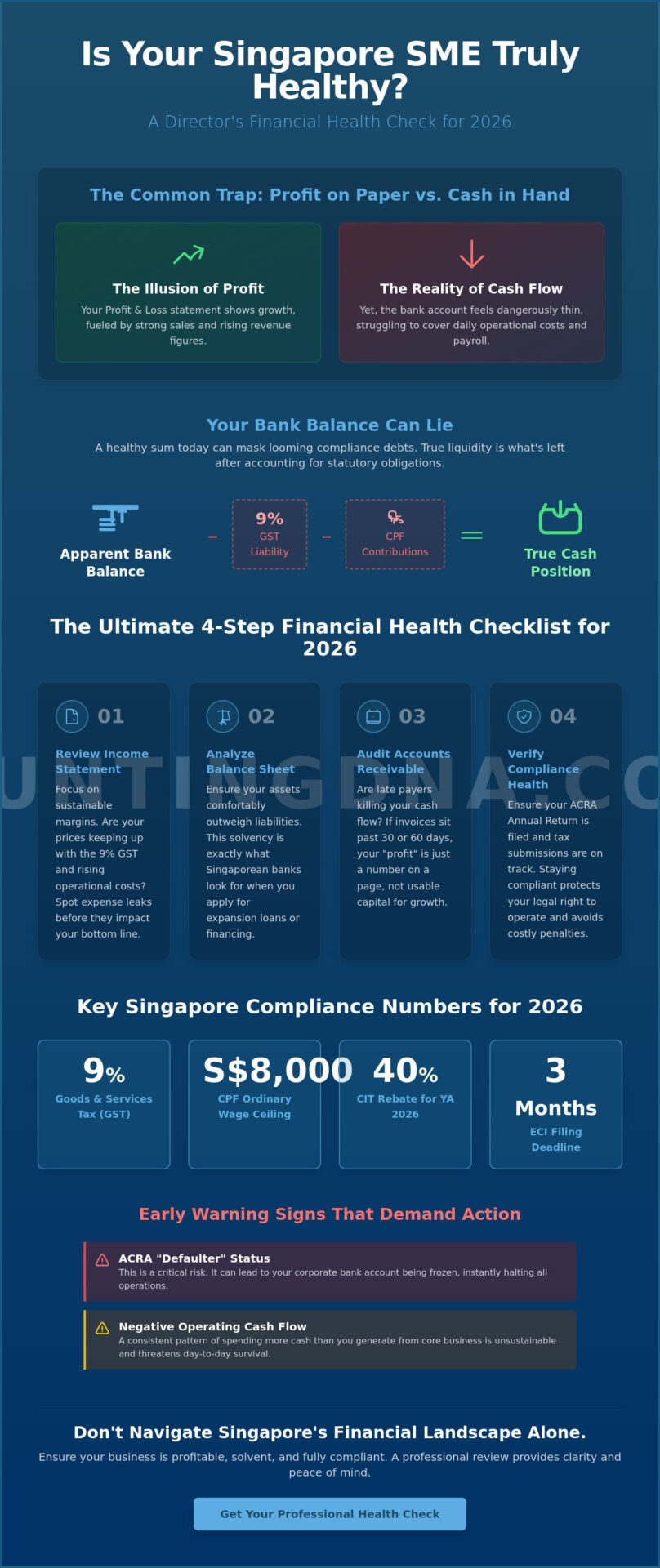
The Ultimate 2026 Small Business Financial Health Checklist
Is your business actually growing, or is it just getting busier? A thorough small business financial health check requires looking beyond the surface bank balance. We’ve broken this down into four essential steps that every Singapore director should follow to maintain a resilient enterprise. It’s about ensuring your operational engine is running without friction while keeping the regulators happy.
- Step 1: Review the Statement of Comprehensive Income. Focus on your sustainable margins. Are your prices keeping up with the 9% GST and rising utility costs?
- Step 2: Analyze the Balance Sheet. Ensure your assets comfortably outweigh your liabilities. This solvency is what Singapore banks look for when you apply for expansion loans.
- Step 3: Audit the Accounts Receivable aging report. Are late payers killing your cash flow? If invoices are sitting past 30 or 60 days, your “profit” is just a number on a page, not usable capital.
- Step 4: Verify Compliance Health. This includes checking your ACRA Annual Return status and ensuring your tax submissions are on track.
Analyzing Your Profitability and Operating Efficiency
Don’t just look at the bottom line. For service and retail sectors in Singapore, you must distinguish between gross and net margins. Are your “Other Services” costs, such as software subscriptions or external consultants, bloating your overheads? Accurate bookkeeping and accounting services help you spot these leaks before they become floods. If you’re unsure where the money is going, it’s time to dig into the transaction details.
The Singapore Compliance Sub-Checklist
Compliance is the backbone of your business vitality. Have you filed your Estimated Chargeable Income (ECI) within three months of your financial year-end? Missing this can lead to unnecessary friction with IRAS. You also need to ensure CPF contributions for local employees are accurate, especially with the 2026 Ordinary Wage ceiling of S$8,000. For GST-registered firms, reconciling Input and Output tax every quarter is non-negotiable. Proper corporate tax filing Singapore ensures you claim all available rebates, like the 40% CIT rebate for YA 2026. If these deadlines feel daunting, you can reach out for a professional review to keep your records spotless.
Identifying Red Flags and Moving Toward Sustainable Growth
When to Seek Professional Intervention
There comes a point where DIY bookkeeping becomes a liability rather than a cost-saving measure. As your SME grows, the complexity of 9% GST reconciliation and the S$8,000 CPF wage ceiling requires more than a simple spreadsheet. Early-stage companies especially benefit from dedicated bookkeeping services for startups that scale alongside their growth without the overhead of an in-house team. Shifting to a boutique firm offers the personalized, bespoke care you won’t find at larger agencies. We pride ourselves on being accessible when you need us most, including evenings and non-working days. You can contact us for a bespoke financial health consultation to see exactly where your business stands.
Leveraging Cloud Accounting for Real-Time Monitoring
Waiting for the end of the financial year to check your health is a risky strategy. By using Singapore-ready versions of Xero or QuickBooks, you can automate many of the metrics we’ve discussed. These platforms provide real-time data, allowing you to spot cash flow dips before they happen. For more details on choosing the right platform, see our guide on SME accounting services Singapore. You can also explore our accounting services Singapore to find a package that fits your current stage of growth and budget.
Securing Your Business Resilience for the Year Ahead
Since 2016, DNA Accounting has served as a dedicated partner for Singapore SMEs, providing the deep technical expertise needed to navigate ACRA and IRAS requirements. As a boutique firm, we offer you direct access to senior advisors who understand your unique challenges. We don’t just process numbers; we provide the protective guidance your business deserves. Don’t wait for a red flag to appear before taking action. Book Your Bespoke Financial Health Consultation with DNA Accounting today to ensure your path to 2026 is clear and profitable. Your peace of mind is our priority, and we’re ready to help you build a stronger foundation.
Frequently Asked Questions
How often should a Singapore SME perform a financial health check?
You should perform a small business financial health check at least once every quarter to stay ahead of market shifts. This frequency aligns perfectly with your quarterly GST filing cycles and allows you to adjust your strategy before the financial year-end. Waiting until the annual tax season often means it’s too late to fix cash flow leaks or capitalize on missed deduction opportunities that could have saved your business money.
What is the most important financial ratio for a small business in Singapore?
The Current Ratio is arguably the most critical metric for a Singapore SME because it measures your ability to pay short-term liabilities with current assets. In our local business environment, having a ratio above 1.5 ensures you can comfortably cover staff salaries, CPF contributions, and supplier invoices. While profit margins are important for long-term growth, this specific liquidity ratio determines whether your doors stay open during a slow month.
Can a business be profitable but still fail a financial health check?
Yes, a business can show high paper profits while failing a small business financial health check due to poor cash flow or non-compliance. If your capital is locked in aging accounts receivable, you won’t have the liquidity to meet immediate obligations like rent or payroll. Additionally, a company with high earnings but outstanding ACRA late filing fees or inaccurate GST records faces statutory risks that can lead to frozen bank accounts.
What are the specific IRAS penalties for poor financial record-keeping in 2026?
In 2026, IRAS mandates that businesses maintain proper records for at least five years; failure to do so can result in fines up to S$5,000. For serious cases of negligence or repeated non-compliance, directors may even face prosecution. Beyond the direct financial penalties, poor record-keeping often leads to the loss of your Corporate Income Tax rebate, which is capped at S$30,000 for the Year of Assessment 2026.
Disclaimer
The information provided on this website is for general informational purposes only and is not intended to constitute professional accounting, tax, legal, or financial advice. While we strive to ensure that the content is accurate and up to date, regulations in Singapore, including those administered by ACRA, IRAS, CPF Board, and MOM, may change from time to time and may differ depending on individual circumstances.
Readers should not act or rely on any information contained on this website without seeking specific advice from a qualified professional based on their individual situation.
DNA Corporate Services and its affiliates accept no responsibility or liability for any loss or damage arising from reliance on the information provided in this website or any linked materials.
For tailored advice relating to accounting, taxation, corporate secretarial, or compliance matters in Singapore, please contact us directly for professional consultation.



