

What if a single clerical error on your GST F5 return could trigger a penalty of up to S$10,000? For many Singapore SME directors, the fear of an unexpected IRAS audit is a constant weight on their shoulders, especially when common GST filing mistakes Singapore businesses often overlook can lead to heavy interest charges and unnecessary stress. With the 9% GST rate and the 2026 InvoiceNow mandates for voluntary registrants adding new layers of complexity, it’s completely natural to feel a sense of dread as filing deadlines approach. You’re managing manual records and trying to grow a company, so the pressure to be perfect is immense.
We understand that you’d rather focus on your customers than worry about whether you’ve misclassified an exempt supply or missed a reverse charge on imported services. This guide identifies the most frequent errors and shows you the exact steps to rectify them before IRAS identifies a discrepancy. We’ll walk you through using the GST F7 form for voluntary disclosures and share practical ways to strengthen your internal controls. By the end of this article, you’ll have the confidence to ensure your filings are accurate and your business remains fully compliant without the sleepless nights.
Key Takeaways
- Avoid the “S$1 million trap” by understanding when you are legally required to register for GST before IRAS imposes backdated liabilities and heavy fines.
- Protect your business from disallowed claims by identifying prohibited input tax expenses, such as S-plated cars, club memberships, and medical insurance for staff.
- Master the “S$3,000 rule” to know exactly when to use Form F7 versus an F5 adjustment for common GST filing mistakes Singapore SMEs encounter.
- Learn how the Voluntary Disclosure Programme can significantly reduce or even waive penalties when you proactively report filing discrepancies to the authorities.
- Verify your supplier’s registration status to avoid the trap of claiming GST on purchases from non-registered entities, ensuring every input tax claim is audit-proof.
Major Output Tax and Registration Errors Singapore SMEs Make
Singapore’s Goods and Services Tax (Singapore) framework is designed for efficiency, yet for many business owners, it remains a source of quiet anxiety. One of the most common GST filing mistakes Singapore directors make is failing to register for GST at the correct moment. You shouldn’t wait until you have physically banked S$1 million in revenue to start the process.
The Compulsory Registration Oversight
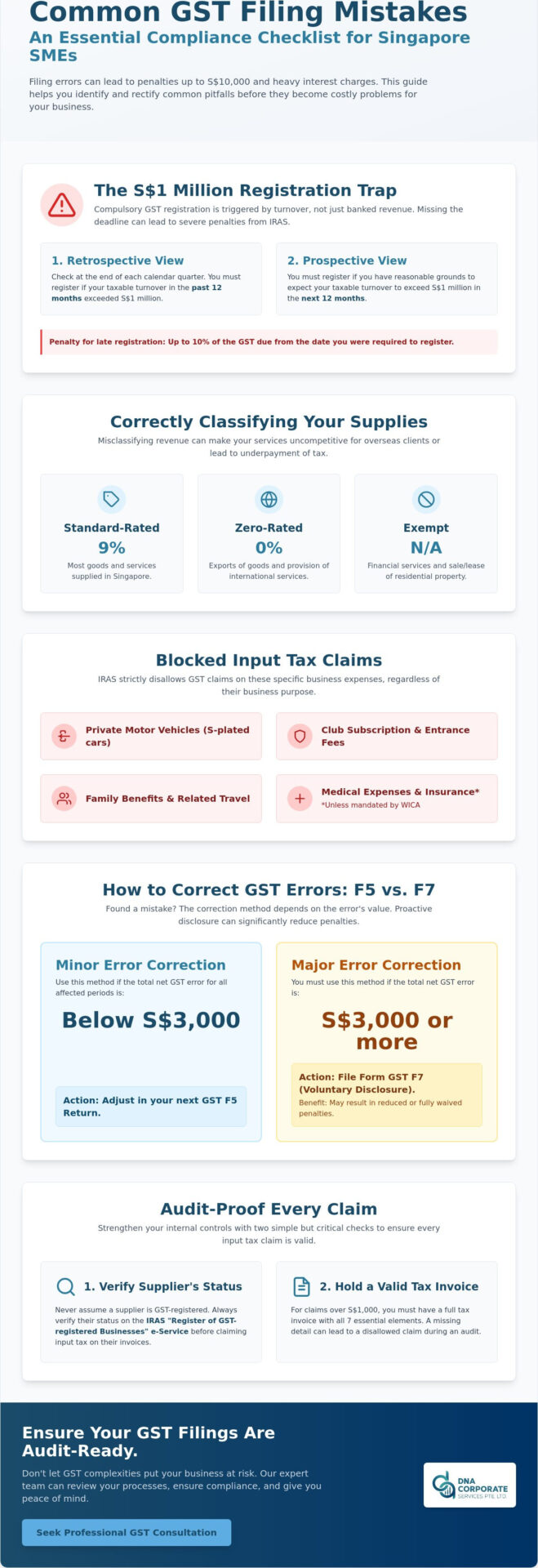
IRAS monitors your turnover through two distinct lenses. The retrospective view requires you to check at the end of every calendar quarter if your taxable turnover for the past 12 months exceeded S$1 million. The prospective view is more immediate; you must register if you have reasonable grounds to expect your turnover will exceed S$1 million in the next 12 months. Missing these specific windows can lead to a penalty of up to 10% of the GST due from the date you should have registered. It’s a heavy price for a simple data entry delay.
Misclassifying Supplies: Standard-Rated vs. Zero-Rated vs. Exempt
Misclassifying your revenue is another frequent pitfall. Standard-rated supplies currently attract the 9% rate, while zero-rated supplies, such as exports of goods or international services, are taxed at 0%. Exempt supplies, like residential property rentals or specific financial services, don’t attract GST at all. A common error is charging 9% on a service that actually qualifies as zero-rated. While it might seem “safe” to charge tax, it makes your services more expensive for overseas clients and complicates your reconciliation.
Beyond classification, you must master the “Time of Supply” rules. GST is generally accounted for at the earlier of the invoice date or the payment date. If you receive a deposit but don’t issue an invoice until the next quarter, you still need to account for that tax in the current period. Don’t forget about “Deemed Supplies” either. If you give away business assets for free or use them for personal purposes, IRAS typically requires you to account for output tax as if you had sold them. If these technical nuances feel overwhelming, our GST filing services can help ensure your records are audit-ready.
Input Tax Pitfalls: Why IRAS Disallows Certain Claims
The ‘Blocked Input Tax’ List Every Director Should Know
IRAS is very specific about what you cannot claim. Even if an expense is ‘for the business,’ it’s disallowed if it falls into these categories:
- Medical expenses and insurance premiums for employees, unless mandated by the Work Injury Compensation Act (WICA).
- Club subscription fees, including entrance fees for sporting or recreational clubs.
- Family travel or any expenses related to the benefit of the directors’ relatives.
- Private motor vehicles, specifically those with ‘S’ registration plates.
S-plated cars are essentially treated as private assets by IRAS, making any input tax claim on their purchase, hire, or running costs an immediate red flag for 2026 audits. If you’ve been unsure about these boundaries, you can learn more about our GST filing services to keep your claims compliant.
Record-Keeping: What Makes a Tax Invoice ‘Valid’?
For any claim exceeding S$1,000, a ‘simplified tax invoice’ won’t cut it. You must hold a full tax invoice that includes seven essential elements: the words ‘Tax Invoice’ in a prominent place, an identifying serial number, the date of issue, your supplier’s name, address, and GST registration number, your company’s name and address, a description of the goods or services, and the total amount payable including a separate breakdown of the GST. If your records are missing even one of these details, IRAS can legally disallow the claim during an audit. If you’re struggling with manual data entry or documentation gaps, it might be time to speak with a professional advisor about your internal controls.
How to Correct GST Errors and Avoid Heavy Penalties
Discovering an error after you’ve clicked ‘submit’ on the myTax Portal can be a heart-stopping moment. However, IRAS isn’t looking to punish honest mistakes; they value transparency and proactive correction. The first thing you need to determine is the scale of the discrepancy. Under the S$3,000 rule, if the net tax error is S$3,000 or less, you can typically adjust the amount in your next GST F5 return. If the error exceeds this threshold, you must file a GST F7 form to correct the specific prescribed accounting period affected. Handling these common GST filing mistakes Singapore SMEs encounter requires a calm, methodical approach to ensure you don’t accidentally compound the error.
The Voluntary Disclosure Programme (VDP) is your most powerful tool for mitigating financial damage. By coming forward before an audit begins, you can often secure a significant reduction or even a full waiver of the 5% late payment penalty. This strategic move transforms a potential compliance crisis into a demonstration of your company’s commitment to integrity. If you’re worried about past filings, you should contact DNA Accounting for a compliance review to identify and resolve issues before they escalate.
Step-by-Step: Filing the GST F7 for Past Errors
When you prepare an F7, accuracy is paramount. Start by pinpointing exactly which quarter the error occurred in and gather all supporting documents. You’ll need to provide IRAS with a clear, concise explanation of why the mistake happened. Whether it was a simple data entry slip or a misunderstanding of a new regulation, being upfront helps build trust. This transparency often leads to a smoother resolution and less scrutiny in future periods.
Implementing Professional Controls to Prevent Recurrence
Why do these errors keep happening? In 2026, manual spreadsheets remain the primary cause of filing failures. Relying on human memory and manual data entry is a high-risk strategy that rarely pays off. Transitioning to automated systems and professional accounting services in Singapore provides the internal controls needed to catch discrepancies before they reach the taxman. A robust pre-filing review is no longer a luxury; it’s a foundational requirement for any growing SME.
Securing Your Company’s Financial Future with Accurate GST Compliance
Managing a business in Singapore’s dynamic economy is challenging enough without the added weight of regulatory anxiety. We’ve explored how misclassifying supplies, claiming blocked input tax, or missing registration deadlines can lead to significant IRAS penalties. However, identifying these common GST filing mistakes Singapore directors often make is only the first step toward peace of mind. The real value lies in moving away from manual spreadsheets and establishing professional controls that protect your company’s reputation and cash flow.
Whether you’re a startup navigating your first voluntary registration or an established SME needing dedicated support for IRAS voluntary disclosures, you don’t have to manage these complexities alone. Our boutique firm provides expert Singapore tax knowledge with a level of bespoke care that larger firms often lack. We specialize in SME and startup compliance, ensuring your filings are technically accurate and submitted on time. Ensure your GST compliance is bulletproof; book a consultation with DNA Accounting today. Your business deserves a partner that is as invested in your growth as you are.
Frequently Asked Questions
What is the penalty for a GST filing mistake in Singapore?
Penalties for common GST filing mistakes Singapore businesses make vary based on the severity of the error. For late filing, you face an immediate S$200 fine and additional S$200 monthly charges up to S$10,000. If an audit reveals undercharged tax due to negligence, IRAS can impose a penalty of up to double the tax amount, along with a 5% late payment penalty and potential monthly interest charges.
Can I claim input tax if I lost the original tax invoice?
You cannot claim input tax without a valid tax invoice in your possession at the time of filing. If the original is lost, you must contact your supplier to request a certified true copy or a replacement invoice. IRAS strictly requires this documentation to substantiate your claims during an audit, so we recommend maintaining digital backups to avoid losing these vital tax credits.
What should I do if I forgot to register for GST on time?
You must notify IRAS immediately if you realize your taxable turnover exceeded the S$1 million threshold in the past 12 months. IRAS will backdate your registration to the date you were legally required to register, making you liable for GST on all past sales even if you didn’t collect it from customers. While you face a 10% penalty on the tax due, proactive disclosure is always better than waiting for an audit.
How far back can IRAS audit my GST returns?
IRAS typically audits GST returns within a five-year window from the end of the relevant accounting period. This timeline aligns with the statutory requirement for all Singapore businesses to maintain their accounting and business records for at least five years. However, it’s vital to understand that if IRAS suspects tax evasion or fraud, they have the legal authority to investigate your records indefinitely without any time limit.
Disclaimer
The information provided on this website is for general informational purposes only and is not intended to constitute professional accounting, tax, legal, or financial advice. While we strive to ensure that the content is accurate and up to date, regulations in Singapore, including those administered by ACRA, IRAS, CPF Board, and MOM, may change from time to time and may differ depending on individual circumstances.
Readers should not act or rely on any information contained on this website without seeking specific advice from a qualified professional based on their individual situation.
DNA Corporate Services and its affiliates accept no responsibility or liability for any loss or damage arising from reliance on the information provided in this website or any linked materials.
For tailored advice relating to accounting, taxation, corporate secretarial, or compliance matters in Singapore, please contact us directly for professional consultation.



