

Could a simple administrative oversight during your GST exit trigger an unexpected IRAS audit or a final tax bill you didn’t budget for? For many local business owners, the decision to stop collecting tax is often a strategic move to stay competitive, yet the actual GST de-registration process Singapore requires involves much more than just a quick update on myTax Portal. It’s completely normal to feel a bit uneasy about the technicalities of the final GST F8 return or the specific rules for accounting for remaining business assets.
We know that managing statutory compliance can feel like a daunting task when your primary focus is on running your company. This guide is designed to simplify that journey and provide you with a clear roadmap for 2026. You’ll learn how to distinguish between compulsory and voluntary cancellation rules, meet the strict 30 day application deadlines, and ensure your final filings are accurate. We’ll walk through every step to help you achieve a successful de-registration while keeping your business safe from unnecessary penalties.
Key Takeaways
- Identify the specific triggers for compulsory de-registration and why notifying IRAS within the 30 day window is vital to avoid penalties.
- Navigate the GST de-registration process Singapore mandates via the myTax Portal with a clear checklist of required documentation for a smooth approval.
- Understand how to correctly manage your effective date of cancellation to prevent the severe legal risks of wrongful tax collection.
- Master the technical requirements for your final GST F8 return, including the critical steps for accounting for remaining business assets.
- Ensure long term compliance by adhering to the 5 year record keeping rule, keeping your business audit ready even after your registration ends.
Eligibility and Timing: When Must You De-register for GST?
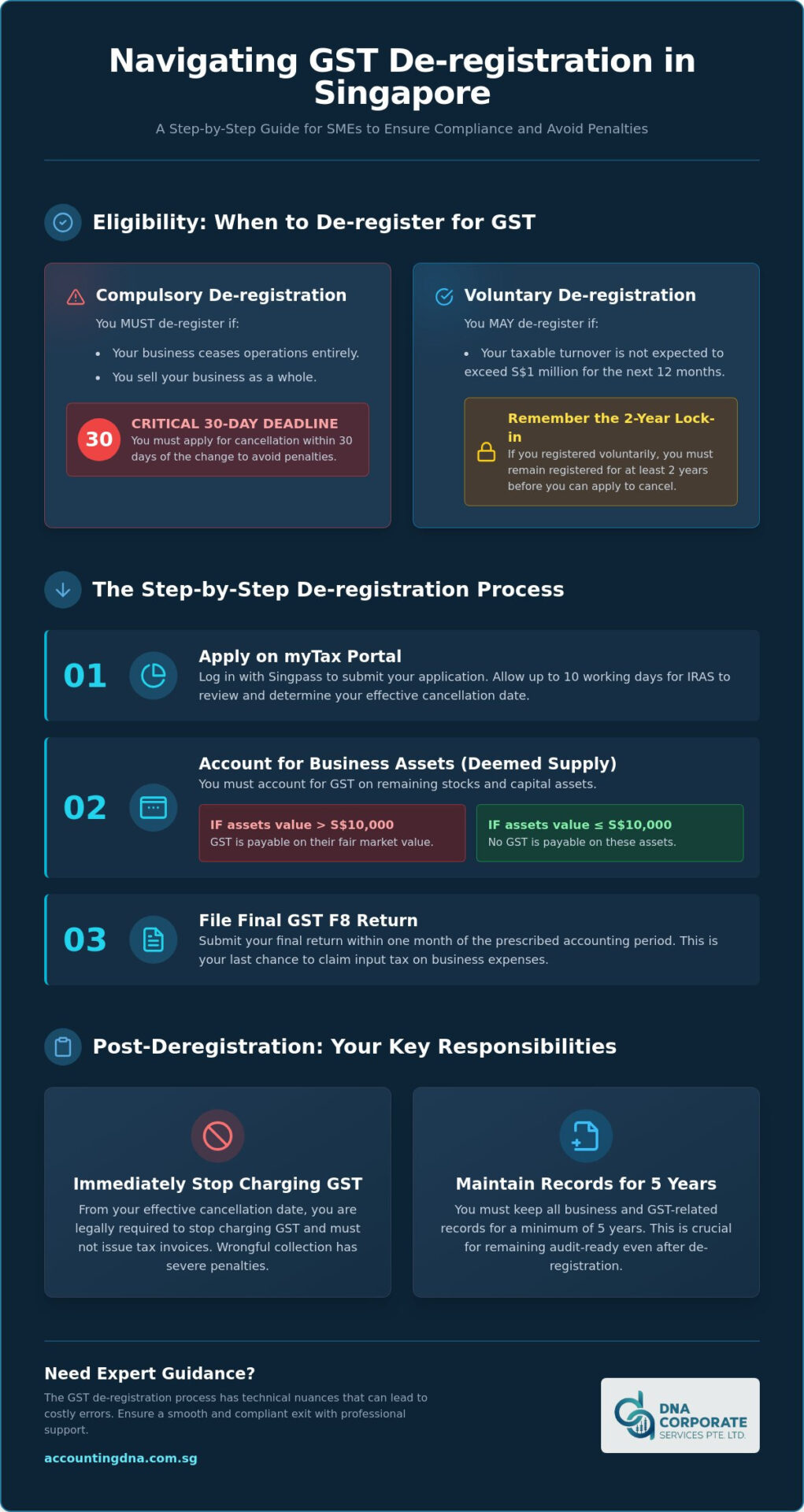
Deciding to exit the GST regime is a significant move that requires precise timing to avoid friction with IRAS. If your business stops making taxable supplies or you sell your entire enterprise, you must apply for cancellation within 30 days of that change. This 30 day window is a hard deadline. Missing it can lead to complications during the GST de-registration process Singapore mandates, especially since the current 9% rate means even a few days of “wrongful collection” can result in significant financial liabilities. Understanding Goods and Services Tax (GST) in Singapore is vital here; the tax is a trust fund you hold for the government, and once your eligibility ends, so does your right to collect it.
Compulsory vs. Voluntary De-registration
IRAS requires compulsory de-registration if your business ceases entirely or if you sell the business as a whole. However, many SMEs consider voluntary de-registration when their taxable turnover for the next 12 months is expected to stay below the S$1 million threshold. Before you jump, check your initial registration status. If you registered voluntarily in the past, you’re bound by a two year “lock-in” period. You cannot cancel your registration until those 24 months have passed, even if your revenue drops significantly. If you’re unsure about your specific timeline, our GST filing services can help clarify your current standing.
Business Transfers and Constitution Changes
A common pitfall occurs during business restructuring. If you convert your sole proprietorship into a Private Limited company, the sole proprietorship must de-register while the new entity might need to register afresh. Similarly, in a Transfer of Business as a Going Concern (TOGC), the seller must cancel their GST status as they are no longer making taxable supplies under that specific UEN. It’s a technical transition where the effective date of cancellation must align perfectly with the transfer date to keep your records audit-ready.
The Step-by-Step GST De-registration Process in Singapore
Ready to begin the formal transition? The GST de-registration process Singapore requires is primarily managed through the myTax Portal, but it demands careful attention to detail to ensure a clean break from the tax regime. You’ll need to log in using your Singpass to submit the application. While many online submissions are processed quickly, sometimes even on the same day, it’s wise to allow up to 10 working days for IRAS to finalize their review. You must propose an effective date of cancellation, but stay flexible. IRAS reserves the right to determine the official date based on your specific business circumstances and the reason for your exit.
One of the most complex hurdles involves your remaining business assets. If you have stocks or capital assets on hand at the point of cancellation, you must account for GST on them if their total fair market value exceeds S$10,000. This is treated as a ‘deemed supply’. If the total value of these assets is below this S$10,000 threshold, you aren’t required to pay GST on them. It’s a nuance that often catches company directors off guard, making the official IRAS guide to cancelling GST registration an essential reference during your preparation.
Mastering the Final GST F8 Return
Once your cancellation is approved, you’ll receive a notification to file your final return, known as Form GST F8. This must be filed within one month from the end of the prescribed accounting period stated on the return. This is your last chance to claim any input tax for business expenses incurred while you were still registered. You must also ensure that any taxable supplies spanning your cancellation date are correctly apportioned. For instance, if you’ve collected payment for a service that will be partially rendered after you de-register, the tax treatment changes at that midnight cutoff. Getting this right is vital to avoid overpaying or under-reporting your final liabilities.
Timeline and Administrative Milestones
What should you expect after you hit submit? Generally, you’ll see a status update within one to two weeks. Once you have that confirmation, you must act immediately. You’re legally required to stop charging GST and issuing tax invoices from your effective cancellation date. This means updating your accounting software, reprinting price displays, and adjusting your invoice templates to remove the 9% GST component and your GST registration number. If you find these technical adjustments overwhelming, our GST filing services Singapore can manage the transition for you.
Taking these steps promptly ensures you don’t accidentally collect tax you’re no longer authorized to hold. If you’re feeling unsure about your specific asset valuation or the F8 filing requirements, it’s always a good idea to speak with a compliance specialist to verify your figures before submission.
Post-Deregistration Compliance and Avoiding Common Pitfalls
Completing the GST de-registration process Singapore requires doesn’t mean your obligations to IRAS vanish overnight. One of the most critical pitfalls is “wrongful collection.” If your team accidentally continues to issue tax invoices showing a 9% GST charge after your effective cancellation date, you’re essentially collecting tax without authority. This can lead to heavy penalties and requires immediate disclosure to IRAS to rectify. If you’re also planning on closing your business, remember that GST de-registration must be settled before ACRA will approve the striking off of your company.
What happens if your business picks up speed again? If your taxable turnover exceeds the S$1 million threshold in the future, you’re legally required to re-register for GST. Monitoring your rolling 12 month turnover remains a vital bookkeeping task even for non-registered firms to ensure you don’t miss the 30 day window for compulsory re-registration. It’s a strategic balance between maintaining lean operations and staying ready for growth.
Record Keeping and IRAS Audit Readiness
IRAS requires all businesses to maintain their records for at least five years, even after de-registration. This archive should include tax invoices, receipts, and export documents to prove that your past filings were accurate. Transitioning to cloud accounting before you exit can make this long term compliance much easier to manage. For a broader look at your ongoing duties, check out The Master Guide to Statutory Compliance in Singapore. You can also find technical specifics in the Official IRAS GST De-registration Guide to ensure your archive meets their standards.
Strategic Next Steps for Your Business
Is your current accounting setup robust enough to track your turnover without the GST framework? Many SMEs find that maintaining professional bookkeeping is still essential to avoid crossing the S$1 million mark unnoticed. If you’re unsure about your final asset valuations or need help with the F8 filing, seeking a specialist review can prevent costly errors. We’re here to help you move forward with confidence. Please contact DNA Accounting for a stress-free de-registration consultation to ensure every detail of your exit is handled with professional care.
Secure Your Business Success Beyond GST Compliance
Navigating your exit from the GST regime doesn’t have to be a source of stress for your leadership team. By respecting the 30 day rule for compulsory cancellation and ensuring your final F8 return accurately accounts for all business assets, you protect your company from unnecessary IRAS scrutiny. Remember that the GST de-registration process Singapore requires is as much about future readiness as it is about closing a chapter. Maintaining your records for five years and consistently monitoring your turnover thresholds will keep you compliant as your business evolves in 2026 and beyond.
At DNA Accounting, we provide boutique, personalized care that respects the unique challenges of Singapore SMEs. Our team specializes in local tax regulations, ensuring your transition is seamless and penalty-free. We understand that your schedule is demanding. That’s why we make ourselves available for consultations during evenings and weekends to suit your timeline. Ready to finalize your exit with confidence? Get Expert Help with Your GST De-registration today. We’re here to guide you toward a successful, compliant future.
Frequently Asked Questions
Can I still claim input tax on purchases made after my GST registration is cancelled?
No, you cannot claim input tax on any purchases made after your effective cancellation date. Once your registration is cancelled, you’re no longer a taxable person in the eyes of IRAS. This means any GST you pay to suppliers becomes a non-recoverable business expense. It’s wise to complete any major business purchases before the GST de-registration process Singapore mandates is finalized to ensure you can still claim that input tax.
What happens to my GST-registered status if I sell my entire business to a new owner?
You’re required to apply for compulsory de-registration within 30 days of the sale if you transfer your entire business as a going concern. Since your entity is no longer making taxable supplies, your GST status must be cancelled. The new owner must then evaluate if they need to register for GST based on the business’s past and future turnover. This clean break prevents confusion over who is responsible for tax collection.
How do I calculate the ‘Fair Market Value’ of my remaining assets for the F8 return?
Fair Market Value is the estimated price your assets would fetch on the open market if sold to a third party on your de-registration date. This includes everything from remaining stock to office equipment and vehicles. If the total value of these assets exceeds S$10,000, you must account for 9% GST on them as a ‘deemed supply’. If the total is S$10,000 or less, no GST is payable on these items.
Is there a penalty if I forget to apply for GST de-registration within the 30-day window?
Yes, failing to notify IRAS within the 30 day window for compulsory cancellation can lead to late notification penalties. More importantly, delayed de-registration increases the risk of “wrongful collection.” If you continue charging 9% GST after you were supposed to de-register, you could face much harsher penalties or legal action. It’s vital to submit your application via myTax Portal as soon as your eligibility for cancellation is confirmed.
Disclaimer
The information provided on this website is for general informational purposes only and is not intended to constitute professional accounting, tax, legal, or financial advice. While we strive to ensure that the content is accurate and up to date, regulations in Singapore, including those administered by ACRA, IRAS, CPF Board, and MOM, may change from time to time and may differ depending on individual circumstances.
Readers should not act or rely on any information contained on this website without seeking specific advice from a qualified professional based on their individual situation.
DNA Corporate Services and its affiliates accept no responsibility or liability for any loss or damage arising from reliance on the information provided in this website or any linked materials.
For tailored advice relating to accounting, taxation, corporate secretarial, or compliance matters in Singapore, please contact us directly for professional consultation.



