

What if your strategy to streamline costs by wearing two hats actually triggers a S$1,000 ACRA penalty before your company’s first anniversary? Many entrepreneurs ask: can a director be a company secretary Singapore? While the short answer depends on your specific board structure, the compliance reality is far more nuanced under Section 171 of the Companies Act. We understand that as an SME director, you’re likely juggling a dozen roles and trying to keep overhead low while staying on the right side of ACRA’s strict filing deadlines. It’s a stressful balancing act, but you don’t have to manage these statutory requirements in a vacuum.
This 2026 compliance guide will clarify exactly when you can legally hold both positions and, more importantly, when doing so puts your business at risk of heavy fines or governance failures. We’ll break down the residency requirements, the specific restrictions for sole directors, and the common pitfalls that lead to late filing penalties in the current regulatory environment. By the end, you’ll have a clear roadmap to ensure your company remains in good standing without the administrative headache.
Key Takeaways
- Confirm the legality of dual roles for your specific company structure and the absolute prohibition for sole directors under Section 171 of the Companies Act.
- Navigate the mandatory six-month appointment window and the strict “ordinarily resident” requirements to ensure your appointee meets ACRA’s legal criteria.
- Learn why can a director be a company secretary Singapore is often a risky strategy that leads to overlooked Register of Registrable Controllers (RORC) updates and statutory fines.
- Identify the escalating penalty tiers for late filings, helping you avoid unnecessary S$300 or S$600 fees for simple administrative delays.
- Understand the impact of the CSP Act 2024 and how professional corporate secretarial services safeguard your business from the S$50,000 fines tied to non-registered providers.
Understanding the Rules: Can a Director Also Serve as the Company Secretary?
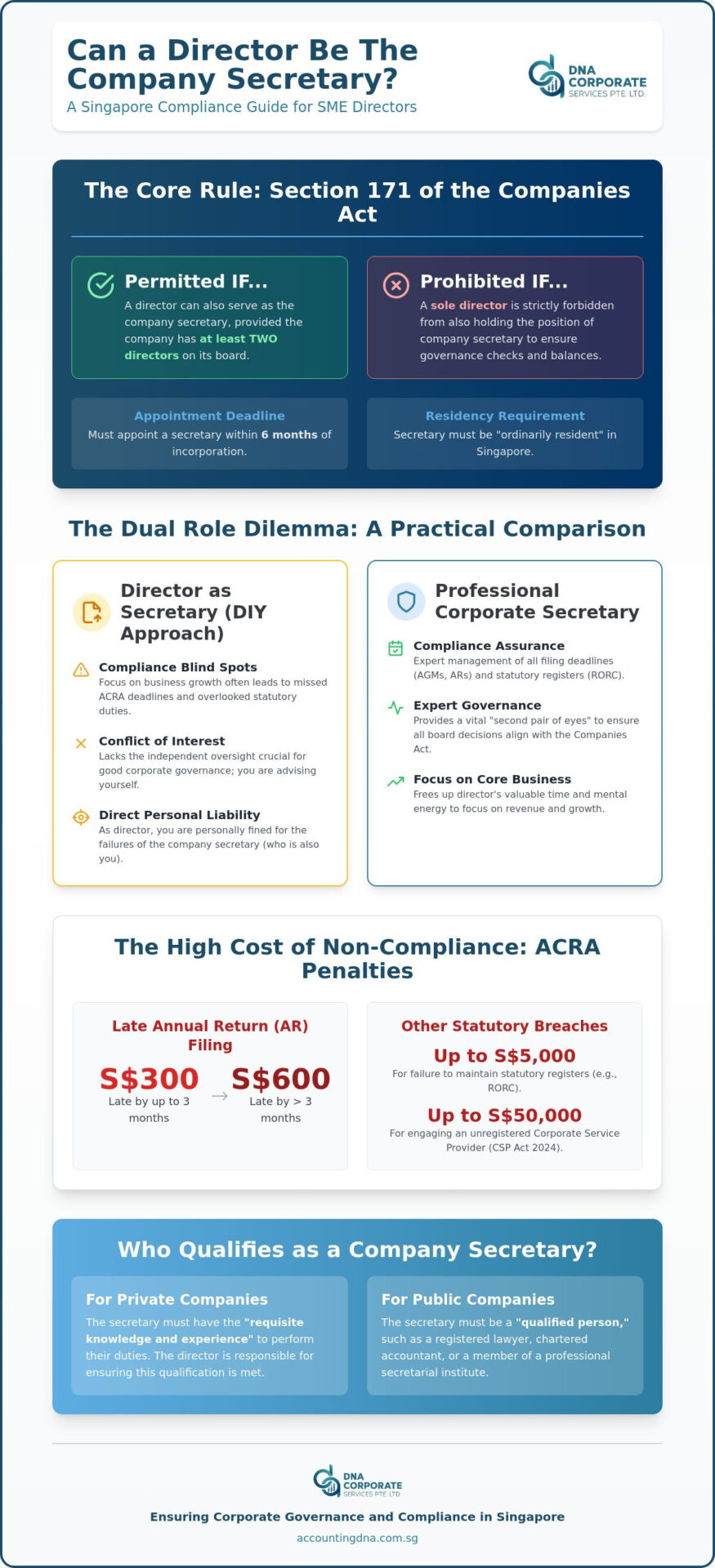
When exploring whether can a director be a company secretary Singapore regulations provide a clear legal framework under Section 171 of the Companies Act. The law permits a director to hold both roles simultaneously, provided the company has at least two directors. This flexibility is often a lifeline for startups aiming to keep their initial team lean. However, you must appoint a secretary within six months of your incorporation date. Missing this deadline is a breach of statutory duty that can lead to significant administrative complications and potential fines.
A critical factor in this appointment is the residency requirement. Your company secretary must be a natural person who is “ordinarily resident” in Singapore. This status applies to Singapore Citizens, Permanent Residents, or individuals holding an Employment Pass or EntrePass. If you’re a foreign director living abroad, you’re legally barred from serving as your own secretary. In these instances, most firms rely on corporate secretarial services to provide a resident secretary who meets ACRA’s strict criteria.
The Sole Director Restriction Explained
The rules change if you’re the only director on the board. Under Section 171(1E), a sole director cannot also act as the company secretary. This prohibition ensures a necessary system of checks and balances within the firm’s governance. As detailed in the Company secretary role, the secretary provides independent oversight for compliance. If your business partner resigns and leaves you as the sole director, you have an immediate legal obligation to appoint a separate individual to the secretarial post to stay compliant.
Private vs. Public Company Requirements
The qualifications required depend on your company type. For private limited companies, the director must simply ensure the secretary has the “requisite knowledge” to handle the task. While this sounds less formal, the director remains liable if the secretary fails to manage statutory filings correctly. Public companies face a higher bar; their secretaries must be “qualified persons,” such as registered lawyers, chartered accountants, or members of professional secretarial institutes. This ensures that larger entities with public stakeholders have highly trained professionals managing their complex regulatory needs.
The Risks and Practical Challenges of Dual Roles
While the technical answer to can a director be a company secretary Singapore is “yes” for companies with multiple directors, the practical reality is a minefield of administrative risks. Directors are naturally focused on business development, revenue, and scaling operations. In contrast, the company secretary role requires a rigid, almost clerical focus on statutory deadlines and legislative updates. This “hat-switching” often leads to what we call compliance blind spots. When you’re busy closing a major deal, it’s remarkably easy to overlook an ACRA notification or miss the filing window for a board resolution.
The conflict of interest is equally subtle but dangerous. A secretary’s primary duty is to advise the board on corporate governance. If you are the board, you lose that vital second pair of eyes that ensures every decision aligns with the Singapore Companies Act 1967. Ultimately, directors are personally liable for the secretary’s performance. If the secretary (which is you) fails to perform, the director (also you) faces the fine. It’s a circular responsibility that offers no safety net during a regulatory audit.
The Burden of ACRA Filing Deadlines
Managing Annual General Meetings (AGMs) and filing Annual Returns (ARs) within five or seven months of your financial year-end is a high-stakes task. ACRA’s penalty system is uncompromising. A delay of just one day can trigger a S$300 fine, which doubles to S$600 if the delay exceeds three months. For a busy founder, these dates often blur together. Outsourcing this burden allows you to focus on your core revenue streams while experts handle the ticking clock.
Maintaining Statutory Registers
Keeping the Register of Members, Register of Directors, and the Register of Registrable Controllers (RORC) updated in real-time is a legal requirement. Manual record-keeping, such as using basic spreadsheets, frequently fails during ACRA audits because it lacks necessary version control and time-stamping. Inaccurate filings or failure to maintain these records can lead to penalties of up to S$5,000 per violation. If you’re feeling overwhelmed by these administrative demands, reaching out for professional guidance can protect your company from these avoidable costs and ensure your governance remains airtight.
Why Singapore SMEs Choose Professional Corporate Secretarial Services
Professional guidance goes beyond mere form-filling. It involves receiving proactive alerts about upcoming deadlines and nuances within Singapore’s Companies Act 1967. When a dedicated firm manages your secretarial needs, they act as a gatekeeper for your corporate governance. They ensure every board resolution is drafted with legal precision and that your company’s standing remains impeccable. This level of expert oversight is difficult to replicate when you’re also trying to manage sales, hiring, and product development simultaneously.
A significant advantage for many local SMEs is the power of centralized management. When you explore our Corporate Secretarial Services, you’ll see how we integrate these tasks with your existing bookkeeping and tax filings. This holistic view ensures that your financial data and statutory records are always in sync. It prevents the common “data silos” that often lead to discrepancies during IRAS or ACRA reviews, saving you from the headache of reconciling conflicting records later.
Benefits of Outsourcing to DNA Accounting
At DNA Accounting, we believe in a “bespoke care” approach. We don’t just process papers; we act as your protective partner in a complex regulatory environment. We understand that entrepreneurship doesn’t follow a strict 9-to-5 schedule. That’s why our team maintains extreme accessibility, often being available during evenings or non-working days to support busy founders with urgent queries. You can view our transparent pricing to see how our secretarial and accounting bundles offer a cost-effective, all-encompassing solution. We make compliance a foundation for your growth rather than a burden.
Secure Your Company’s Compliance Future
Determining if can a director be a company secretary Singapore is the right move for your business requires weighing legal permissions against practical risks. While multi-director companies have the legal flexibility to combine these roles, the administrative burden and the risk of S$600 late filing penalties are significant. You’ve worked hard to build your business; don’t let a missed ACRA deadline or an outdated statutory register jeopardize your company’s standing.
Our ACRA-certified advisors at DNA Accounting provide a protective layer for your business through bespoke service for Singapore SMEs. We deliver proactive compliance alerts and holistic support, ensuring your governance is airtight while you focus on driving revenue. We’re here to make the complex simple, even during non-traditional hours when you need us most. Take the first step toward stress-free management and Get a Professional Company Secretary for Your Startup today. Your peace of mind is our priority, and we’re excited to support your growth journey.
Frequently Asked Questions
Can a foreigner be a company secretary in Singapore?
A foreigner can only serve as a company secretary if they are “ordinarily resident” in Singapore. This means you must reside in the country and hold a valid Employment Pass, EntrePass, or be a Permanent Resident. If you’re a foreign director managing your Singapore entity from overseas, you cannot legally appoint yourself. You’ll need to engage a local resident or a professional corporate service provider to fulfill this mandatory residency requirement.
What qualifications does a company secretary need for a private limited company?
For a private limited company, the secretary doesn’t need specific professional certifications like a law degree or a chartered accountant license. Instead, the directors must simply ensure the individual has the “requisite knowledge and experience” to manage the role’s duties. This is where the question can a director be a company secretary Singapore arises. While the bar is lower for private firms, the appointee must still be capable of navigating ACRA’s rigorous filing deadlines.
Can a shareholder be a company secretary?
Yes, a shareholder can absolutely hold the position of company secretary. There are no restrictions in the Companies Act preventing a member of the company from taking on this administrative role. The primary requirements remain the same: they must be a natural person and ordinarily resident in Singapore. Many startups use this approach to keep their initial team small, provided the company has more than one director to maintain proper corporate governance.
What are the penalties if my company stays without a secretary for more than 6 months?
If your company fails to appoint a secretary within the mandatory six-month window, the company and its directors could face a fine of up to S$1,000. ACRA views a vacant secretarial office as a serious compliance breach because the role is vital for maintaining statutory records. Beyond the initial fine, persistent vacancies can lead to further prosecution. It’s far more cost-effective to secure a professional appointee early than to risk these avoidable legal penalties.
Disclaimer
The information provided on this website is for general informational purposes only and is not intended to constitute professional accounting, tax, legal, or financial advice. While we strive to ensure that the content is accurate and up to date, regulations in Singapore, including those administered by ACRA, IRAS, CPF Board, and MOM, may change from time to time and may differ depending on individual circumstances.
Readers should not act or rely on any information contained on this website without seeking specific advice from a qualified professional based on their individual situation.
DNA Corporate Services and its affiliates accept no responsibility or liability for any loss or damage arising from reliance on the information provided in this website or any linked materials.
For tailored advice relating to accounting, taxation, corporate secretarial, or compliance matters in Singapore, please contact us directly for professional consultation.



