

Did you know that with approximately 68,000 new companies projected to register in Singapore this year, ACRA has significantly sharpened its focus on regulatory oversight? It’s a daunting environment for any entrepreneur, especially when the task of appointing a company secretary Singapore requires navigating a maze of residency rules and professional qualifications. You aren’t alone if you feel a sense of dread about the 6 month appointment deadline or the risk of a S$1,000 fine for a single oversight.
We understand that you’d rather focus on scaling your business than deciphering the latest amendments to the Companies Act 1967. That’s why we’ve put together this 2026 compliance guide to help you unlock the legal criteria and practical steps needed to protect your firm. You’ll learn exactly who qualifies for the role, how the April 2026 law change finally allows sole directors to act as their own secretary, and how to structure your governance to avoid costly summonses. Let’s ensure your business foundation is as secure as your vision for the future.
Key Takeaways
- Learn the essential legal criteria for your appointee, including residency status and age requirements, to ensure full compliance with the Companies Act 1967.
- Navigate the specific timelines and ACRA filing procedures for appointing a company secretary Singapore to avoid costly late penalties and summonses.
- Understand the distinction between private and public company requirements, from “requisite knowledge” to the mandatory “Qualified Person” status.
- Identify critical disqualification risks, such as bankruptcy or persistent filing defaults, that could compromise your company’s standing with regulators.
- Discover how the 2026 legislative updates impact sole directors and why professional secretarial support is a strategic safeguard against increased director liability.
Core Legal Requirements for a Singapore Company Secretary
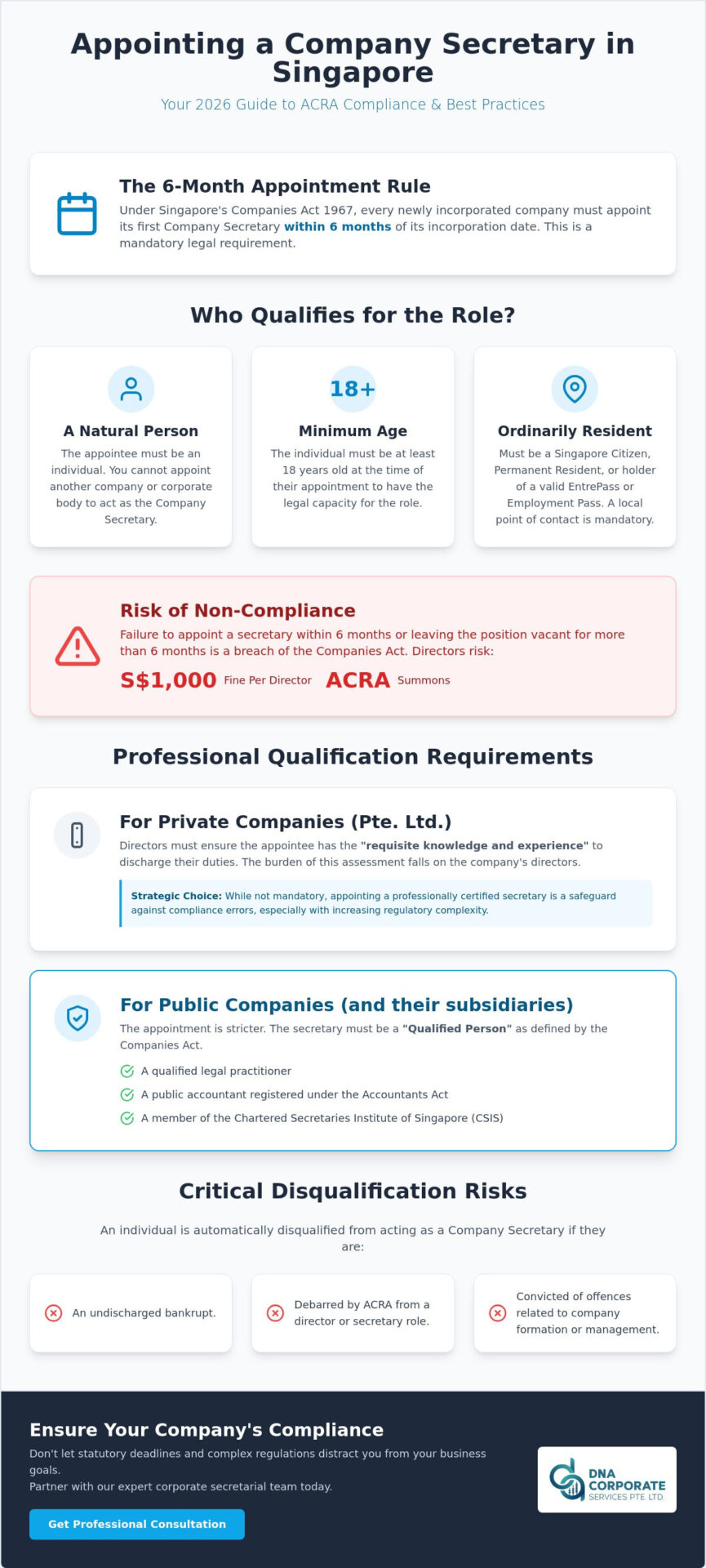
Every company registered in the Lion City must adhere to Section 171 of the Companies Act 1967. This law mandates that you must have at least one Company secretary on record at all times. It’s not just a administrative formality; it’s a vital statutory pillar that ensures your business stays on the right side of ACRA’s evolving standards. When you’re appointing a company secretary Singapore, remember that this individual must be a “natural person.” This means you cannot appoint another company or a corporate entity to handle these specialized duties. The appointee must also be at least 18 years of age at the time of their appointment to ensure they have the legal capacity to sign official documents.
Residency and Eligibility Criteria for Appointees
To meet the residency requirement, the person must be “ordinarily resident” in Singapore. This definition specifically includes Singapore Citizens, Permanent Residents, or individuals holding a valid EntrePass or Employment Pass. ACRA maintains this strict requirement to ensure there’s a locally accountable point of contact for legal notices and regulatory inquiries. Foreign directors who live outside the country must appoint a local resident to this role, as they cannot fulfill the residency criteria while based abroad. Beyond residency, the appointee must not be debarred by ACRA or disqualified under the Companies Act due to bankruptcy or persistent filing defaults.
The 6-Month Appointment Rule and Penalties
Timing is everything when it comes to statutory compliance. New companies must officially name their secretary within six months of their incorporation date. If the position ever becomes vacant due to a resignation or removal, the law is clear: you cannot leave the office empty for more than six months at any given time. Missing these deadlines is a serious oversight. Directors who fail to act within the window risk personal fines of up to S$1,000 and the unnecessary stress of ACRA summonses. If you’re navigating the complexities of appointing a company secretary Singapore for the first time, engaging professional corporate secretarial services provides a reliable safety net that keeps your business compliant while you focus on scaling operations.
Professional Qualifications: Private vs Public Company Requirements
The legal bar for private companies might seem low, but the stakes have never been higher. For private entities, directors simply need to ensure their appointee possesses the “requisite knowledge” to fulfill the role. This sounds straightforward, yet it places the burden of proof squarely on the directors’ shoulders. In contrast, public companies must appoint a “Qualified Person.” This distinction is critical because the secretary is a fiduciary officer. They owe a legal duty to the company and its shareholders, acting as more than just a filing clerk. When you are appointing a company secretary Singapore, you’re choosing a guardian for your corporate integrity who understands the weight of these legal responsibilities.
When a “Qualified Person” is Legally Mandatory
Under Singapore law, public companies and their subsidiaries must appoint a secretary who meets specific professional benchmarks. The Accounting and Corporate Regulatory Authority (ACRA) recognizes several professional bodies for this purpose. These include Chartered Accountants of Singapore (CA), legal practitioners, and members of the Singapore Association of the Institute of Chartered Secretaries and Administrators (SAICSA). During the electronic filing process, ACRA’s system automatically verifies these credentials against professional registers. This ensures that only those with the right technical expertise oversee the complex governance needs of public entities.
Why Professional Certification Benefits Private SMEs
While private SMEs aren’t legally forced to hire a “Qualified Person,” the complexity of 2026 regulations makes it a strategic choice. Recent changes to the Register of Registrable Controllers (RORC) and increased penalties for director duty breaches mean that “requisite knowledge” is no longer a DIY task. An expert who understands annual filing ACRA requirements can prevent costly summonses and late fees. Many directors find that the peace of mind gained from a professional partner far outweighs the Cost of Corporate Secretarial Services Singapore. If you’re unsure which level of support your business needs, feel free to reach out for a quick chat about your specific compliance profile.
Avoiding Common Compliance Pitfalls and Disqualifications
Why do some businesses face heavy penalties while others breeze through ACRA audits? Often, the difference lies in the quality of oversight. When you’re appointing a company secretary Singapore, the biggest mistake is choosing a “paper secretary”-someone who exists on record but never actually maintains your statutory registers. With the Corporate and Accounting Laws (Amendment) Act 2025 now in full effect as of May 2026, the maximum fine for a director’s breach of duties has jumped from S$5,000 to S$20,000. This makes the secretary’s role as a compliance gatekeeper more critical than ever. Relying on a provider who lacks a deep understanding of the Singapore Companies Act 1967 isn’t just a minor risk; it’s a threat to your company’s survival.
The 2026 Shift in Sole Director Rules
For years, a major hurdle for startups was the restriction preventing a sole director from also serving as the company secretary. However, the landscape shifted in April 2026. Under the Corporate and Accounting Laws (Amendment) Act 2025, a sole director can now legally act as the company secretary. While this provides flexibility for DIY founders, it also doubles the compliance burden on one individual. You’re now responsible for both strategic growth and the meticulous details of statutory filing. If you find this dual responsibility overwhelming, or if your current provider is non-responsive, it’s often safer to change company secretary to a professional firm. This ensures a proper check-and-balance system remains in place even if the law now allows for a consolidated role.
Disqualification and Removal Procedures
Compliance isn’t a “set and forget” task. A secretary can be automatically disqualified under Section 155 of the Companies Act if they have a history of persistent default in filing with ACRA. Other red flags include undischarged bankruptcy or specific court orders. If your secretary becomes disqualified, the board has the power to remove them immediately. You must notify ACRA of any change in the secretarial office within 14 days to avoid late filing fees. Keeping a close eye on our Singapore business compliance checklist can help you spot these risks early. Don’t wait for a summons to arrive; proactive management is the only way to safeguard your firm’s reputation in this high-stakes regulatory environment.
Securing Your Corporate Future in 2026
As ACRA-registered filing agents with deep expertise in 2026 compliance standards, we provide the boutique service and direct advisor access your business deserves. We understand the unique challenges SMEs face and are here to ensure your statutory registers remain pristine. Get a Professional Company Secretary for Your Singapore Business today and gain the peace of mind that comes with expert oversight. You’ve worked hard to build your vision; let’s work together to protect it with a foundation of total compliance.
Frequently Asked Questions
Can a director also be the company secretary in Singapore?
Yes, a director can hold both roles simultaneously. Following the commencement of the Corporate and Accounting Laws (Amendment) Act 2025 in April 2026, even a sole director is now permitted to act as the company secretary. While this offers flexibility for startups, you should consider the heavy administrative burden of managing both strategic growth and complex statutory filings alone. Many directors choose to outsource this role to ensure full compliance.
Does a private limited company need a qualified company secretary?
No, private companies aren’t legally required to appoint a “Qualified Person” like a chartered accountant or lawyer. Instead, the law requires directors to ensure the appointee has the “requisite knowledge” to manage ACRA filings and statutory registers. However, with the maximum fine for a director’s breach of duties rising to S$20,000 in 2026, having an expert who truly understands the Companies Act is a vital safeguard for your business.
What happens if a company fails to appoint a secretary within 6 months?
Failure to meet this strict 6-month deadline can result in a fine of up to S$1,000 for the company directors. Beyond the financial penalty, ACRA may issue summonses that require your personal attendance in court. If you’re currently appointing a company secretary Singapore, it’s vital to file the appointment via BizFile+ within 14 days of the board’s decision to avoid additional late filing fees and unnecessary regulatory scrutiny.
Can a foreigner be a company secretary for their own Singapore company?
Disclaimer
The information provided on this website is for general informational purposes only and is not intended to constitute professional accounting, tax, legal, or financial advice. While we strive to ensure that the content is accurate and up to date, regulations in Singapore, including those administered by ACRA, IRAS, CPF Board, and MOM, may change from time to time and may differ depending on individual circumstances.
Readers should not act or rely on any information contained on this website without seeking specific advice from a qualified professional based on their individual situation.
DNA Corporate Services and its affiliates accept no responsibility or liability for any loss or damage arising from reliance on the information provided in this website or any linked materials.
For tailored advice relating to accounting, taxation, corporate secretarial, or compliance matters in Singapore, please contact us directly for professional consultation.



