

Is your current corporate secretary actually protecting your business, or are they just sending invoices for hidden fees while missing critical AGM deadlines? It’s a common frustration for many Singapore directors who feel stuck with slow communication and rising costs. You shouldn’t have to worry about whether your company is meeting its statutory obligations. If you’re feeling the strain, changing corporate secretary ACRA filings is a straightforward process that can significantly improve your business operations and peace of mind.
We understand that the idea of moving your statutory books might feel daunting, especially with the May 6, 2026, legal amendments that increased director accountability and raised potential fines for breaches to S$20,000. This guide provides a clear, step-by-step roadmap to switching your service provider seamlessly. You’ll learn exactly how to handle the Bizfile notification within the required 14-day window and ensure a smooth handover of all records, keeping your company fully compliant with the latest regulations without the usual stress.
Key Takeaways
- Understand the legal requirements for your new appointment, including the necessity of a local resident and the strict six-month vacancy limit.
- Follow our 5-step checklist for changing corporate secretary ACRA filings to ensure your transition is legally sound and completed within the mandatory 14-day window.
- Learn how to manage a professional handover of statutory books, ensuring the outgoing provider returns all essential registers like the RORC and Minute Books.
- Protect yourself from the increased director penalties introduced in May 2026 by securing a proactive partner who manages your Bizfile updates accurately.
- Discover how to eliminate hidden fees and communication delays while maintaining 100% compliance with Singapore’s latest regulatory standards.
Understanding the Requirements for Changing a Corporate Secretary in Singapore
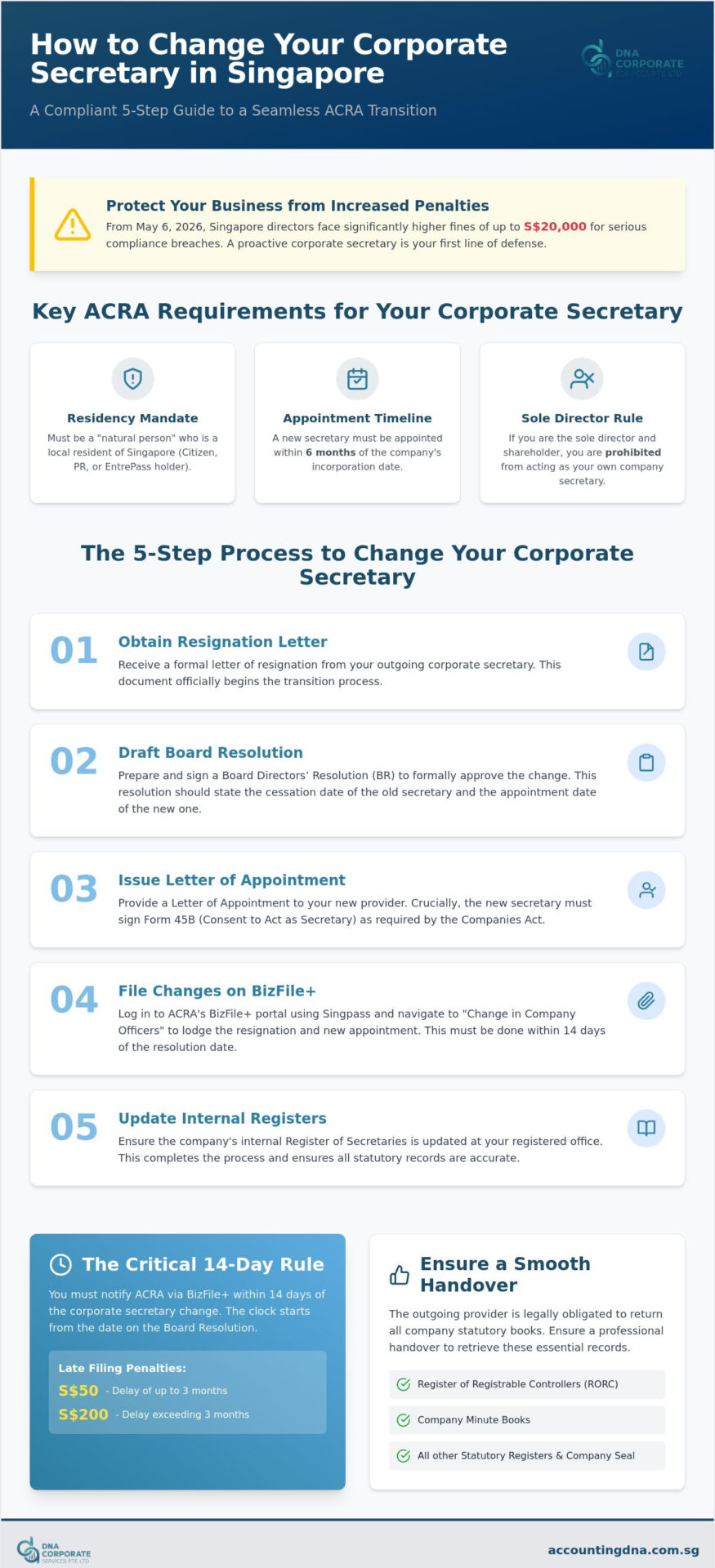
Every private limited company in Singapore is legally required to appoint a company secretary within six months of its incorporation date. It isn’t just an administrative suggestion; it’s a mandate under the Companies Act. This individual must be a “natural person” and a local resident of Singapore, meaning they should be a Singapore Citizen, Permanent Resident, or an EntrePass holder with a local residential address. While the Role of a Company Secretary is often viewed as back-office support, they are actually your primary shield against regulatory slip-ups.
Are you a sole director of your company? If so, Section 171 of the Companies Act explicitly prohibits you from acting as your own company secretary. This rule ensures a necessary system of checks and balances within your corporate structure. For public companies, the standards are even more stringent. You’ll need a professionally qualified secretary, such as a lawyer, a public accountant, or a member of a prescribed professional body. Choosing the right partner is vital because, in the eyes of ACRA, the responsibility for compliance ultimately rests on the shoulders of the directors.
Common Reasons for Switching Secretarial Providers
Many SMEs find themselves changing corporate secretary ACRA records because their current provider has become unresponsive or lacks transparency regarding fees. With the significant legal amendments that took effect on May 6, 2026, directors now face fines of up to S$20,000 for serious compliance breaches. If your secretary isn’t proactively advising you on these stricter accountability rules, they’re putting your business at risk. Many entrepreneurs are now moving toward boutique firms that offer corporate secretarial services with a more personalized, bespoke approach rather than the “one-size-fits-all” model of larger agencies.
The 14-Day ACRA Notification Rule
Timing is everything when it comes to statutory compliance. Once you’ve decided on a change, you must notify ACRA via the Bizfile portal within 14 days of the appointment or resignation. Don’t let this deadline slip. Filing after the 14-day mark results in an immediate S$50 penalty, which increases to S$200 if the delay exceeds three months. To keep your company’s profile clean, always ensure the effective date of the outgoing secretary’s resignation aligns perfectly with the new secretary’s appointment date, preventing any gaps in your statutory records.
The 5-Step Process to Change Your Corporate Secretary via BizFile+
How do you transition to a new service provider without triggering a compliance red flag? Changing corporate secretary ACRA records is a methodical process that requires precision in documentation. While the steps are logical, the sequence is vital to avoid administrative overlaps or late filing penalties. Most directors find that having a clear checklist prevents the “compliance anxiety” that often comes with switching providers.
- Step 1: Obtain a formal letter of resignation from your outgoing secretary.
- Step 2: Draft and sign a Board Directors’ Resolution (BR) formally approving the change.
- Step 3: Issue a Letter of Appointment to your new corporate secretarial partner.
- Step 4: Lodge the resignation and new appointment on ACRA’s Bizfile portal.
- Step 5: Update your internal Register of Secretaries kept at your registered office.
Preparing the Board Resolution and Resignation Letter
The transition legally begins with paperwork. Your board resolution must explicitly state the cessation of the previous secretary and the appointment of the new one. Before you head to the portal, ensure your new secretary has signed Form 45B. This is the “Consent to Act as Secretary” required under Section 171 of the Companies Act. It’s a critical safeguard that proves the appointee is aware of their legal duties and meets the residency requirements mentioned earlier. If you aren’t sure about the wording, you can reach out for a quick consultation to ensure your templates are compliant.
Filing with ACRA: Tips for a Smooth Lodgement
Once your documents are signed, a director or the new secretary must log in to Bizfile using Singpass. Navigate to the “Change in Company Officers” section to update the records. Remember, the 14-day clock starts from the date of the board resolution, not the date you decide to log in. Filing late, even by a single day, triggers an automatic S$50 penalty. If you’re looking for a provider that handles these filings with military precision, check DNA Accounting’s pricing for transparent, all-inclusive secretarial packages. This ensures you never have to worry about late fees or missing the 14-day window again.
Managing the Handover: Retrieving Statutory Records and Minute Books
Once the paperwork is filed, the physical and digital handover begins. It’s a common misconception that an outgoing provider can hold records hostage over disputed fees. In reality, your previous secretary is legally obligated to return all statutory books and company registers. This transition is the perfect time to perform a mini-audit of your records to ensure your new partner starts with a clean slate. Don’t let your records stay behind; they’re the legal foundation of your business.
A complete handover should include the Register of Members, Register of Directors, and the Register of Registrable Controllers (RORC). You must verify that the RORC has been updated on the central register of the Accounting and Corporate Regulatory Authority (ACRA) before the final transfer. Additionally, your minute books should be checked for completeness. This includes all past AGM minutes and board resolutions, which are essential for proving corporate governance during future audits or business sales.
Avoiding Compliance Gaps During the Transition
Timing your move is just as important as the paperwork itself. Try to avoid changing corporate secretary ACRA filings right in the middle of your Annual Return (AR) season. Overlapping these tasks can lead to confusion and missed deadlines. We recommend reviewing our corporate secretarial services page to understand how we coordinate these transitions without disrupting your filing schedule. Ensure all physical items, such as the company’s common seal and share certificates, are accounted for and handed over safely to your new registered office.
Why Switch to DNA Accounting for Your Secretarial Needs?
Why settle for a distant service provider when you can have a dedicated partner? At DNA Accounting, we offer a centralized service model where your accounting, tax, and secretarial duties are managed under one roof. This eliminates the communication gaps that often lead to compliance errors. We pride ourselves on extreme accessibility, offering support even during non-working days to suit your busy schedule. Our boutique size allows us to provide the bespoke care your SME deserves. Learn more about our Corporate Secretarial Services and discover how we can help your business stay 100% compliant with the latest 2026 regulations.
Secure Your Company’s Compliance with Proactive Support
Managing a business in Singapore is demanding enough without the added stress of tracking statutory deadlines and regulatory shifts. The process of changing corporate secretary ACRA filings is more than just a digital update; it’s a vital step in protecting your company from the heightened penalties introduced in May 2026. By ensuring your statutory books are complete and your Bizfile records are lodged within the strict 14-day window, you move from reactive troubleshooting to proactive growth.
At DNA Accounting, we believe your secretarial partner should be a reliable guide, not a distant service provider. Our boutique firm provides the bespoke care your SME needs to thrive in Singapore’s complex regulatory environment. Whether it’s a late evening or a weekend, our team remains accessible to ensure your IRAS and ACRA obligations are met with absolute precision. We don’t just file papers; we protect your business foundation. Don’t let administrative friction or slow communication slow your momentum any longer.
Switch to DNA Accounting for Stress-Free Secretarial Support and experience the peace of mind that comes with expert, personalized care. We’re ready to help you navigate your next chapter with confidence and total compliance.
Frequently Asked Questions
How long does it take to change a corporate secretary in Singapore?
The transition typically takes one to three business days once all the necessary documentation is signed. While the electronic filing on the Bizfile portal is instantaneous, you’ll need time to draft the board resolution and obtain the new secretary’s formal consent. Once the lodgement is complete, your company’s updated Business Profile will reflect the change immediately, allowing for a swift handover of duties.
What are the penalties for late notification of secretarial changes to ACRA?
ACRA enforces a strict 14-day notification window for any changes to company officers. If you miss this deadline but file within three months, an automatic composition fine of S$50 is imposed. For delays exceeding three months, the penalty increases to S$200. Diligence when changing corporate secretary ACRA records is vital, as these fines are easily avoidable with a proactive partner who manages the timeline for you.
Can I change my corporate secretary if I have an outstanding contract with the current one?
Yes, you have the legal right to change your secretary at any time, though you must respect the termination notice period in your existing agreement. Most contracts require a 30 to 90-day notice or payment in lieu of notice. It’s best to review your service agreement for any “exit fees” or specific handover protocols to ensure your transition remains professional and doesn’t lead to unnecessary contractual disputes.
Does changing my secretary affect my company’s tax filing with IRAS?
Changing your secretary doesn’t alter your tax liability, but it does influence the accuracy and timing of your IRAS submissions. Your secretary plays a key role in preparing the minutes and resolutions required for your Annual Return, which must be completed before filing your Corporate Tax (Form C-S/C). A competent secretary ensures these documents align perfectly, helping you avoid penalties for late tax filings and ensuring all available tax incentives are properly documented.
Disclaimer
The information provided on this website is for general informational purposes only and is not intended to constitute professional accounting, tax, legal, or financial advice. While we strive to ensure that the content is accurate and up to date, regulations in Singapore, including those administered by ACRA, IRAS, CPF Board, and MOM, may change from time to time and may differ depending on individual circumstances.
Readers should not act or rely on any information contained on this website without seeking specific advice from a qualified professional based on their individual situation.
DNA Corporate Services and its affiliates accept no responsibility or liability for any loss or damage arising from reliance on the information provided in this website or any linked materials.
For tailored advice relating to accounting, taxation, corporate secretarial, or compliance matters in Singapore, please contact us directly for professional consultation.



