

Could your choice of business address be the very thing that exposes your private home life to the public or leads to a S$5,000 fine? It’s a question many SME owners forget to ask until a statutory letter arrives at their doorstep. Meeting the registered office address requirements Singapore mandates isn’t just about ticking a box during incorporation; it’s about establishing a reliable, legally compliant communication hub for your company. As ACRA’s regulations evolve, ensuring your physical address remains accessible while protecting your personal data has become a delicate balancing act.
We understand that deciphering the latest statutory rules can feel like a daunting task when you’re already busy scaling your business. You want to stay on the right side of the law without sacrificing your personal privacy or getting tangled in the complexities of the Home Office Scheme. This 2026 guide simplifies the compliance landscape for you. We’ll walk through the mandatory transition to the “Contact Address” system, explain how to legally use a residential property, and show you how to handle statutory mail with total peace of mind. By the end of this article, you’ll know exactly how to keep your company’s foundation secure and your private life private.
Key Takeaways
- Understand the essential registered office address requirements Singapore enforces, including the need for a physical location accessible to the public for at least three hours every weekday.
- Learn how to leverage the Home Office Scheme for HDB or private units without compromising your personal privacy or violating local housing regulations.
- Stay ahead of ACRA’s strict 14-day deadline for address updates to avoid unnecessary late filing penalties and maintain your company’s good standing.
- Identify which statutory registers and corporate records must be physically maintained at your registered address to ensure you’re always ready for a regulatory check.
- Discover why a virtual office address might be the most cost-effective and professional solution for startups looking to balance compliance with operational flexibility.
Core ACRA Requirements for a Registered Office Address
Every business needs a home. In Singapore, that home isn’t just a place where you conduct your daily operations; it’s a legal anchor. When you register with the Accounting and Corporate Regulatory Authority (ACRA), you’re required to provide a physical address that serves as your company’s official face to the government. We know that managing these details can feel like a heavy burden when you’re trying to focus on growth, but getting this foundation right is your first step toward long-term security.
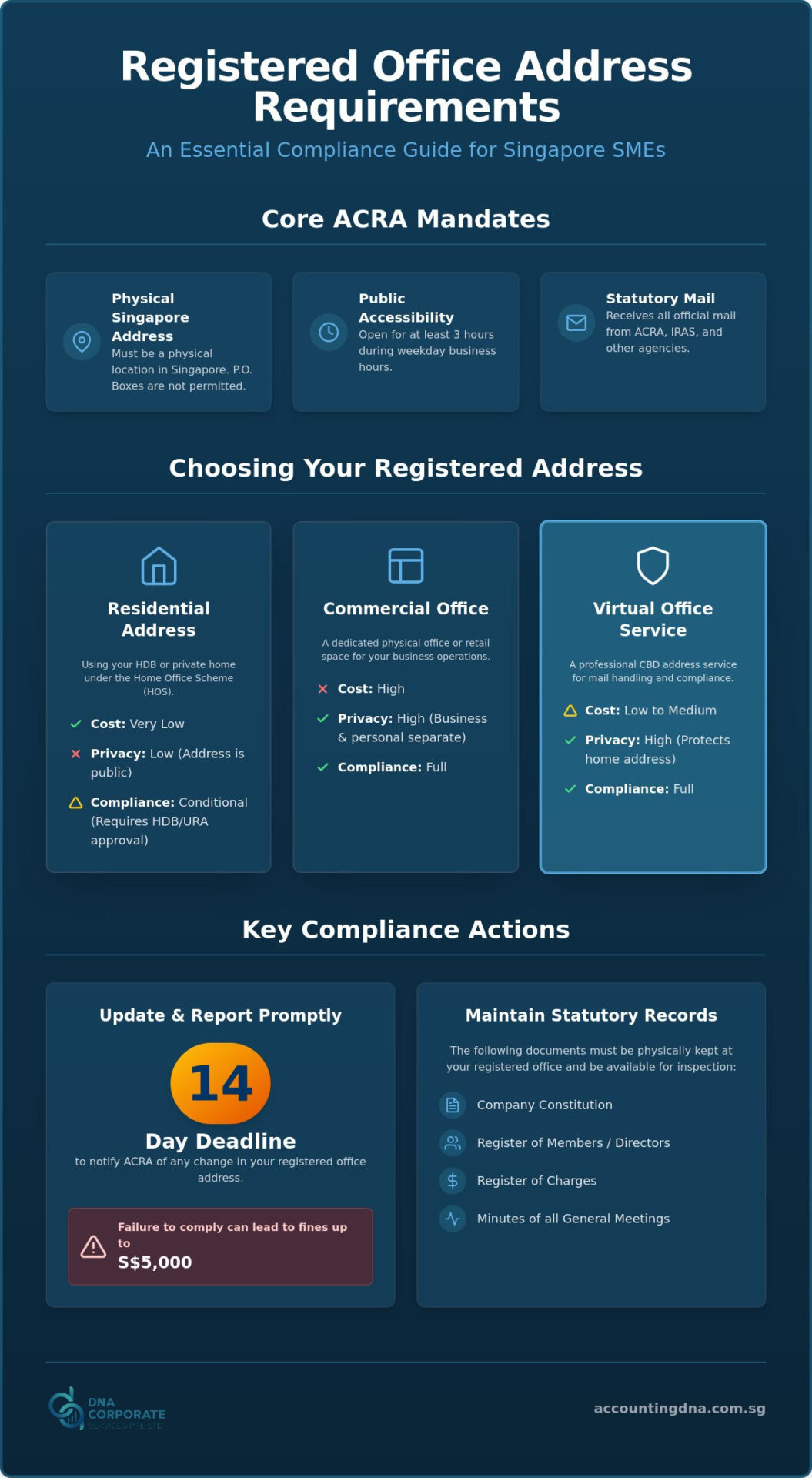
To meet the registered office address requirements Singapore has established, your chosen location must be a physical spot on the island. You can’t use an overseas address or a P.O. Box. The law is quite strict about this because there must be a location where legal documents can be physically served and received by a real person. Additionally, your office must be open and accessible to the public for at least three hours during ordinary business hours each window day. This ensures that government agencies or members of the public can reach your company for official matters without hurdles. All your most critical mail, including tax assessments from IRAS and compliance notices from ACRA, will be delivered here.
Why Your Registered Office Matters for Compliance
Under the Companies Act, every Singapore-incorporated entity must maintain a registered office from its very first day of existence. This address is publicly searchable on the BizFile+ portal, which helps build trust with your clients and partners. If you’re utilizing corporate secretarial services, your provider will often help you manage these filings to ensure you don’t fall behind. Failing to keep this information current can lead to fines of up to S$5,000, which is a stress no business owner needs. The Registered Office serves as the official point of contact for government agencies, ensuring all legal and tax correspondence reaches the company directors reliably.
If you don’t have a dedicated commercial space yet, you might consider a Registered Office Address service. This provides a professional, compliant location that satisfies all ACRA requirements while keeping your overhead low. It’s a practical solution that allows you to work from anywhere while we ensure your statutory mail is handled with the care it deserves.
Residential vs. Commercial vs. Virtual Office Addresses
Choosing where to anchor your business is a strategic decision that impacts your brand image and your personal privacy. While every company must adhere to the legal standards set out in Section 142 of the Companies Act, the path you take depends on your specific operational needs. For businesses with high foot traffic or physical inventory, a commercial office or retail unit is the natural choice. However, for the growing number of remote-first startups in Singapore, the decision between a residential address and a virtual office requires a bit more thought.
The Home Office Scheme (HOS) Rules
If you’re looking to keep costs low, the Home Office Scheme allows you to use your HDB flat or private residence as your official business home. It’s a practical solution, but it isn’t a free-for-all. For HDB dwellers, you must obtain written approval from the Housing & Development Board before you begin operations. Private property owners must ensure their business activities align with Urban Redevelopment Authority (URA) guidelines. Regardless of the property type, strict conditions apply to protect the residential character of your neighborhood. You’re limited to a maximum of two non-resident employees, and you cannot display any external business signage. Most importantly, your business must not cause any noise, smoke, or traffic nuisances for your neighbors.
Benefits of a Professional Registered Office Service
One significant drawback of the Home Office Scheme is that your residential address becomes a matter of public record on the ACRA portal. For many directors, this lack of privacy is a dealbreaker. This is where virtual office services provide a perfect middle ground. By using a professional service, you satisfy the registered office address requirements Singapore mandates while maintaining a prestigious CBD image. These services offer more than just a label; they provide essential mail scanning and instant notifications. This ensures you never miss a critical letter from IRAS or a compliance deadline from ACRA.
We’ve seen many founders find great peace of mind by separating their home life from their corporate identity. You can explore our Corporate Secretarial Services for address support that keeps your business compliant and your home private. If you’re weighing the pros and cons of different address types for your 2026 strategy, we’re here to help you navigate the best options for your specific situation.
Managing Address Changes and Statutory Record Keeping
Life moves fast in the Singapore business world. What happens if you move your operations but forget the paperwork? If your business scales and you transition to a larger office, you don’t just pack boxes; you must update your legal records. The most critical regulation to remember is the “14-Day Rule.” Under the registered office address requirements Singapore enforces, any change to your office location must be reported to ACRA via the BizFile+ portal within exactly 14 days. While ACRA doesn’t charge a filing fee for this update, missing this window is a compliance risk you don’t want to take.
Steps to Update Your Registered Address
Updating your address involves a specific internal process to stay compliant. First, you must pass a Board Resolution where the directors formally approve the change of location. Once that’s documented, you can proceed with the “Change in Company Information” filing via BizFile+. Following these steps ensures you meet the registered office address requirements Singapore mandates without any administrative hiccups. A common mistake we see is directors forgetting to update their address with IRAS, the Ministry of Manpower (MOM), and their corporate bankers. Your business licenses and official stationery must also reflect the new location to avoid missed correspondence.
Avoiding ACRA Late Filing Penalties
Falling behind on compliance is a stress you can easily avoid. For late filings, penalties can reach S$350, and continued non-compliance could lead to a fine of up to S$5,000 or even prosecution for directors. It’s often safer to consult with a seasoned Singapore accounting advisor to manage these filings on your behalf. For a deeper dive into staying on the right side of the law, check out our Master Guide to Statutory Compliance in Singapore (2026 Edition). We believe that by getting these details right, you can focus on what you do best: growing your business.
Secure Your Company’s Foundation Today
How can you ensure your business remains a pillar of stability while you navigate the competitive Singapore market? It starts with a solid legal foundation. We’ve explored how meeting the registered office address requirements Singapore mandates is about more than just picking a location; it’s about protecting your private life and staying ahead of the strict 14-day update window. Whether you’re leveraging the Home Office Scheme or moving into a commercial hub, your address is the vital link between your company and the regulatory authorities.
We know that managing these statutory details can be exhausting when your schedule is already packed. That’s why we offer boutique personalized service tailored to the unique needs of your SME. Our team provides expert ACRA compliance monitoring to ensure you never miss a deadline, and we’re even available during evenings and non-working days to suit your busy lifestyle. If you’re ready to simplify your business management and find peace of mind, secure a professional registered office address for your business today. Let’s work together to keep your company compliant and your focus where it belongs: on your growth.
Frequently Asked Questions
Can I use my HDB flat as my company’s registered office address?
Yes, you can use your HDB flat as a registered office under the Home Office Scheme, provided you obtain prior written approval from the Housing & Development Board. This is a cost-effective choice for small-scale entrepreneurs, but you must ensure your business doesn’t disturb neighbors or violate residential guidelines. For instance, you are prohibited from displaying business signage outside the flat or employing more than two non-resident staff members.
Is a P.O. Box allowed for a registered office in Singapore?
No, a P.O. Box is strictly prohibited as a registered office in Singapore. The law requires a physical location where legal documents can be served and received during business hours. This is one of the core registered office address requirements Singapore mandates to ensure government agencies like ACRA and IRAS have a reliable point of contact for all your official and legal correspondence.
Does the registered office address have to be the same as the place of business?
What happens if I fail to notify ACRA of an address change within 14 days?
Failing to notify ACRA of an address change within 14 days can lead to serious consequences, including late filing penalties of up to S$350. In more severe cases of prolonged non-compliance, directors may face prosecution or a court fine of up to S$5,000. It’s a stressful situation that’s easily avoided by keeping your records updated via the BizFile+ portal as soon as your relocation is finalized.
Disclaimer
The information provided on this website is for general informational purposes only and is not intended to constitute professional accounting, tax, legal, or financial advice. While we strive to ensure that the content is accurate and up to date, regulations in Singapore, including those administered by ACRA, IRAS, CPF Board, and MOM, may change from time to time and may differ depending on individual circumstances.
Readers should not act or rely on any information contained on this website without seeking specific advice from a qualified professional based on their individual situation.
DNA Corporate Services and its affiliates accept no responsibility or liability for any loss or damage arising from reliance on the information provided in this website or any linked materials.
For tailored advice relating to accounting, taxation, corporate secretarial, or compliance matters in Singapore, please contact us directly for professional consultation.



