

Choosing the cheapest setup today could become your most expensive mistake by the next tax season. While a simple registration might seem attractive when you’re just starting out, the debate of sole proprietorship vs pte ltd Singapore involves much more than just the initial filing fee. The wrong choice can leave your personal home and savings vulnerable to business debts, creating a level of risk that no entrepreneur should carry alone.
We understand that the weight of these legal and financial decisions often keeps directors awake at night. You want a structure that protects what you’ve built while keeping your tax bill as low as possible. This 2026 comparison guide provides a clear framework so you can make an informed choice with total confidence. We will walk you through the generous YA 2026 tax rebates, the actual cost of staying compliant, and the strategic milestones that signal it’s time to scale up to a private limited company.
Key Takeaways
- Understand how a Private Limited structure protects your personal assets from business liabilities, a critical safeguard that a sole proprietorship cannot provide.
- Compare the tax efficiency of sole proprietorship vs pte ltd Singapore, including the 17% flat corporate rate and the Start-Up Tax Exemption (SUTE) scheme.
- Identify the specific compliance requirements for both structures, from ACRA annual return filings to maintaining proper accounting records under IRAS regulations.
- Learn why growth-oriented milestones, such as applying for government grants or seeking venture capital, typically require your business to be incorporated as a Pte Ltd.
- Get up to speed on the YA 2026 tax landscape, including the 50% Corporate Income Tax rebate and the S$2,000 cash grant available to active companies.
Understanding the Core Differences: Sole Proprietorship vs Pte Ltd in Singapore
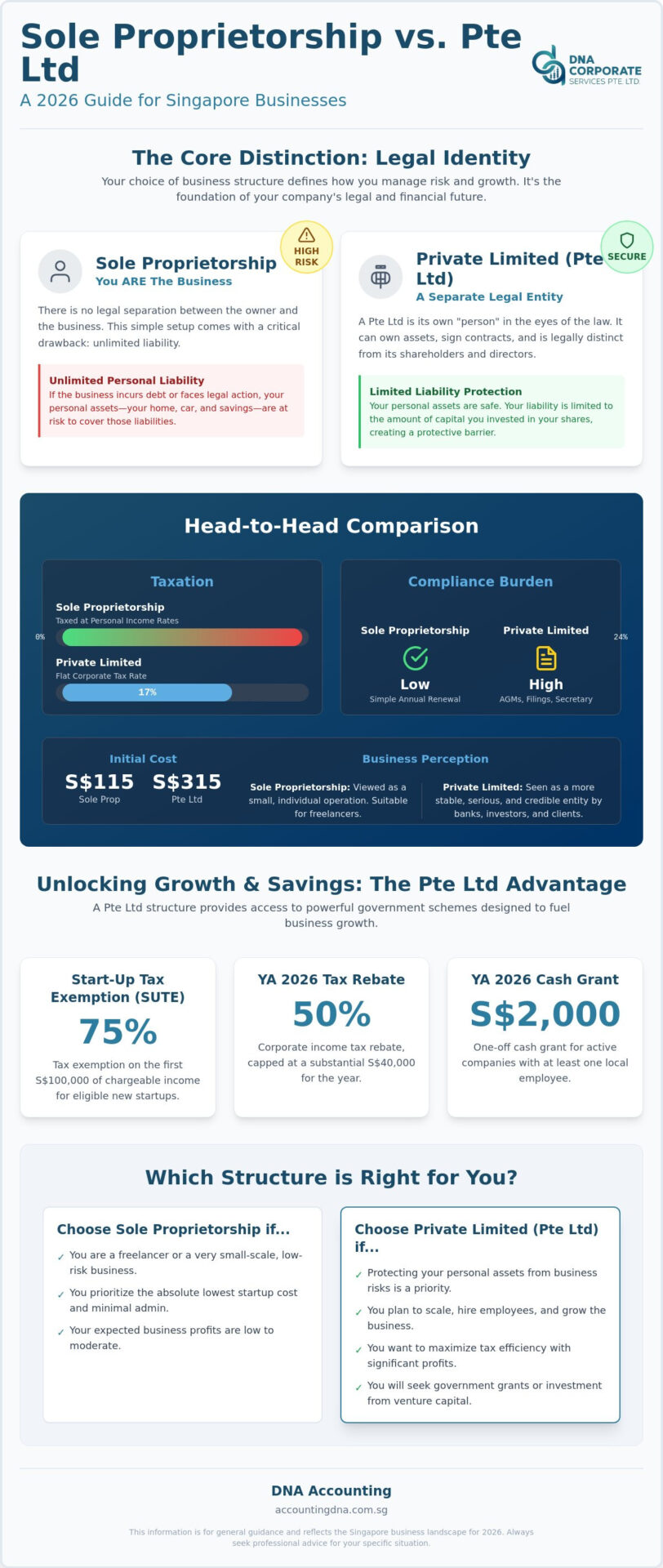
In the Singapore business landscape of 2026, your company structure is more than just a registration category; it’s a statement of intent. When you weigh a sole proprietorship vs pte ltd Singapore, you’re choosing between simplicity and security. A sole proprietorship is a business owned by one person where there’s no legal distinction between the owner and the entity. On the other hand, a Private Limited (Pte Ltd) company is a separate legal person, distinct from its shareholders and directors. This distinction is the bedrock of how you’ll manage risk and growth.
The Legal Identity: Why Separation Matters
Think of a Pte Ltd as its own “person” in the eyes of the law. It can own assets, enter into rental agreements, and even sue or be sued. This separation is the foundation of modern business entities in Singapore. Without this shield, a sole proprietor faces “unlimited liability.” This isn’t just a technical term. It means if your business can’t settle a debt or loses a legal dispute, your personal bank accounts, your car, and even your family home are at risk. In a Pte Ltd, your liability is generally limited to the capital you’ve invested in shares. It’s a protective barrier that keeps your family’s future safe from business volatility.
Citizenship and Residency Requirements for Registration
ACRA requires at least one manager or director to be a local resident. If you’re a Singapore Citizen, Permanent Resident, or an EntrePass holder, you can usually proceed with registration immediately. Foreign entrepreneurs face a different path. To incorporate a Pte Ltd, you must appoint a locally resident director. Many global founders utilize nominee director services to satisfy this legal requirement while they manage operations. While a sole proprietorship is cheaper to start at S$115, the S$315 registration fee for a Pte Ltd is a small price for the professional credibility it brings. When comparing sole proprietorship vs pte ltd Singapore, remember that most local banks and vendors view a Private Limited company as a more stable, serious partner for the long term.
Comparing Liability, Taxation, and Compliance Requirements
How do you weigh the cost of compliance against the benefits of tax savings? When evaluating sole proprietorship vs pte ltd Singapore, the choice often comes down to your expected turnover and your appetite for risk. While the setup for a sole proprietorship is faster, the long term financial advantages of a Private Limited company often outweigh the initial simplicity. Use the ACRA guide to business entities to see the foundational differences, or review our summary table below.
| Feature | Sole Proprietorship | Private Limited (Pte Ltd) |
|---|---|---|
| Legal Liability | Unlimited (Personal assets at risk) | Limited to share capital |
| Taxation | Personal Income Tax (0% to 24%) | Corporate Tax (Flat 17%) |
| Compliance | Minimal (Annual renewal) | High (Statutory filings, AGMs) |
Tax Savings: The PTE LTD Advantage
For businesses generating significant profit, a Pte Ltd is nearly always more tax efficient. In 2026, companies benefit from a 50% Corporate Income Tax rebate capped at S$40,000. Active companies with at least one local employee also receive a S$2,000 cash grant. New startups can leverage the Start-Up Tax Exemption (SUTE) scheme, which provides a 75% exemption on the first S$100,000 of income. Sole proprietors don’t qualify for these corporate schemes. Instead, your business profit is added to your personal income, which could push you into a higher tax bracket of up to 24%. Professional corporate tax filing Singapore helps ensure you don’t miss these lucrative 2026 incentives.
Compliance Burden: ACRA and IRAS Deadlines
The trade off for tax efficiency is a stricter compliance cycle. A Pte Ltd must appoint a Corporate Secretary within six months of incorporation and file Estimated Chargeable Income (ECI) within three months of the financial year end. You’ll also need to file Form C-S or Form C and submit Annual Returns to ACRA. If these deadlines feel daunting, you aren’t alone. Many directors rely on corporate secretarial services to manage statutory records and ensure they never miss a filing date. If you’re feeling overwhelmed by the paperwork, reach out to our team for a friendly chat about your compliance needs.
Which Structure Should You Choose for Your Singapore Business?
The Conversion Trigger: When to Scale Up
We often see founders struggle with the administrative weight as they grow. There are three clear signs it’s time to transition. First, if your taxable turnover is approaching the S$1 million GST threshold, you need the robust structure of a company. Second, when you begin hiring staff and need to manage CPF and MOM requirements, a Pte Ltd provides the necessary framework. Third, when you take on high value contracts that expose you to significant legal risk, you need a separate legal entity. Our team specializes in making company incorporation Singapore feel like a natural next step rather than a bureaucratic hurdle.
Focus on Growth, Not Paperwork
You might wonder if the cost of professional support is worth it. Think of it this way: every hour you spend on ACRA filings or manual ledgers is an hour you aren’t spending on your customers. By utilizing bookkeeping services for startups, you offload the mental burden of compliance to experts who care about your success. At DNA Accounting, we offer the personalized advisory that larger firms often miss. We treat your business as our own, ensuring your structure supports your specific goals in the sole proprietorship vs pte ltd Singapore journey. Let us handle the statutory details so you can focus on building your legacy.
Taking the Next Step Toward Your Business Goals
Get a personalized consultation on the best structure for your business. We’re ready to help you navigate your next chapter with confidence and clarity.
Frequently Asked Questions
Can I change from a Sole Proprietorship to a Pte Ltd later?
Yes, you can transition your business structure as your operations expand. This process involves incorporating a new Private Limited company and then transferring the assets, existing contracts, and bank accounts from the sole proprietorship to the new entity. It is a strategic move often made when turnover increases or when you need to protect personal assets. We recommend professional assistance to ensure that the transfer of GST registrations and vendor agreements is handled seamlessly without disrupting your daily business.
Do I need an audit for a small Pte Ltd in Singapore?
Most small companies in Singapore are exempt from statutory audit requirements. Your company qualifies for this exemption if it meets at least two of the three “small company” criteria: annual revenue not exceeding S$10 million, total assets not exceeding S$10 million, or having fewer than 50 employees. While an audit might not be mandatory, you are still legally required to maintain proper accounting records and file annual financial statements with ACRA to remain compliant.
What are the minimum capital requirements for a Pte Ltd?
You can incorporate a Private Limited company with a minimum paid-up capital of just S$1. This low entry barrier allows founders to start their journey with minimal upfront investment and increase the share capital as the business grows. When evaluating the sole proprietorship vs pte ltd Singapore choice, remember that a Pte Ltd allows you to issue shares to new investors. This flexibility is essential for startups that plan to raise external funding or bring on new partners later.
Can a foreigner be the 100% owner of a Singapore Pte Ltd?
Yes, Singapore law allows 100% foreign shareholding for Private Limited companies across almost all industries. There are no restrictions on the nationality of shareholders, making it an ideal hub for international entrepreneurs. However, you must appoint at least one director who is ordinarily resident in Singapore. If you don’t have a local resident partner, you can engage nominee director services to satisfy this ACRA requirement while you maintain full control over your company’s equity and strategic direction.
Disclaimer
The information provided on this website is for general informational purposes only and is not intended to constitute professional accounting, tax, legal, or financial advice. While we strive to ensure that the content is accurate and up to date, regulations in Singapore, including those administered by ACRA, IRAS, CPF Board, and MOM, may change from time to time and may differ depending on individual circumstances.
Readers should not act or rely on any information contained on this website without seeking specific advice from a qualified professional based on their individual situation.
DNA Corporate Services and its affiliates accept no responsibility or liability for any loss or damage arising from reliance on the information provided in this website or any linked materials.
For tailored advice relating to accounting, taxation, corporate secretarial, or compliance matters in Singapore, please contact us directly for professional consultation.



