

Did you know that an incorrectly structured business could cost you more in ACRA penalties and missed tax incentives than the actual cost of your registration? It’s understandable why so many founders feel overwhelmed when trying to untangle the specific business registration requirements Singapore demands. Between the stress of finding a reliable local nominee director and the fear of facing a S$5,000 fine for a non-compliant registered address, the initial excitement of launching your startup can quickly turn into compliance anxiety.
We agree that the paperwork shouldn’t stand in the way of your vision. You deserve to start your journey with absolute confidence that your foundation is solid. This guide provides the clear, jargon-free roadmap you need to master essential ACRA requirements and ensure 100% regulatory compliance for a successful 2026 launch. We’ll walk you through the S$315 registration process, explain the 17% corporate tax landscape, and show you how to choose a structure that protects your bottom line from day one.
Key Takeaways
- Understand why the Private Limited structure remains the gold standard for tax efficiency and liability protection for Singapore SMEs in 2026.
- Master the essential business registration requirements Singapore mandates, including the critical appointment of a resident director and a qualified company secretary.
- Navigate the ACRA registration process with precision, from securing your unique business name to preparing a constitution that supports your specific operational model.
- Prepare for your first 90 days of operations by streamlining corporate bank account applications and accurately assessing your mandatory GST registration obligations.
- Protect your startup from costly late-filing penalties by establishing a clear compliance roadmap for annual returns and statutory updates from day one.
Defining Your Foundation: Structural and Eligibility Requirements for Singapore Companies
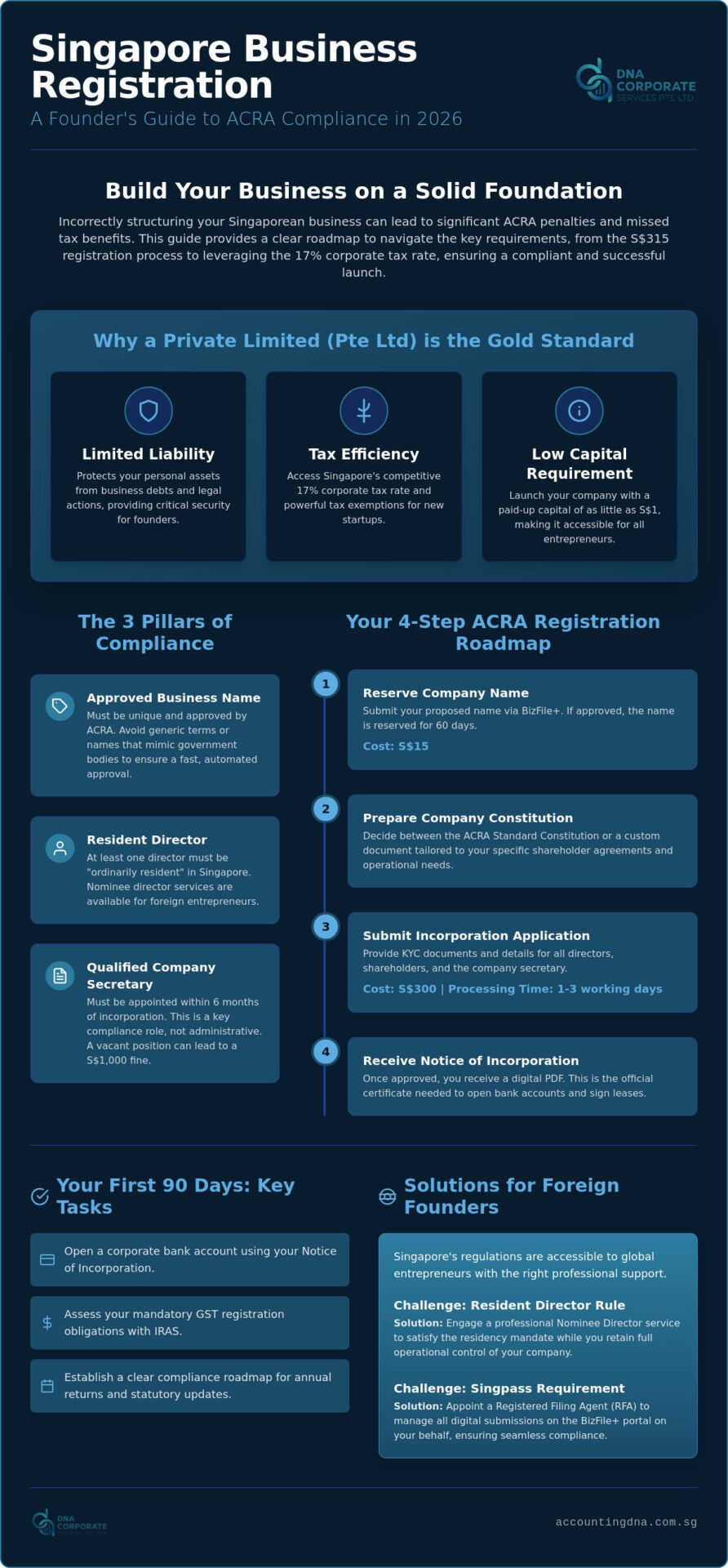
Choosing the right structure is your first major hurdle. While options like sole proprietorships exist, the Private Limited (Pte Ltd) company remains the gold standard for startups in 2026. This structure provides a separate legal entity, meaning your personal assets stay protected if the business faces debt. It’s also the most tax-efficient path, allowing you to tap into Singapore’s 17% corporate tax rate and various startup exemptions. To get started, the business registration requirements Singapore mandates are surprisingly accessible; you can launch with as little as S$1 in paid-up capital.
Before you submit your application to the Accounting and Corporate Regulatory Authority (ACRA), you’ll need an approved business name. Avoid generic terms or names that mimic government agencies. A unique, descriptive name speeds up the approval process, which usually takes just a few minutes if there are no conflicts. If your name is too similar to an existing entity, ACRA may flag it for manual review, potentially delaying your launch by several days.
The Resident Director and Nominee Services
Every company must have at least one director who is “ordinarily resident” in Singapore. This means they must be a Singapore Citizen, a Permanent Resident, or an EntrePass holder. For foreign entrepreneurs, this often feels like a roadblock. You shouldn’t just appoint any acquaintance; a director holds significant legal responsibility for your company’s compliance. We help bridge this gap by providing professional nominee director services that ensure your business meets local laws while you maintain full operational control. This protects your interests while satisfying the residency mandate.
The Importance of a Qualified Company Secretary
Don’t let the title “secretary” fool you into thinking this is a clerical role. ACRA requires every company to appoint a qualified secretary within six months of incorporation. This person acts as your compliance officer, managing board resolutions and ensuring statutory registers are up to date. Missing these deadlines can lead to fines of up to S$1,000 for a vacant position. Our team provides comprehensive corporate secretarial services Singapore businesses rely on to stay on the right side of the law from day one. We handle the heavy lifting of statutory filings so you can focus on growth.
The Step-by-Step ACRA Registration Process in 2026
Ready to move from planning to action? The efficiency of the digital registration system is a primary reason why Singapore’s business environment continues to attract global investment. Most standard applications are processed within one to three working days, provided you follow the sequence correctly. First, you must reserve your company name via BizFile+. This costs S$15 and holds the name for 60 days. Once approved, you’ll move to preparing your company’s constitution. While many founders opt for the ACRA “Standard Constitution,” it might not provide the protection you need if you have multiple shareholders or specific vesting schedules. Customizing this document early prevents messy legal disputes later.
The final hurdle is the actual submission. You’ll provide details for all directors, shareholders, and the company secretary, then pay the S$300 incorporation fee. Once ACRA approves the filing, you’ll receive a digital Notice of Incorporation. This PDF is your official birth certificate for the business; it’s what you’ll need to open bank accounts and sign office leases. If you’re unsure which specific documents apply to your industry, it’s best to speak with a consultant before you hit submit.
Digital Identity and Singpass Requirements
In 2026, Singpass is the mandatory gateway for all local business filings. It serves as your secure digital signature, verifying your identity instantly. Foreign directors who don’t have a Singpass shouldn’t worry; you can still satisfy the business registration requirements Singapore mandates by engaging a Registered Filing Agent (RFA). DNA Accounting acts as your Registered Filing Agent to handle all BizFile+ interactions, ensuring your submission meets every regulatory standard without you needing to touch the portal yourself.
Required Documentation for Incorporation
Before you begin, gather your Know Your Customer (KYC) documents, including clear copies of passports or NRICs and proof of residential addresses for all officers. You’ll also need a physical registered office address in Singapore; using a P.O. Box isn’t permitted and can result in fines up to S$5,000. If you change this address later, you’re legally required to notify ACRA within 14 days to remain compliant. Having these details organized prevents the back-and-forth queries that often delay new setups.
Post-Registration Checklist: Navigating Your First 90 Days of Compliance
Receiving your digital Notice of Incorporation is a major milestone, but it’s only the start of your journey. The first 90 days are critical for setting up the systems that keep you compliant with business registration requirements Singapore law demands. One of your first hurdles will be opening a corporate bank account. Don’t be surprised if this takes several weeks; banks have intensified their due diligence processes to meet global anti-money laundering standards. Simultaneously, you must determine if your business needs to register for GST. While it’s mandatory if your taxable turnover exceeds S$1 million in a 12-month period, remember that since April 1, 2026, new voluntary registrants are required to use the InvoiceNow network for e-invoicing.
Your compliance calendar actually begins the moment you incorporate. You’ll need to decide on a Financial Year End (FYE). This isn’t just an administrative choice; picking the right date can help you maximize the benefits of the ‘Tax Exemption Scheme for New Startups’. Under the Singapore Companies Act, private companies must also prepare for their first Annual General Meeting (AGM) and ensure all board resolutions are properly documented to avoid future disputes during a due diligence exercise.
Tax and GST Obligations
Staying ahead of the Inland Revenue Authority of Singapore (IRAS) is about timing. You’re required to file your Estimated Chargeable Income (ECI) within three months of your FYE, even if you’re declaring zero income. Navigating these filings alongside Form C-S or Form C can be daunting for new directors. Utilizing professional corporate tax and GST filing services ensures your submissions are accurate, protecting you from the stress of unexpected audits or queries from the tax authorities.
Bookkeeping and Annual Returns
It’s a common mistake to think bookkeeping can wait until the end of the year. Messy accounts lead to missed deadlines and ACRA late filing penalties, which start at S$300 and double to S$600 if you’re more than three months late. Clean, monthly records are the foundation of a smooth Annual Return filing. By outsourcing to dedicated bookkeeping and accounting services, you ensure your financial statements are always ready for submission. For a deeper look at your long-term obligations, see The Master Guide to Statutory Compliance in Singapore (2026 Edition) for a full breakdown of Singapore company registration requirements and post-incorporation rules.
Secure Your Vision With a Compliant Foundation
Launching a business is a major feat, but the journey doesn’t end with a successful ACRA filing. As we’ve explored, choosing a Private Limited structure and appointing the right officers are vital first steps. Mastering the business registration requirements Singapore enforces is about more than avoiding fines; it’s about building a tax-efficient vehicle that protects your personal assets and attracts future investment. By aligning your setup with a clear 90 day compliance roadmap, you ensure that your focus remains on innovation rather than administrative stress.
With over 10 years of experience supporting Singapore SMEs, DNA Accounting serves as your dedicated ACRA Registered Filing Agent. We pride ourselves on a boutique approach that offers the flexibility you need, including availability during evenings and weekends to fit your busy schedule. We’re here to turn complex regulations into a seamless, protective shield for your company. You don’t have to navigate these statutory waters alone.
Ready to launch? Get a personalized consultation for your Singapore business registration today.
Frequently Asked Questions
Can a foreigner register a business in Singapore without living there?
Yes, you can register and own 100% of a Singapore company without residing in the country. However, you must satisfy the requirement of appointing at least one ordinarily resident director who lives in Singapore. Since you won’t have a Singpass to access the ACRA portal, you’ll need to engage a Registered Filing Agent to manage the submission on your behalf.
How long does the business registration process take in 2026?
Most registrations are completed within one to three working days once your name is approved. If your business activity falls under a regulated industry, like education or travel, ACRA may refer the application to another government agency. This referral can extend the timeline from 14 days up to two months; it’s vital to plan your launch with these potential delays in mind.
What is the difference between a Business Name and a Company Name in Singapore?
A Company Name belongs to a Private Limited entity, which is a separate legal person that protects your personal assets. A Business Name is typically used for sole proprietorships where you and the business are legally one and the same. Understanding these business registration requirements Singapore sets is crucial because only a company structure offers limited liability and specific corporate tax benefits.
Is it mandatory to hire an accounting firm for business registration?
While local founders can technically file themselves, most choose to engage a professional firm to ensure 100% compliance from day one. For foreign entrepreneurs, hiring a Registered Filing Agent is a legal requirement since you cannot log into the BizFile+ system directly. A professional partner helps you avoid common pitfalls like incorrect constitution drafting or missing the six month deadline for appointing a company secretary.
Disclaimer
The information provided on this website is for general informational purposes only and is not intended to constitute professional accounting, tax, legal, or financial advice. While we strive to ensure that the content is accurate and up to date, regulations in Singapore, including those administered by ACRA, IRAS, CPF Board, and MOM, may change from time to time and may differ depending on individual circumstances.
Readers should not act or rely on any information contained on this website without seeking specific advice from a qualified professional based on their individual situation.
DNA Corporate Services and its affiliates accept no responsibility or liability for any loss or damage arising from reliance on the information provided in this website or any linked materials.
For tailored advice relating to accounting, taxation, corporate secretarial, or compliance matters in Singapore, please contact us directly for professional consultation.



