

Why should your dormant company continue to rack up secretarial fees and ACRA late filing penalties when you’ve already moved on to your next big venture? Many directors feel trapped by their inactive entities, fearing that the exit process is a legal minefield of hidden debts and complex filings. If you’re asking what is a striking off application Singapore, you’re likely looking for the most cost-effective and straightforward way to dissolve your company without the heavy lifting of a formal winding up. It’s a practical choice for many local SMEs, but it requires a precise “clean house” strategy to be successful.
We understand that the pressure to get things right with ACRA and IRAS can be overwhelming, especially when you’re trying to avoid unnecessary costs or legal slip-ups. You’ve worked hard to build your reputation, and you deserve a closure process that protects it. This guide will help you master the legal requirements, navigate the latest 2026 ACRA procedures, and secure your tax clearance with confidence. We’ll walk you through the entire timeline, from the initial board resolution to the final Gazette notification, ensuring your exit from the register is clean, compliant, and final.
Key Takeaways
- Learn why striking off is the preferred fast-track method for dissolving dormant companies under Section 344 of the Companies Act, offering a simpler alternative to formal winding up.
- Understand exactly what is a striking off application Singapore and how it allows directors to close their business without the high costs and administrative burden of liquidation.
- Master the 5-point eligibility checklist to ensure your company has zero assets, no outstanding debts, and full tax clearance from IRAS before you begin the process.
- Navigate the ACRA timeline with confidence, from the initial board resolution to the First Gazette notification and the critical 60-day objection period.
- Discover how a professional corporate secretary ensures your filings are accurate, helping you avoid ACRA penalties and ensuring a clean exit from the register.
Understanding the Striking Off Application in Singapore
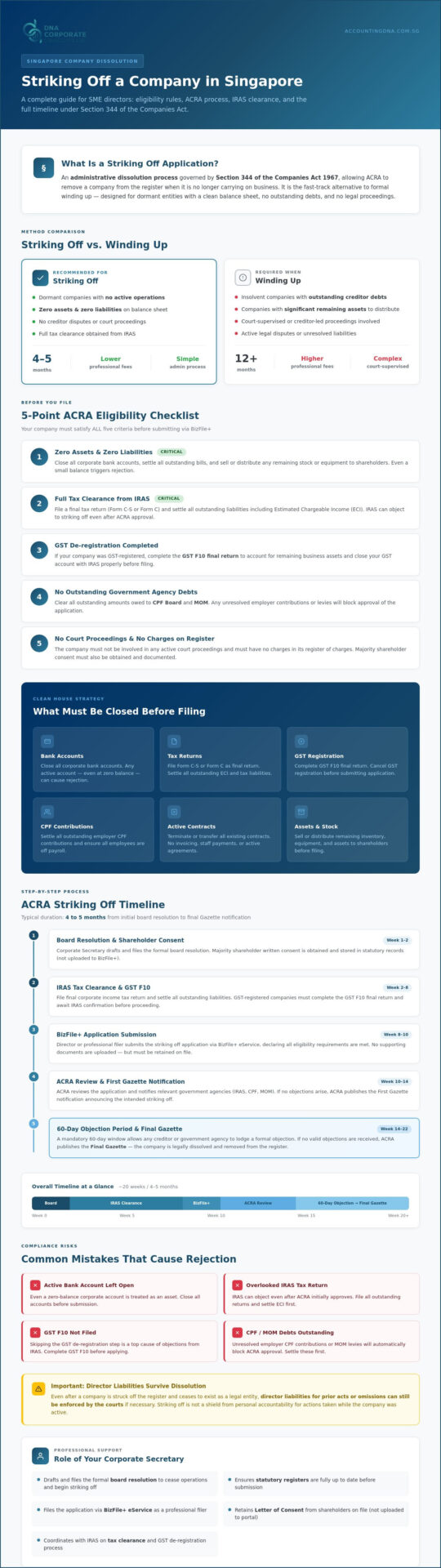
A striking off application is an administrative process governed by Section 344 of the Companies Act 1967. It allows the Accounting and Corporate Regulatory Authority (ACRA) to remove a company’s name from the register if there’s reasonable cause to believe the entity is no longer carrying on business. For many directors, understanding what is a striking off application Singapore is the first step toward a clean exit. It’s a fast-track dissolution method designed for companies that have reached the end of their lifecycle without accumulating complex debts or legal baggage.
The primary appeal of this route lies in its efficiency. Compared to formal liquidation, striking off involves lower professional fees and significantly shorter timelines, typically concluding within four to five months. However, this path is strictly reserved for “dormant” companies. To qualify, your business must have completely ceased all operations. If you’re still issuing invoices, paying staff, or maintaining active contracts, you aren’t ready to apply. While the company ceases to exist as a legal entity once struck off, you should be aware that director liabilities for prior acts or omissions can still be enforced by the courts if necessary.
Striking Off vs. Winding Up: Which Path to Choose?
Choosing between these two routes depends heavily on your company’s financial health. When asking what is a striking off application Singapore, directors often wonder if it’s the same as company liquidation. While both result in dissolution, winding up is a more rigorous, court-supervised or creditor-led process required for insolvent businesses or those with significant remaining assets. If your business is embroiled in legal proceedings or owes money to creditors, striking off isn’t an option. For a deeper look at your ongoing obligations before closure, you can refer to The Master Guide to Statutory Compliance in Singapore (2026 Edition).
The ‘No Assets, No Liabilities’ Rule
Core Requirements for a Successful ACRA Striking Off
Before you can successfully move forward with what is a striking off application Singapore, your company must pass ACRA’s strict five-point eligibility test. It isn’t enough to simply stop operating; you need to prove the entity is legally “clean.” This means having no assets or liabilities, no outstanding debts to government agencies (like CPF or MOM), and no involvement in any court proceedings. Additionally, the company must not have any charges in its register of charges and must obtain consent from the majority of its shareholders. Your Corporate Secretary is essential during this phase, as they draft the formal board resolution and ensure your statutory registers are perfectly in order before the final submission.
Navigating IRAS Tax Clearance and GST De-registration
Tax clearance is the most frequent stumbling block for Singapore SMEs. You’re required to file a final tax return (Form C-S or Form C) and settle all outstanding tax liabilities, including any Estimated Chargeable Income (ECI) for the current year. If your company was GST-registered, you must also complete the GST F10 process. This final return accounts for any remaining business assets and ensures your GST account is closed properly. It’s vital to remember that IRAS can object to your striking off even if ACRA has initially approved it, usually because of an overlooked tax return or an unpaid penalty.
The Bizfile+ Submission Process
The actual application is filed online via Bizfile+ by a director or a professional filer. During this eService submission, you’ll declare that the company has met all eligibility requirements and has no outstanding debts. While you don’t need to upload the ‘Letter of Consent’ from your shareholders to the portal, you’re legally required to keep this document in your records for verification. If the administrative burden of closing your company feels heavy, you might find it easier to consult with a professional to ensure your final filings are error-free and compliant.
The Striking Off Timeline: What Happens After You Apply?
Once you’ve submitted your application via BizFile+, the waiting period begins. Within 30 days of ACRA’s approval, your company’s name is published in the First Gazette Notification. This is a public announcement of the intent to dissolve the entity. It triggers a critical 60-day objection period. During this time, any interested party can lodge an objection. While you’re learning what is a striking off application Singapore, it’s vital to realize that this phase is where most compliance gaps come to light. If no valid objections are received, ACRA will publish the Final Gazette Notification, and your company is officially struck off the register. The entire journey typically takes between four and five months.
Managing Objections and Withdrawal
What happens if you receive a ‘Notice of Objection’ from IRAS? This usually occurs due to outstanding tax filings or unpaid penalties you might have overlooked. You’ll have two months to resolve the issue with the relevant authority. If the objection isn’t cleared within this timeframe, your application will lapse, and you’ll have to start the process again. Conversely, if you decide to resume business operations before the Final Gazette is issued, you can file a withdrawal of the striking off application through BizFile+ at no cost.
Restoration: Can a Struck-Off Company be Revived?
A company isn’t always gone forever. Under the Companies Act, an application can be made to the Court to restore a struck-off company within six years of its dissolution. This often happens when directors discover forgotten assets, such as a bank account balance that wasn’t zeroed out, or if a legal claim arises against the company. If you’re facing a complex closure or need guidance on handling a “Notice of Objection,” you can Contact DNA Accounting for expert assistance to ensure your exit remains permanent and compliant.
Secure Your Clean Exit and Move Forward
Closing a chapter in your business journey should be a moment of relief, not a source of administrative dread. We’ve explored what is a striking off application Singapore and the precise steps needed to ensure both ACRA and IRAS are satisfied. By maintaining a zero-balance sheet and securing majority shareholder consent, you avoid the heavy costs and complexities of formal liquidation. It’s essential to remember that even after the final gazette, your records must remain safe for at least five years to meet statutory requirements.
Why navigate these technical hurdles alone when you can have a dedicated partner by your side? At DNA Accounting, we provide expert ACRA and IRAS compliance handling to ensure your application is processed without a hitch. Our centralized service model manages every detail, from bespoke secretarial support for startups to final tax clearances. We’re here to make the transition seamless, offering the reliability and professional care you need to protect your reputation as a director.
Let DNA Accounting handle your Stress-Free Company Striking Off. You can step into your next venture with the absolute peace of mind that your previous business has been closed with total integrity and compliance.
Frequently Asked Questions
How long does the striking off process take in Singapore?
The entire striking off process typically takes between four and five months to reach completion. After your initial application is approved, ACRA publishes the company name in the First Gazette within 30 days. This triggers a mandatory 60-day waiting period for public objections. If no objections are lodged by creditors or government agencies, the Final Gazette is published, and the company is officially dissolved.
Can I strike off a company if it has outstanding debts?
No, you cannot proceed if your company still has outstanding liabilities or debts. A fundamental requirement for what is a striking off application Singapore is that the business must have zero assets and zero liabilities. You must settle all amounts owed to creditors, employees, and statutory bodies like the CPF Board before applying. Attempting to strike off a company with debts will lead to objections and potential legal complications.
Do I need to file an Annual Return before striking off?
You must ensure that all outstanding Annual Returns are filed up to the date your company ceased operations. ACRA requires your records to be fully compliant and up to date before they will consider your application for dissolution. If you’ve missed previous deadlines, you’ll need to clear those filings and pay any associated late fees first. Keeping your secretarial records in order is a prerequisite for a clean and successful exit.
What happens to the company’s bank account after striking off?
You should close all corporate bank accounts before submitting your application to ACRA. If an account remains active after the company is struck off, any remaining funds are treated as “bona vacantia” and transferred to the Insolvency and Public Trustee’s Office. Reclaiming these assets is difficult and usually requires a court order to restore the company to the register. It’s much simpler to distribute all remaining cash to shareholders before the final filing.
Disclaimer
The information provided on this website is for general informational purposes only and is not intended to constitute professional accounting, tax, legal, or financial advice. While we strive to ensure that the content is accurate and up to date, regulations in Singapore, including those administered by ACRA, IRAS, CPF Board, and MOM, may change from time to time and may differ depending on individual circumstances.
Readers should not act or rely on any information contained on this website without seeking specific advice from a qualified professional based on their individual situation.
DNA Corporate Services and its affiliates accept no responsibility or liability for any loss or damage arising from reliance on the information provided in this website or any linked materials.
For tailored advice relating to accounting, taxation, corporate secretarial, or compliance matters in Singapore, please contact us directly for professional consultation.



