

Managing payroll in Singapore is far more than a simple administrative task—it’s a high-stakes compliance function governed by strict, ever-changing regulations. For SME owners and HR managers, the question isn’t just about paying staff on time. It’s about how to ensure every calculation, contribution, and submission is 100% compliant with the Ministry of Manpower (MOM) and Inland Revenue Authority of Singapore (IRAS) without losing valuable hours that should be spent on growing the business.
The reality is that mistakes, even unintentional ones, can lead to significant penalties. This guide will walk you through the essential compliance requirements for 2026, compare the strategic benefits of in-house versus outsourced payroll, and show you how professional payroll services in Singapore can protect your business and free you to focus on what truly matters.
Why Payroll Services in Singapore are a Compliance Necessity
In Singapore, “payroll services” refers to the comprehensive management of employee compensation in strict accordance with the nation’s regulatory framework. This isn’t just about calculating salaries; it’s about ensuring every payslip is itemised correctly under the Employment Act, Central Provident Fund (CPF) contributions are made on time, and annual tax reporting is flawless. The government holds employers directly responsible for this accuracy, with three key bodies overseeing the process.
| Regulatory Body | Primary Role & Responsibility |
|---|---|
| Ministry of Manpower (MOM) | Enforces the Employment Act, including regulations on itemised payslips, working hours, overtime pay, and timely salary payments. |
| Central Provident Fund (CPF) Board | Manages the national social security savings plan. Employers are legally required to make accurate and timely monthly contributions for eligible employees. |
| Inland Revenue Authority of Singapore (IRAS) | Oversees all tax-related matters, including the Auto-Inclusion Scheme (AIS) for employee income reporting (Form IR8A) and tax clearance for foreign workers (Form IR21). |
Failing to meet the standards of any of these bodies can result in financial penalties, legal action, and significant reputational damage. As regulations for 2026 demand even tighter integration between HR and accounting functions, the risk of non-compliance for businesses managing payroll manually has never been higher. (Employment in Singapore)
The Employment Act and Your Legal Obligations
The Employment Act is the cornerstone of Singapore’s labour law, and understanding its scope is non-negotiable. It outlines mandatory requirements for salary payment cycles, record-keeping, and overtime calculations for specific employee groups. A common pitfall for startups is the use of “informal” payroll arrangements, which often violate the Act’s mandate for itemised payslips and proper documentation. These oversights can lead to disputes and MOM-led mediation, creating unnecessary stress and cost.
IRAS and the Auto-Inclusion Scheme (AIS)
The Auto-Inclusion Scheme (AIS) is a mandatory program for employers with 5 or more employees. Under this scheme, employers must electronically submit their employees’ income information to IRAS by the 1st of March each year. While this simplifies tax filing for employees, it places a heavy burden of data accuracy squarely on the employer. Any errors in the IR8A submissions can trigger an IRAS audit. A professional payroll service ensures these submissions are accurate and timely, integrating seamlessly with your broader financial strategy, including corporate tax services for holistic planning.
Navigating Statutory Contributions: CPF, SDL, and Beyond
Managing statutory contributions is one of the most complex aspects of Singapore payroll. It involves more than just a simple percentage calculation; rates vary based on employee age, residency status, and monthly salary. These details are critical, as errors can lead to penalties and complicated rectification processes.
| Contribution | Purpose | Applicable To |
|---|---|---|
| Central Provident Fund (CPF) | A mandatory social security savings scheme for retirement, housing, and healthcare. | Singapore Citizens and Permanent Residents (PRs). Contribution rates vary by age. |
| Skills Development Levy (SDL) | Funds the SkillsFuture Singapore Agency (SSG) to support workforce upgrading and training. | All employees, including foreign workers. The employer pays this levy. |
| Foreign Worker Levy (FWL) | A levy paid by employers for hiring foreign workers holding a Work Permit or S Pass. | Employers of Work Permit or S Pass holders. Rates depend on the industry and dependency ceiling. |
Tax Clearance for Foreign Employees (Form IR21)
When a non-Singaporean employee ceases employment, the process is not as simple as paying their final salary. Employers are legally obligated to file Form IR21 with IRAS for tax clearance. This involves withholding the final month’s salary to settle any outstanding income taxes. Failure to file the IR21 on time can make the company director personally liable for the employee’s unpaid taxes. Professional payroll services are adept at managing these sensitive, ad-hoc filings, ensuring a smooth and compliant exit process for your foreign talent. (Singapore's Ministry of Manpower)
Monthly vs. Ad-hoc Payroll Tasks
Effective payroll management involves a rhythm of recurring monthly tasks and unpredictable ad-hoc requirements. While monthly duties are predictable, ad-hoc tasks like managing leave claims or National Service make-up pay require immediate and accurate attention. Juggling both can be overwhelming for a small team.
- Monthly Tasks: Core duties include salary calculation, CPF e-submission, SDL payment, and generating itemised payslips.
- Ad-hoc Tasks: These include processing Government-Paid Maternity/Childcare Leave (GPML/GPCL) claims, managing NS make-up pay, and handling IR21 tax clearance.
Misunderstanding the nuances between these can lead to compliance issues. For a deeper dive into common errors, explore our guide on 7 dangerous payroll compliance myths.
In-House vs. Outsourced Payroll: A Strategic Analysis
For many SMEs, the default option is to manage payroll in-house. However, this approach often carries hidden costs and risks that are not immediately obvious. A strategic analysis reveals that outsourcing is often the more secure, efficient, and cost-effective solution, especially for small teams.
| Factor | In-House Payroll | Outsourced Payroll |
|---|---|---|
| Cost | Includes software subscriptions, staff salary, training, and the high opportunity cost of time spent on administration. | A predictable monthly fee. Eliminates costs of software, training, and reduces administrative overhead. |
| Expertise & Compliance | Reliant on the knowledge of one or two individuals who must constantly keep up with changing regulations. | Access to a team of dedicated specialists who are experts in CPF, IRAS, and MOM regulations. |
| Risk of Errors | Higher risk of manual errors in calculations or submissions, leading to potential penalties. | Significantly lower risk due to automated systems, professional oversight, and accuracy guarantees. |
| Data Security | Sensitive salary data is stored on company servers or spreadsheets, which may be vulnerable. | Managed by professional firms with robust, encrypted systems designed to protect confidential information. |
| Scalability | Process can become strained and inefficient as the company grows from 5 to 50 employees. | Seamlessly adapts to your business growth, whether you’re hiring your first employee or your hundredth. |
Hidden Costs of In-House Payroll Administration
The true cost of in-house payroll goes beyond software fees. Consider the “opportunity cost”—the hours a director or manager spends on payroll could be invested in sales, strategy, or client relationships. Furthermore, the financial impact of errors, such as IRAS penalties for incorrect IR8A submissions or MOM fines for non-compliant payslips, can far exceed the cost of outsourcing. For a detailed breakdown, see our payroll outsourcing cost and ROI guide.
Scalability for Growing Startups
As a startup grows, its payroll complexity multiplies. Outsourced services are built to scale, effortlessly adapting as you expand your team. This ensures your payroll processes remain efficient and compliant at every stage of growth. When integrated with professional bookkeeping and accounting services, it creates a centralized financial record, providing real-time data for decision-making and simplifying future audits or due diligence for investors.
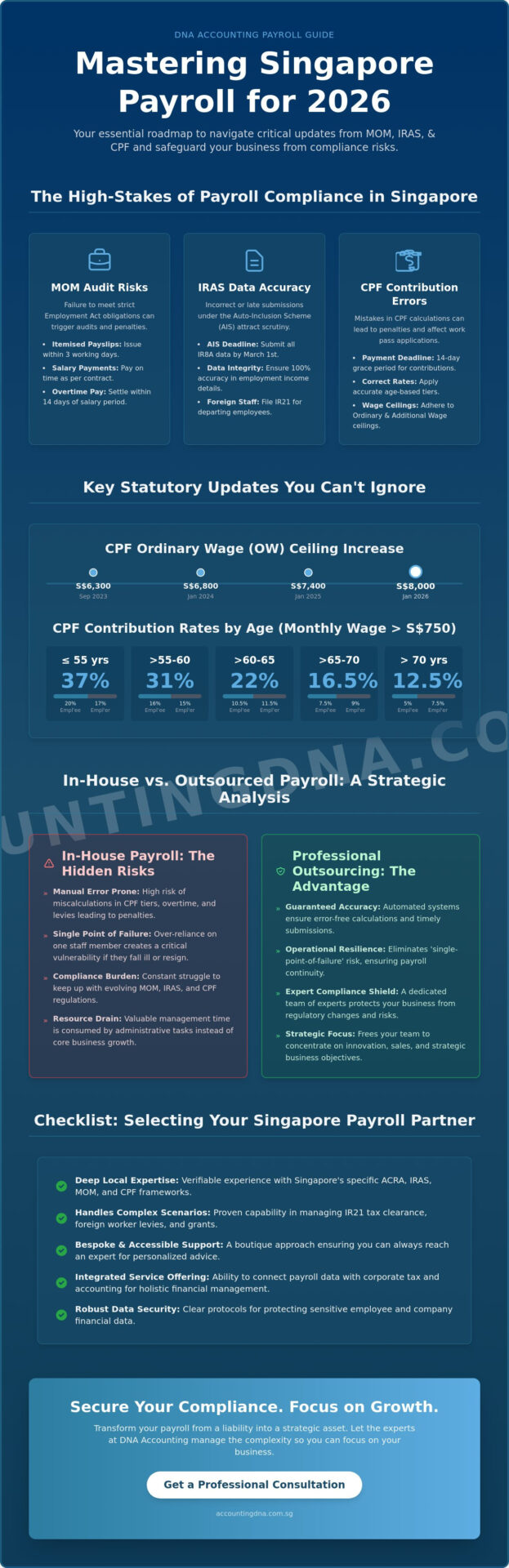
Selecting the Right Payroll Partner in Singapore: A Checklist
Choosing a provider for your payroll services in Singapore is a critical decision. The right partner acts as a protective layer for your business, while the wrong one can create more problems than they solve. Use this checklist to evaluate potential providers.
- Verify Local Expertise and Knowledge of 2026 Regulations: Ensure the provider has deep, specific experience with Singapore’s MOM, IRAS, and CPF frameworks. General international knowledge is not enough.
- Assess Security Protocols for Sensitive Salary Data: Ask about their data encryption, storage policies, and confidentiality agreements. How do they protect your most sensitive information?
- Check for Integration with CPF and IRAS Portals: The provider should use systems that can generate submission-ready files for CPF and IRAS, minimising the risk of manual data entry errors.
- Evaluate the Level of Personalized Support and Accessibility: Can you reach a dedicated manager when you have an urgent question? Or will you be stuck in a call centre queue? Test their responsiveness.
- Review the Transparency of the Pricing Model: Look for clear, upfront pricing without hidden fees for ad-hoc tasks like IR21 filings or special reports.
Technical Proficiency and Software Compatibility
A modern payroll partner must use ACRA and IRAS-approved digital solutions. This ensures compliance and efficiency. Automated CPF file generation is a key feature that dramatically reduces errors compared to manual calculations. Furthermore, in 2026, offering employees access to their payslips and leave information via a secure, cloud-based portal is no longer a luxury—it’s a standard expectation for a professional workplace.
The Importance of a Dedicated Account Manager
The single biggest differentiator in payroll services is the quality of support. Avoid the “call centre” trap where you speak to a different person every time. A dedicated account manager understands your business, your employees, and your specific needs. They become a single point of contact who you can trust to handle sensitive issues efficiently, especially during peak filing seasons. Ready to simplify your operations with a partner who understands this? Contact DNA Accounting for a bespoke consultation.
The DNA Advantage: Bespoke Payroll Care for Singapore SMEs
At DNA Accounting, we believe payroll is a function of trust and protection, not just processing. We move beyond simply running calculations to become your strategic compliance partner. For busy SME directors, our commitment to extreme accessibility—including support during evenings and non-working days—means you get answers when you actually need them, not just during standard office hours.
Our centralized model integrates your payroll, accounting, and corporate secretarial needs under one roof. This holistic approach eliminates communication gaps and ensures your business is protected from every regulatory angle, a level of care larger, siloed firms often cannot provide.
Personalized Support Beyond the Paycheck
Our service extends to strategic advisory on employee benefits, SDL and levy optimisation, and managing complex statutory claims on your behalf. We handle the administrative burden of leave management and government submissions so you don’t have to. This comprehensive support is a core part of our mission to ensure your business meets every obligation detailed in The Master Guide to Statutory Compliance in Singapore.
Peace of Mind for Business Owners
Ultimately, our goal is to give you peace of mind. By ensuring 100% accuracy in payroll, we help keep your employees motivated and loyal. We manage the stress of critical deadlines like IR8A and sensitive processes like IR21, freeing you to focus on leading your team and growing your business. Take the first step toward stress-free management. Request a personalized quote today.
Frequently Asked Questions (FAQs)
Is it mandatory for all Singapore companies to provide itemised payslips?
Yes. Under the Employment Act, all employers must issue itemised payslips to employees covered by the Act at least once a month. The payslip must be given alongside salary payment or within three working days. It must include details such as basic salary, allowances, deductions, overtime pay, and CPF contributions.
What are the current CPF contribution rates for 2026?
CPF contribution rates are subject to change by the government. As of early 2024, the rates vary based on the employee’s age and wage, with the total contribution for employees aged 55 and below at 37% (20% from employee, 17% from employer). It’s crucial to consult the official CPF Board website or a professional payroll provider for the latest applicable rates.
How much do payroll services typically cost for a small business in Singapore?
The cost typically depends on the number of employees and the complexity of your payroll (e.g., number of foreign workers, claims processing). For a small business with 1-10 employees, prices can range from S$30 to S$50 per employee per month. Most providers offer tiered pricing that becomes more cost-effective as your team grows.
Do payroll providers handle tax clearance (IR21) for foreign employees?
Yes, a comprehensive payroll service provider will manage the entire IR21 tax clearance process. This includes calculating the final tax liability, withholding the necessary funds, and filing the Form IR21 with IRAS on your behalf to ensure you meet your legal obligations as an employer.
Can I outsource payroll if I only have one or two employees?
Absolutely. Outsourcing payroll is highly beneficial even for very small teams. It ensures compliance from day one, establishes proper processes, and saves the founder or director valuable time that is better spent on core business activities. It is often more cost-effective than subscribing to payroll software and managing it yourself.
How does the Auto-Inclusion Scheme (AIS) affect my annual tax filing?
If you are an employer under the AIS, you are required to electronically submit your employees’ income information (Form IR8A) to IRAS annually. This means you do not need to issue hardcopy IR8A forms to your employees. It increases your responsibility for data accuracy, as IRAS uses this information directly for employee tax assessments.
What happens if I miss the deadline for CPF contributions?
Missing the CPF contribution deadline (the 14th of the following month) results in penalties. The CPF Board charges late payment interest, currently calculated at 1.5% per month, starting from the first day of the following month. Continued failure to pay can lead to legal action and fines.
Disclaimer
The information provided on this website is for general informational purposes only and is not intended to constitute professional accounting, tax, legal, or financial advice. While we strive to ensure that the content is accurate and up to date, regulations in Singapore, including those administered by ACRA, IRAS, CPF Board, and MOM, may change from time to time and may differ depending on individual circumstances.
Readers should not act or rely on any information contained on this website without seeking specific advice from a qualified professional based on their individual situation.
DNA Corporate Services and its affiliates accept no responsibility or liability for any loss or damage arising from reliance on the information provided in this website or any linked materials.
For tailored advice relating to accounting, taxation, corporate secretarial, or compliance matters in Singapore, please contact us directly for professional consultation.



