

Would your business survive a S$20,000 fine simply because your corporate representative missed a filing deadline? With ACRA’s 2026 enforcement reaching new heights, learning how to choose a company secretary who acts as a proactive shield is the most critical decision you’ll make this year. It’s exhausting to deal with unresponsive providers and “bundled” fees that hide the true cost of compliance. You deserve a partner who understands that statutory filings aren’t just paperwork; they’re the foundation of your growth.
This guide outlines the essential criteria for selecting a secretary who offers bespoke care and total regulatory peace of mind. We’ll explore the importance of ACRA-registered expertise and a commitment to accessibility that doesn’t stop at 6 PM. Discover how to find a reliable, boutique partner who protects your firm with transparent, predictable pricing while you focus on what you do best.
Key Takeaways
- Understand the mandatory legal requirements under Section 171 of the Companies Act, including the strict six-month window for appointing a secretary after incorporation.
- Master how to choose a company secretary by verifying Registered Qualified Individual (RQI) status and identifying hidden costs in “bundled” service agreements.
- Learn why an integrated service model that combines accounting and secretarial functions prevents filing errors and provides a seamless, single point of contact.
- Identify the specific ACRA compliance deadlines and penalty structures for 2026 to ensure your business remains in good standing without the stress of late fees.
Understanding the Legal Mandate for a Singapore Company Secretary
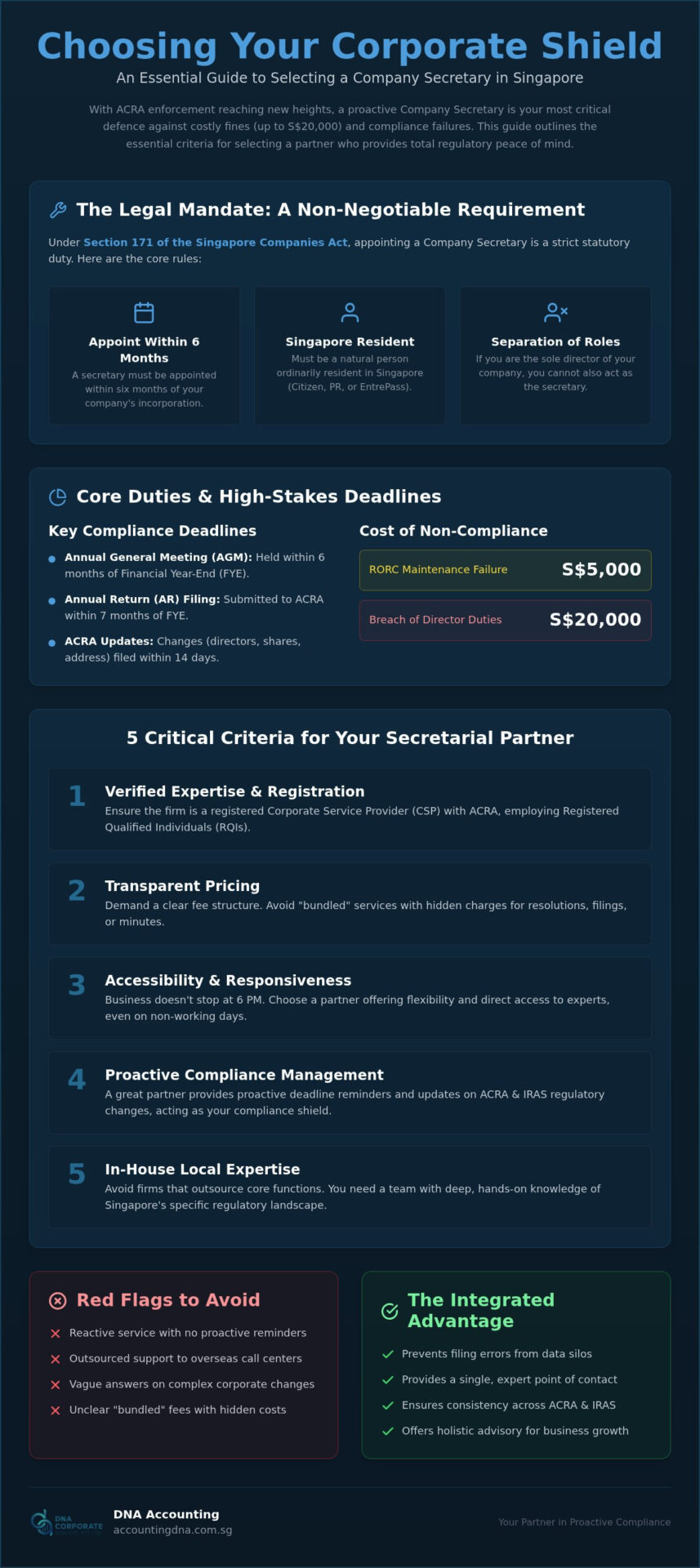
Under Section 171 of the Singapore Companies Act, every company must appoint a secretary within six months of its incorporation. This isn’t just a suggestion; it’s a statutory requirement. The person you choose must be a natural person and an ordinary resident of Singapore. This means they must hold Singapore Citizenship, Permanent Residency, or an EntrePass. If you’re a sole director, you cannot also be the company secretary. This division of roles ensures a system of checks and balances within your business structure. When looking at how to choose a company secretary, you need someone who doesn’t just fill a seat but actively protects your standing with ACRA.
Mandatory ACRA Compliance and Statutory Duties
The duties of a Company Secretary extend far beyond simple record-keeping. They act as your primary liaison with the Accounting and Corporate Regulatory Authority (ACRA), managing the BizFile+ portal and maintaining the Register of Registrable Controllers (RORC). Key responsibilities include:
- Coordinating the Annual General Meeting (AGM) within six months of your financial year-end.
- Filing the Annual Return (AR) with ACRA within seven months of your financial year-end.
- Updating ACRA on changes in directors, shareholders, or company addresses within 14 days.
Failing to maintain the RORC is a costly mistake; penalties can reach S$5,000. If filing milestones are missed, directors face composition fines or debarment. Under 2026 regulations, breaches of director duties can trigger fines up to S$20,000. For many SMEs, engaging corporate secretarial services provides the safety net needed to avoid these risks while focusing on business growth.
5 Critical Criteria for Choosing Your Secretarial Partner
Selecting the right partner is fundamentally about risk management. When researching how to choose a company secretary, prioritize firms registered as a Corporate Service Provider (CSP) with ACRA. This ensures they meet the ACRA statutory requirements and employ Registered Qualified Individuals (RQI) who are held to high professional standards. Don’t settle for a provider who treats your compliance as a mere administrative tick-box.
Pricing transparency is another vital pillar. Many firms lure you in with low annual base fees but then add hidden charges for every director’s resolution, share certificate, or AGM minute. A trustworthy partner offers a clear, predictable fee structure that covers your routine compliance needs without surprise invoices. You should also evaluate their accessibility. Business doesn’t stop at 6 PM. If you’re finalizing an urgent corporate change on a weekend, an “office hours only” provider leaves you stranded. Look for a boutique firm that offers flexibility and direct access to experts when it matters most.
Red Flags to Watch During Your Consultation
Silence is a major red flag. If a provider doesn’t offer proactive reminders for your annual filing deadlines or updates on IRAS and ACRA regulatory changes, they aren’t truly protecting your business. Avoid firms that outsource core secretarial functions to overseas call centers; you need local expertise that understands Singapore’s specific regulatory pulse. During your initial meeting, ask how they handle complex share transfers or changes in corporate structure. If their answers are vague, they likely lack the technical depth your growth demands. If you’re unsure about your current compliance status, it’s often helpful to speak with a local advisor directly.
The Advantage of an Integrated Corporate Service Model
Why should you consider an integrated approach? When your accounting and secretarial functions operate in isolation, data silos are inevitable. If your accountant updates your share capital but your secretary isn’t informed, your ACRA records become inconsistent. This leads to filing errors and potential penalties. An integrated model ensures that tax, payroll, and statutory filings are managed under one roof. This centralized strategy is a key factor when deciding how to choose a company secretary who truly supports your business growth.
DNA Accounting’s boutique model offers the bespoke care that larger, impersonal firms often lack. We provide a single point of contact, ensuring you aren’t bounced between departments. Our team is available during non-traditional hours, including evenings and non-working days, because we know business challenges don’t follow a 9-to-5 schedule. You get the expertise of a seasoned advisor who understands the nuances of your specific SME or startup.
Switching Providers: A Seamless Transition Strategy
Are you stuck with an unresponsive provider? Transitioning is simpler than you might think. The process involves your incoming secretary preparing the resignation of the outgoing officer and the appointment of the new one. This change is updated on ACRA’s BizFile+ portal within 14 days. We specialize in making this a hassle-free handover through our Corporate Secretarial Services. For a deeper dive into your ongoing obligations, refer to The Master Guide to Statutory Compliance in Singapore. We handle the heavy lifting, ensuring your statutory registers are transferred accurately and your compliance status remains unblemished.
Secure Your Company’s Future with the Right Partnership
Choosing a corporate partner is one of the most vital decisions for your business’s longevity. You’ve learned that compliance isn’t just about avoiding ACRA fines; it’s about building a foundation for growth. By understanding how to choose a company secretary who prioritizes transparency and integrated care, you protect your company from the risks of data silos and hidden costs. A proactive secretary ensures you never miss a filing while you focus on scaling your operations.
At DNA Accounting, we provide bespoke support tailored specifically for Singapore SMEs. Our experts are even available during evenings and non-working days to address your urgent queries. We believe in predictable, transparent pricing with no hidden resolution fees to clutter your budget. Ready to experience a more personalized level of service? Get a Reassuring Consultation for Your Secretarial Needs today. Your peace of mind is our priority.
Common Questions About Singapore Corporate Secretarial Services
Can a company director also serve as the company secretary in Singapore?
Yes, a director can serve as the secretary, but there is a significant restriction. If you are the sole director of your Singapore company, the Companies Act prohibits you from also holding the secretarial position. You must appoint another natural person who is an ordinary resident. This requirement ensures a necessary layer of administrative oversight and compliance for your business operations.
What are the typical fees for corporate secretarial services in Singapore?
When learning how to choose a company secretary, you’ll find that fees are typically structured as an annual retainer. This usually covers the maintenance of statutory registers and the filing of your Annual Return. It’s important to ask about ad-hoc costs. Many firms charge extra for director resolutions, share transfers, or changes to your corporate structure that aren’t included in the base package.
How quickly can I change my company secretary if I am unhappy with the current service?
The transition process is quite efficient. Once your new provider prepares the resignation and appointment documents, the update must be filed via ACRA’s BizFile+ portal within 14 days. You don’t have to wait for a contract to end if you’re facing unresponsive service. A competent partner will manage the handover of your statutory records seamlessly to ensure your compliance remains uninterrupted.
Does a dormant company still need to appoint a company secretary?
Yes, every company incorporated in Singapore must maintain a secretary, regardless of its activity level. Even if your business is dormant, you still have mandatory statutory obligations to fulfill. These include filing your Annual Return and holding an Annual General Meeting unless you’ve met specific exemption criteria. Neglecting these duties can lead to late filing penalties or debarment for the company’s directors.
Disclaimer
The information provided on this website is for general informational purposes only and is not intended to constitute professional accounting, tax, legal, or financial advice. While we strive to ensure that the content is accurate and up to date, regulations in Singapore, including those administered by ACRA, IRAS, CPF Board, and MOM, may change from time to time and may differ depending on individual circumstances.
Readers should not act or rely on any information contained on this website without seeking specific advice from a qualified professional based on their individual situation.
DNA Corporate Services and its affiliates accept no responsibility or liability for any loss or damage arising from reliance on the information provided in this website or any linked materials.
For tailored advice relating to accounting, taxation, corporate secretarial, or compliance matters in Singapore, please contact us directly for professional consultation.



