

If “accounting retainer singapore” is on your shortlist, how can you tell whether a provider will handle the work your business actually needs? A monthly fee can look straightforward, yet leave you unsure whether bookkeeping, GST work or support with ACRA and IRAS filings is included or billed separately.
That uncertainty is understandable. Singapore SMEs need accurate accounts and clear compliance responsibilities, not assumptions about what a retainer covers. This guide explains what to look for in an accounting retainer, how to compare providers against your business activity and GST status, and what to confirm in writing before you engage one. Use it to clarify filing responsibilities, deadlines, communication expectations and out-of-scope work, so you can choose a service scope that fits your needs.
Key Takeaways
- An accounting retainer in Singapore is an ongoing service arrangement, not a standard package. Check whether bookkeeping is scoped separately from GST, tax, payroll or corporate secretarial work.
- Compare providers by their stated deliverables, response expectations, record access, exclusions and process for handling changes in scope.
- Match the support to your business activity: transaction volume, GST needs and payroll requirements can all affect what your SME needs from a provider.
- Before onboarding, map your needs, share relevant records, agree who handles each responsibility and review the arrangement once work begins.
What Does an Accounting Retainer in Singapore Actually Cover?
An accounting retainer is an ongoing arrangement for agreed services, not a promise that every accounting task is included for one recurring fee. A general retainer agreement sets out the basis of the relationship. For an accounting retainer singapore arrangement, the practical value is in spelling out exactly what the provider and your business will each handle.
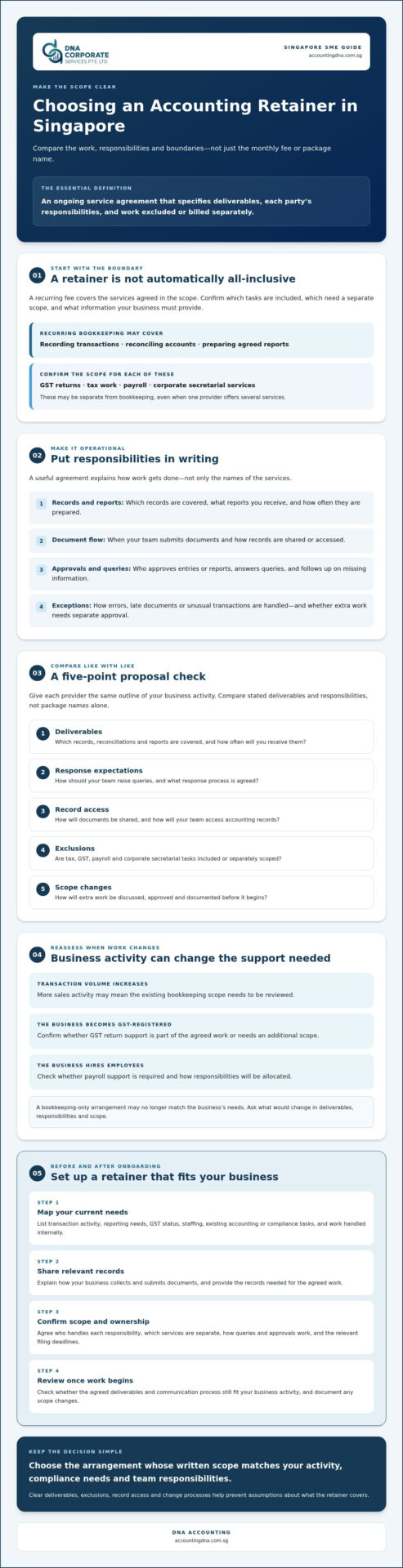
A useful definition: an accounting retainer is an ongoing service agreement that specifies the deliverables, each party’s responsibilities, and the work excluded or billed separately.
Recurring bookkeeping may cover recording transactions, reconciling accounts and preparing agreed reports. Tax work, GST returns, payroll and corporate secretarial services are distinct areas that may need separate scope, even if one provider offers several of them. For example, a business might engage a provider for monthly bookkeeping but still need to confirm who prepares its GST returns, processes payroll or manages statutory filings. Don’t assume those tasks are bundled.
DNA Accounting provides bookkeeping and accounting services. Before engaging a provider, ask for a task-by-task description of what its proposed arrangement includes, what information you must supply and which services require a separate agreement.
Which accounting responsibilities should the agreement spell out?
Make the scope operational, not just a list of service names. Confirm which records are covered, what reports you’ll receive and how often, when your team must submit documents, and how records will be shared. Clarify who answers accounting queries, approves entries or reports, corrects errors and follows up when information is missing. Ask what happens if a document arrives late or an unusual transaction needs extra work. For instance, if a report depends on your team providing complete records, agree who checks for missing information and how gaps will be raised. Clear boundaries help directors and finance teams understand their roles and reduce last-minute confusion around Singapore reporting and compliance tasks.
How Can Singapore SMEs Compare Accounting Retainers Fairly?
Compare what each provider will do and how the work will run, not just the monthly label. Compare the same responsibilities and outputs, not package names alone. A lower headline fee may reflect a narrower scope, while two similarly named retainers may cover different tasks. To make a fair comparison, give each provider the same outline of your business activity and ask for the proposed deliverables, exclusions and responsibilities in writing.
Use this checklist to assess each proposal:
- Deliverables: Which records, reconciliations and reports are covered, and how often will you receive them?
- Response expectations: How should you raise queries, and what response process is agreed?
- Record access: How will your team share documents and access accounting records?
- Exclusions: Are tax, GST, payroll or corporate secretarial tasks included, or separately scoped?
- Scope changes: How will extra work be discussed, approved and documented before it begins?
Consider a Singapore SME whose transaction volume increases as sales grow. If it also becomes GST-registered or hires employees, it may need additional GST or payroll support. A bookkeeping-only proposal may no longer match its needs. Ask each provider what would change in the deliverables, responsibilities and scope, rather than assuming the existing retainer covers the new work.
What questions should you ask before signing an accounting retainer?
Ask who supplies source documents, provides approvals and confirms information needed for relevant compliance work. Then check which tasks are included, which are separate, and how changes are agreed in writing. It can help to describe a typical month of transactions and ask how the provider would handle the records, reporting and follow-up. Review the provider’s accounting service and pricing information alongside the proposed scope, and consider discussing your requirements with DNA Accounting’s team if you need help defining a suitable arrangement.
How Do You Set Up an Accounting Retainer That Fits Your Singapore Business?
A suitable accounting retainer singapore arrangement starts with your actual workload and compliance needs, not a standard package. Before agreeing to a scope, work through these steps:
- Map current needs: List your transaction activity, reporting needs, GST status, staffing and existing accounting or compliance tasks. Note any work your team already handles internally.
- Share records: Provide relevant accounting records and explain how your business collects and submits documents.
- Confirm the scope: Agree on deliverables, frequency, exclusions and how additional work will be handled.
- Assign responsibilities: Clarify who supplies information, approves outputs and follows up on missing records or queries.
- Review after onboarding: Check that the process and outputs match your operations, then raise any gaps promptly.
For relevant Singapore obligations, identify your company’s financial year-end and confirm which deadlines apply. For example, a private company’s ACRA Annual Return is due within 7 months after its financial year-end, while IRAS requires ECI filing within 3 months after year-end, subject to applicable requirements. Agree who tracks each deadline, what records they need from you and how reminders or follow-ups will be handled. Verify current obligations for your company rather than relying on assumptions. If your scope includes tax or GST support, review the provider’s corporate tax and GST services and confirm exactly what is included.
When should a business review or expand its retainer scope?
Revisit the arrangement if transaction activity rises, staffing changes, your GST status changes or your reporting needs develop. These are practical prompts to check whether the current deliverables still fit, not a reason to assume every new task belongs in the retainer. Don’t assume payroll or corporate secretarial support is included just because the same provider offers it. Confirm any added work, responsibilities and terms before relying on that support.
DNA Accounting serves Singapore SMEs and startups across related services, which may help you discuss connected needs without assuming they all belong in one retainer. Discuss your Singapore accounting needs to explore a scope suited to your business.
Choose a Retainer That Grows With Your Business
A well-matched accounting retainer singapore arrangement is built around clear deliverables, responsibilities and exclusions, not a package label. Before you commit, check that the scope reflects your current transaction activity and reporting needs. Also clarify how changes will be reviewed and agreed as your business develops.
Bookkeeping, taxation, GST, payroll and corporate secretarial support may need to be scoped separately. Confirm which services you need and who will handle each responsibility, including relevant ACRA or IRAS matters. That makes it easier to see whether a proposal covers your actual workload or leaves important tasks with your team.
DNA Accounting is a Singapore-based provider serving SMEs and startups, with accounting, taxation, GST, corporate secretarial and payroll services available. These related services can help you discuss connected needs, but confirm exactly what any proposed retainer includes.
Ready to clarify the right scope for your business? Discuss your accounting requirements with DNA Accounting. A clear agreement can make your next steps more confident and manageable.
Frequently Asked Questions
What is included in an accounting retainer in Singapore?
An accounting retainer in Singapore covers the ongoing services specified in the agreement, which may include recurring bookkeeping and agreed financial reports. Tax, GST filing, payroll and corporate secretarial work may need separate scope. Check the deliverables, service frequency, records you must provide, responsibilities on both sides and any exclusions before you engage a provider.
Is an accounting retainer suitable for a Singapore startup?
Yes, it can suit a startup that needs ongoing help keeping its financial records organised without building an in-house accounting function. The right scope depends on the business’s activity and current needs. A startup may begin with bookkeeping, then review whether GST, tax or payroll support is relevant as transactions increase or it hires employees.
Can an accounting retainer include GST filing and payroll services?
Yes, a provider may offer GST filing and payroll services, but don’t assume they’re included in an accounting retainer. Confirm whether GST work applies to your business and is part of the agreed scope. If you employ staff, clarify whether payroll processing and related responsibilities are included, separately engaged or handled by your business.
What should I check before signing an accounting retainer agreement in Singapore?
Check the specific services, deliverables and reporting frequency, along with what’s excluded and how additional work will be agreed. Clarify who supplies records, approves outputs and responds to queries. If ACRA or IRAS matters are relevant, confirm who handles each task and what information they need from you. Make sure responsibilities and communication expectations are clear in writing.
Disclaimer
The information provided on this website is for general informational purposes only and is not intended to constitute professional accounting, tax, legal, or financial advice. While we strive to ensure that the content is accurate and up to date, regulations in Singapore, including those administered by ACRA, IRAS, CPF Board, and MOM, may change from time to time and may differ depending on individual circumstances.
Readers should not act or rely on any information contained on this website without seeking specific advice from a qualified professional based on their individual situation.
DNA Corporate Services and its affiliates accept no responsibility or liability for any loss or damage arising from reliance on the information provided in this website or any linked materials.
For tailored advice relating to accounting, taxation, corporate secretarial, or compliance matters in Singapore, please contact us directly for professional consultation.



