

What if the lowest book keeping fee quote costs more in the long run because GST work, payroll or catch-up entries sit outside its scope? For Singapore SMEs, the headline amount alone rarely shows what support you’ll receive. Transaction volume matters, but so do the condition of your records, business complexity and how often your accounts are updated.
Compare responsibilities, not just prices. This guide explains what can shape bookkeeping fees, how to assess package scope and service frequency, and what information to prepare when requesting a quote. It also clarifies how bookkeeping relates to GST filing and tax work, so you can distinguish routine transaction recording from separate compliance services. With a clearer picture of your activity and records, you can choose support that fits your business and gives you useful visibility into cash flow and financial performance.
Key Takeaways
- Assess a book keeping fee against the agreed work, including transaction handling, record condition, reconciliations and reporting frequency.
- Before comparing quotes, list your bookkeeping needs and check which deliverables, review steps and responsibilities each scope covers.
- Match bookkeeping support to your business activity, such as regular sales, GST-related records or more complex transactions.
- Accounting software can help organise records, while professional bookkeeping support can help maintain consistent accounts and connect them with relevant GST or tax work.
What determines a bookkeeping fee for a Singapore business?
A bookkeeping fee covers an agreed set of tasks, rather than one standard service. The scope may include recording income and expenses, reconciling accounts and preparing regular reports. For a general overview of what bookkeeping is, see how it helps organise a business’s financial activity. The specific work depends on how your business operates and what information you need from your accounts.
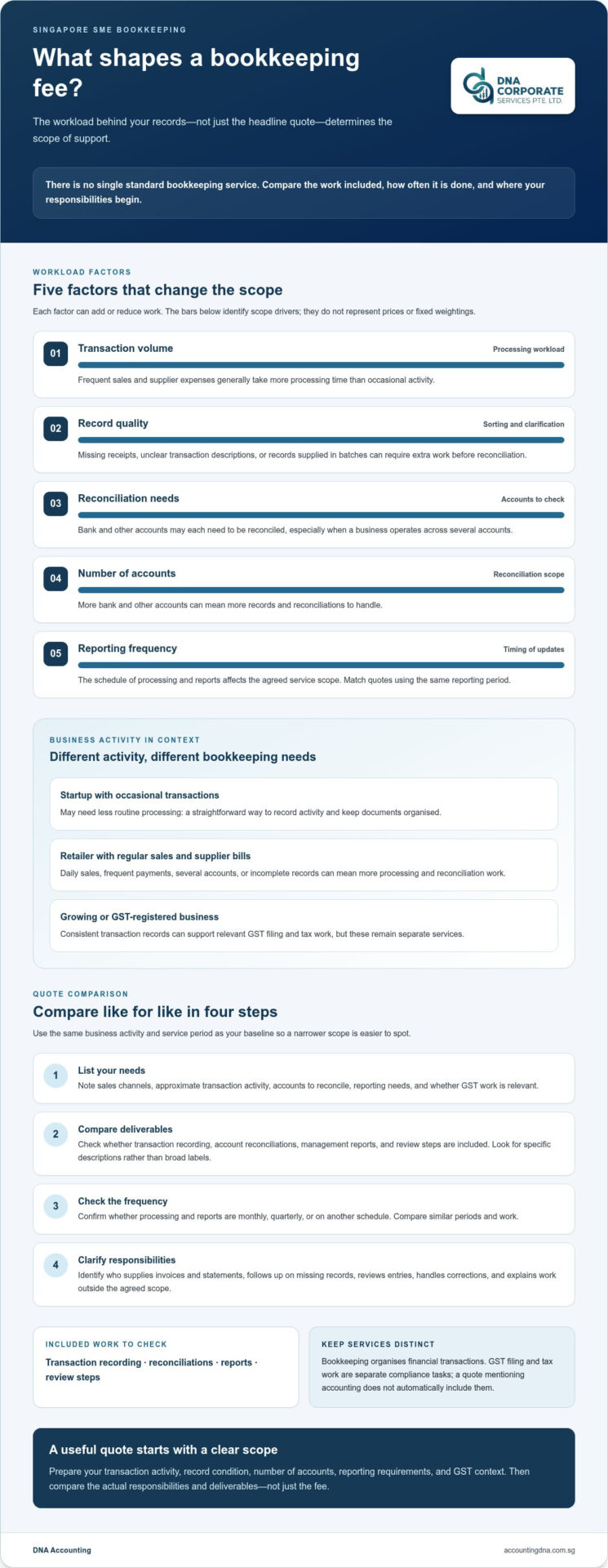
Transaction volume is one cost driver. Processing frequent sales and supplier expenses generally takes more time than recording occasional activity. Record quality matters too. Missing receipts, unclear transaction descriptions or records supplied in batches can require extra work before accounts are ready to reconcile. The number of bank and other accounts, along with how often you need reports, can also affect the scope.
Which business activities can change the bookkeeping scope?
Bookkeeping records and organises financial transactions. It does not automatically include GST filing or tax services. For example, a GST-registered SME needs accurate transaction records, while preparing and submitting its GST return is a separate compliance task. Tax work is separate too. The scope can be tailored to the business’s activity and reporting needs. Bookkeeping supports accurate records, but does not by itself ensure ACRA or IRAS compliance.
The main workload factors are transaction volume, record quality, reconciliation needs, number of accounts, and reporting frequency.
How to compare bookkeeping fee quotes in Singapore
- List your needs. Note your sales channels, approximate transaction activity, accounts to reconcile, reporting needs and whether GST work is relevant.
- Compare deliverables. Check whether transaction recording, bank and account reconciliations, management reports and review steps are included. Look for specific descriptions instead of broad labels such as “full bookkeeping”.
- Check the frequency. Establish whether processing and reports are monthly, quarterly or arranged on another schedule. Compare quotes for the same period and similar work.
- Clarify responsibilities. Identify who supplies invoices and statements, follows up on missing records, reviews entries and handles corrections. Check how the provider treats work outside the agreed scope.
What should a bookkeeping quote clearly explain?
A clear proposal sets out the included tasks, reporting schedule, documents you need to provide and any stated exclusions. It should distinguish bookkeeping from related services. For example, GST filing may be a separate deliverable from transaction recording. Whether your business must register or file depends on its circumstances and current IRAS requirements. Don’t assume GST work is included just because a quote mentions accounting.
For context on how bookkeeping fits with broader support, see bookkeeping and accounting services. You can also find contact details through the DNA Accounting contact page.
Choose bookkeeping support that fits your Singapore SME
Bookkeeping need: A straightforward process for recording activity and keeping documents organised.
Bookkeeping need: Ongoing transaction processing and account reconciliations, with reports at a useful cadence.
Bookkeeping need: Consistent records that can support relevant GST filing and tax work, with each service’s responsibilities clearly scoped.
When is outsourced bookkeeping worth considering?
Consider outside support if reconciliations keep falling behind, your team lacks capacity to maintain the books, or reports arrive too late to guide decisions. A tailored book keeping fee should reflect the actual workload and agreed deliverables. Bookkeeping can provide organised records for related GST or tax support, but those services involve separate work. Review professional accounting services in Singapore and the available bookkeeping pricing information when defining a suitable scope.
Before discussing your needs, gather your approximate transaction volume, reporting requirements, number of accounts and GST context. This helps shape a practical scope around your business activity. The contact page provides a way to discuss those requirements with DNA Accounting.
Set a Bookkeeping Scope That Works for Your Business
The right book keeping fee reflects the work your Singapore SME needs, from transaction processing and reconciliations to reporting frequency and any additional responsibilities. Before deciding, summarise your business activity, record-keeping challenges and reporting needs. Then compare proposals by what they include, how often the work is done and where bookkeeping ends and GST filing or tax support begins.
DNA Accounting is a Singapore-based accounting provider founded in 2016, offering bookkeeping and accounting alongside GST and taxation support. A clearly defined scope can keep your records organised and connect bookkeeping with related services where appropriate. Bookkeeping supports financial visibility, but does not by itself ensure compliance with ACRA or IRAS requirements.
Ready to discuss a scope suited to your business? Discuss bookkeeping support for your business. Share your transaction activity, reporting needs and GST context to start planning a practical approach to your records.
Frequently Asked Questions
How much does bookkeeping cost for a small business in Singapore?
There’s no single standard amount for bookkeeping in Singapore. The fee depends on the agreed scope, including transaction volume, record condition, account reconciliations and how often you need reports. A small startup with occasional transactions may need less ongoing work than an SME with frequent sales and expenses. To understand a quote, compare its deliverables and responsibilities, not just the headline book keeping fee.
What affects a bookkeeping fee in Singapore?
A bookkeeping fee reflects the time and complexity involved in maintaining your accounts. Factors include the number of transactions and accounts, how complete and organised your records are, the reconciliation work required and reporting frequency. Missing receipts or unclear payment descriptions, for example, may require follow-up and sorting. Share these details when discussing a scope so it reflects your actual business activity.
Does a bookkeeping fee include GST filing and tax services?
Not necessarily. Bookkeeping generally involves recording and organising transactions, while GST filing and tax services are separate work unless the agreed scope includes them. For a Singapore business, accurate bookkeeping records can support GST and tax processes, but do not complete those tasks on their own. Check the proposal for each service, its deliverables and who is responsible for providing information.
Can accounting software replace outsourced bookkeeping?
Disclaimer
The information provided on this website is for general informational purposes only and is not intended to constitute professional accounting, tax, legal, or financial advice. While we strive to ensure that the content is accurate and up to date, regulations in Singapore, including those administered by ACRA, IRAS, CPF Board, and MOM, may change from time to time and may differ depending on individual circumstances.
Readers should not act or rely on any information contained on this website without seeking specific advice from a qualified professional based on their individual situation.
DNA Corporate Services and its affiliates accept no responsibility or liability for any loss or damage arising from reliance on the information provided in this website or any linked materials.
For tailored advice relating to accounting, taxation, corporate secretarial, or compliance matters in Singapore, please contact us directly for professional consultation.



