

What if the biggest threat to your company’s growth isn’t a competitor, but a simple administrative oversight in your monthly filings? For many Singapore SME owners, payroll is a source of constant anxiety, especially when you’re juggling the S$8,000 CPF wage ceiling or trying to calculate SDL contributions without making a costly error. It’s exhausting to stay on top of shifting MOM regulations while ensuring your departing foreign staff have their IR21 tax clearance filed exactly one month before they leave.
We understand that you’d rather focus on your team than on the fine print of the Employment Act. This 2026 payroll compliance checklist Singapore is designed to replace that stress with absolute certainty. We’ll walk you through the updated 2026 CPF contribution rates, explain how to handle community fund deductions correctly, and provide a step-by-step framework to keep your business fully compliant with IRAS and MOM standards.
Key Takeaways
- Master the essential monthly cycle by using our payroll compliance checklist Singapore to track CPF contributions and SDL payments before the strict 14th-day deadline.
- Protect your business from MOM disputes by accurately calculating overtime at 1.5 times the hourly rate and auditing mandatory leave entitlements.
- Streamline your year-end reporting obligations by preparing IR8A submissions through the Auto-Inclusion Scheme (AIS) well before the 1 March cutoff.
- Ensure smooth departures for foreign talent by triggering the mandatory IR21 tax clearance process at least one month before employment ceases.
The Monthly Payroll Cycle: Core Statutory Obligations in Singapore
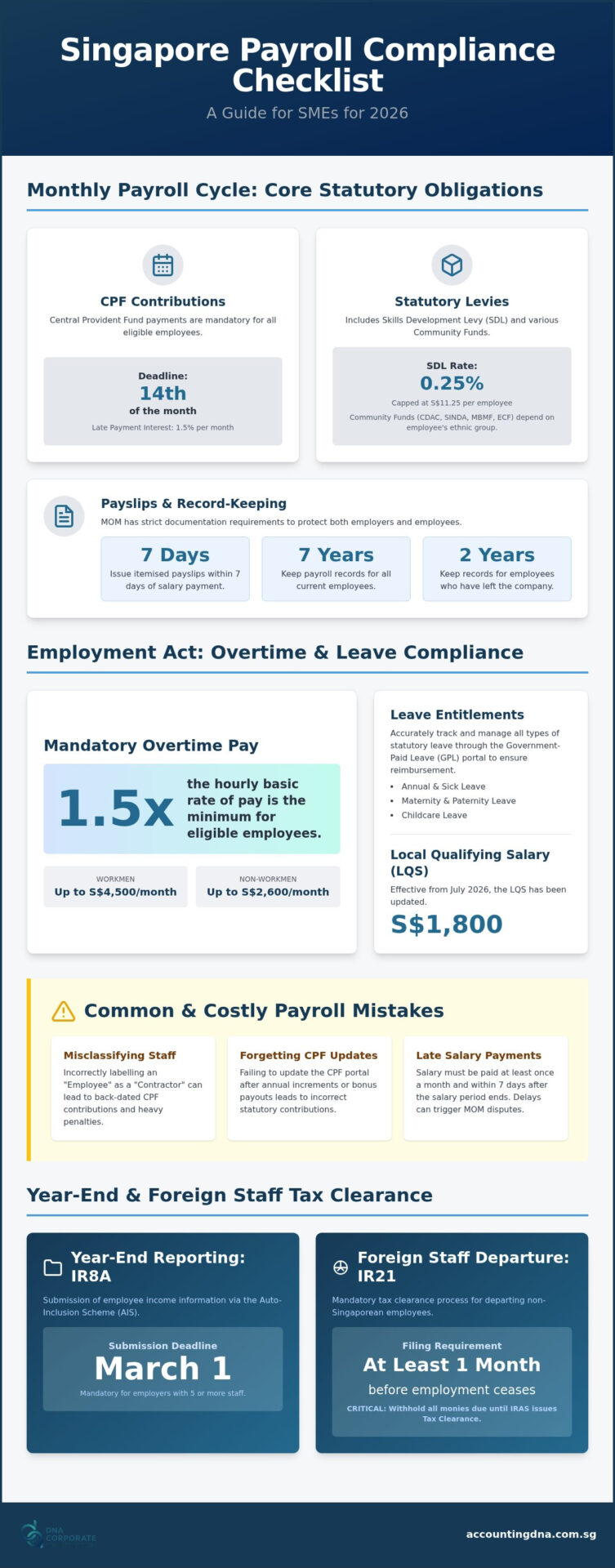
Managing a team is rewarding, but the admin behind it? That’s where things get tricky. Every month, your payroll compliance checklist Singapore starts with the 14th. This is the hard deadline for submitting Central Provident Fund (CPF) contributions. Missing this date triggers late payment interest at 1.5% per month, a cost no SME should bear. Beyond CPF, you must calculate the Skills Development Levy (SDL). It’s 0.25% of total monthly wages, but it’s capped at S$11.25 per employee. Don’t forget the community fund deductions; whether it’s CDAC, SINDA, MBMF, or ECF, these depend strictly on your employee’s ethnic group and religion. It helps to integrate this into a broader payroll compliance checklist Singapore to avoid missing these small but vital details. To keep your records clean, always reconcile these figures with your monthly bookkeeping services. It’s the only way to ensure your financial statements aren’t hiding hidden liabilities.
The 7-Day Rule: Itemised Pay Slips and Record-Keeping
MOM isn’t flexible about documentation. You’re required to issue itemised pay slips within 7 days of the salary payment. These slips must be comprehensive. They need to show basic salary, every allowance, specific deductions, and a clear breakdown of overtime hours. If you’re audited, ACRA and IRAS expect to see payroll records dating back 7 years. For employees who’ve moved on, you still need to keep their data for 2 years. It sounds like a lot of paper, but digital storage is your best friend here. Accurate record-keeping isn’t just about following rules; it’s about protecting your business from future disputes.
Navigating the Employment Act: Leave and Overtime Compliance
Compliance isn’t just about paying on time; it’s about paying the right amount for the right reasons. For workmen earning up to S$4,500 and non-workmen up to S$2,600, overtime pay is mandatory at a minimum of 1.5 times the hourly basic rate. Failing to track these hours accurately is a common pitfall that leads to MOM inquiries. You should also audit your annual and sick leave entitlements regularly. The Employment Act sets the floor, but managing maternity, paternity, and childcare leave claims through the Government-Paid Leave (GPL) portal requires precise documentation to ensure your company gets reimbursed. Maintaining an updated payroll compliance checklist Singapore helps you stay aligned with the latest standards, especially since the Local Qualifying Salary (LQS) was raised to S$1,800 as of July 2026. If you’re ever unsure about your current standing, you can reach out for a quick compliance check to ensure your team is protected. It’s much easier to fix a process now than to face an audit later.
Common Payroll Mistakes for Singapore SMEs
Many business owners accidentally stumble into legal trouble by misclassifying staff. Are they “Contractors” or “Employees”? If they’re performing core duties under your control, they’re likely employees, and you’re liable for back-dated CPF contributions and heavy penalties. Another frequent error is forgetting to update the CPF portal after annual increments or bonus payouts, which skews your statutory obligations. Your payroll compliance checklist Singapore must also account for the strict 7-day payment window. Salary must be paid at least once a month and within 7 days after the salary period ends. Keeping your records reconciled prevents these minor errors from becoming major liabilities and keeps your focus on growing your business. Accuracy today means peace of mind tomorrow.
Year-End Reporting & Foreign Tax Clearance (IR8A & IR21)
March 1 is the non-negotiable deadline for IR8A submissions via the Auto-Inclusion Scheme (AIS). If you’re an employer with 5 or more staff, this is a mandatory step on your payroll compliance checklist Singapore. Beyond annual filings, managing departing foreign staff requires the IR21 process. You must trigger this at least one month before they leave or cease employment. Crucially, you must withhold all monies due to the employee, including leave encashment and bonuses, until IRAS issues the Tax Clearance Certificate. Following the Ministry of Manpower guidelines on salary ensures you remain compliant with payment timelines while fulfilling tax obligations. For complex reporting like benefits-in-kind, it’s wise to consult a corporate tax consultant in Singapore to ensure every detail is accurate.
How Outsourced Payroll Services Protect Your Business
Why carry the stress of administrative deadlines alone? Outsourcing allows you to navigate corporate tax filing Singapore requirements with specialized expertise. By centralizing payroll, bookkeeping, and secretarial duties with a boutique partner like DNA Accounting, you eliminate vendor friction. Our team handles the 2026 compliance updates automatically, giving you the freedom to focus on growth. We don’t just process numbers; we provide a protective layer that ensures every statutory obligation is met with precision. This integrated approach turns a daunting payroll compliance checklist Singapore into a streamlined, stress-free monthly habit.
Future-Proof Your Payroll Strategy
Managing payroll in Singapore isn’t just about cutting checks; it’s about protecting the business you’ve worked so hard to build. By mastering the monthly CPF cycle and staying ahead of IR21 tax clearances, you eliminate the risk of penalties that drain your resources. This payroll compliance checklist Singapore provides the foundation you need, but you don’t have to carry the administrative burden alone. At DNA Accounting, we specialize in the unique regulatory needs of startups and SMEs. Our boutique approach means you get integrated support across accounting and corporate secretarial tasks, with the added comfort of evening and weekend availability for those urgent compliance questions. Ready to clear the clutter from your desk? Get a Professional Payroll Compliance Review today. Let’s ensure your team is taken care of while you focus on your next big milestone.
Frequently Asked Questions
What is the deadline for CPF contributions in 2026?
The deadline for CPF contributions is the 14th of every month following the month for which wages are paid. If the 14th falls on a weekend or public holiday, the deadline moves to the next working day. Late payments attract an interest charge of 1.5% per month, so it’s a vital item on your payroll compliance checklist Singapore.
Does my company need to join the Auto-Inclusion Scheme (AIS) for IR8A?
You must join the Auto-Inclusion Scheme (AIS) if your company has 5 or more employees during the year. Under this scheme, you submit employment income information to IRAS electronically. This data then pre-fills your employees’ individual income tax returns. It’s a mandatory requirement that simplifies the tax season for your team and ensures your records are perfectly aligned with IRAS.
How is the Skills Development Levy (SDL) calculated for part-time staff?
SDL is calculated at 0.25% of each employee’s total monthly remuneration, including part-time staff and casual laborers. For employees earning S$800 or less, the minimum levy is S$2. If they earn S$4,500 or more, the levy is capped at S$11.25. This contribution is mandatory for all employees, including foreign workers, and helps fund workforce training programs across Singapore.
What happens if I miss the IR21 filing deadline for a departing foreign employee?
Missing the IR21 filing deadline can lead to a penalty of up to S$1,000. Additionally, the employer may be held personally liable for the employee’s unpaid tax. You must file at least one month before the foreign employee ceases work or leaves the country. Always withhold all final payments, including leave encashment, until IRAS issues the Tax Clearance Certificate to avoid these risks.
Disclaimer
The information provided on this website is for general informational purposes only and is not intended to constitute professional accounting, tax, legal, or financial advice. While we strive to ensure that the content is accurate and up to date, regulations in Singapore, including those administered by ACRA, IRAS, CPF Board, and MOM, may change from time to time and may differ depending on individual circumstances.
Readers should not act or rely on any information contained on this website without seeking specific advice from a qualified professional based on their individual situation.
DNA Corporate Services and its affiliates accept no responsibility or liability for any loss or damage arising from reliance on the information provided in this website or any linked materials.
For tailored advice relating to accounting, taxation, corporate secretarial, or compliance matters in Singapore, please contact us directly for professional consultation.



