

What if a corporate service company with a long list of services still leaves you unsure who is responsible for a filing? When comparing corporate service companies in Singapore, SMEs, startups and foreign entrepreneurs need more than a provider for accounting, tax or company secretarial work. They need to understand how responsibilities connect across ACRA, IRAS, CPF and MOM requirements, and who will keep each agreed task on track.
Choosing a provider can be confusing: some coordinate several recurring services, while specialist firms focus on a narrower scope. This guide explains what corporate service companies may handle, how to assess their Singapore experience, and what to ask about service scope, communication, records and compliance workflows. Use the questions and steps below to match support to your needs now, plan for upcoming requirements, and compare providers with greater confidence.
Key Takeaways
- Corporate service companies may combine accounting, GST and tax, corporate secretarial, incorporation, and payroll support, but confirm each provider’s actual scope.
- Compare Singapore providers on relevant experience, task ownership, communication, and how they’ll manage handovers.
- Before engaging a provider, list your current and expected needs, then clarify who prepares, reviews, submits, and follows up on each agreed task.
- Prepare company details, existing records, questions, and known upcoming requirements so your initial discussion can focus on fit and next steps.
What Singapore Corporate Services Handle for SMEs
A corporate services company provides business administration and financial support, but the exact scope varies. One provider may focus on company secretarial work, while another coordinates accounting, tax and payroll as well. For a Singapore business, start by listing the tasks you need done and matching each one to a specific service. A broad service list does not necessarily mean every task, filing or follow-up is included.
Common support includes bookkeeping to organise transactions and financial records; GST and tax services to help manage relevant filings with IRAS; corporate secretarial support for company administration and ACRA-related work; incorporation for setting up a company; and payroll support for salary processing and related CPF or MOM matters. For background on the regulator, see the Accounting and Corporate Regulatory Authority (ACRA).
Which Singapore business tasks can a corporate services provider support?
A startup preparing to incorporate may also want help setting up its accounting records and arranging ongoing corporate secretarial support. An operating SME may instead need regular bookkeeping, tax and GST support alongside payroll coordination. In either case, identify the tasks that recur, the records needed to complete them, and who will supply those records.
Coordinating several services through one provider can reduce handover friction, but only when responsibilities are clear. Ask which records you must provide, who handles each agreed task, and how information moves between services. For example, clarify how bookkeeping records will be used for tax work and who will contact you if information is missing. DNA Accounting supports Singapore SMEs and startups with accounting and bookkeeping, GST and taxation, corporate secretarial support, incorporation and payroll. Explore its bookkeeping and accounting services to understand one part of that support.
How to Compare Corporate Service Companies in Singapore
A long service list doesn’t show whether a provider is right for your business. Compare corporate service companies by the work they’ll take responsibility for, their relevant Singapore experience, and how they’ll keep you informed. ACRA’s role as the regulator of corporate service providers is useful context, but assess each provider’s actual scope and working arrangements directly.
| What to compare | Questions to ask |
|---|---|
| Service scope | Which services are included, excluded, or referred to another professional? |
| Singapore experience | What relevant experience does the team have supporting businesses with needs like yours? |
| Task ownership | Who prepares, reviews, submits, and follows up on each agreed task? |
| Communication | How will you receive document requests, approval queries, and filing-status updates? |
| Handover | How will records and open items be transferred if the engagement changes or ends? |
What should you ask before appointing a corporate services company?
Ask for clear boundaries, not just a brochure. If a provider handles bookkeeping and tax work, for example, confirm which records you must supply, who checks whether the information is complete, and who will contact you about gaps before the agreed work proceeds. For broader context on your business’s responsibilities, review current guidance on Singapore statutory compliance and confirm requirements with the relevant authority.
Compare accountability and fit, not portfolio size or claims you can’t verify. Agree how approvals will be recorded, where documents will be shared, and how unanswered queries or pending work will be flagged. If you’d like to discuss whether DNA Accounting’s services fit your needs, contact the team with your questions.
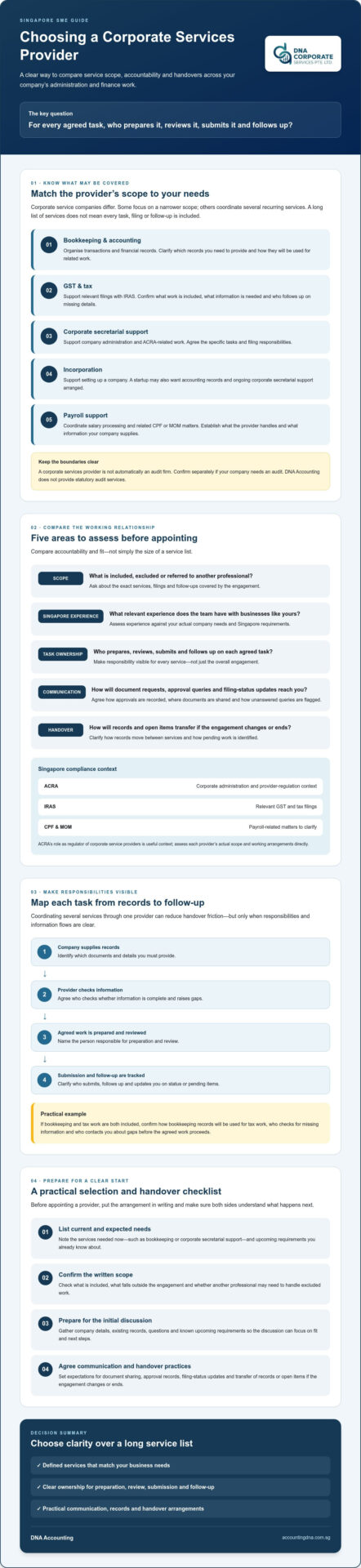
Choosing a Corporate Services Partner and Planning the Handover
A clear start reduces the chance of missing records or duplicated work. Before appointing a provider, put the arrangement in writing and make sure both sides understand what happens next.
- List your needs. Note the services you need now, such as bookkeeping or corporate secretarial support, and any upcoming requirements you already know about.
- Confirm the scope. Check which services are included, what falls outside the engagement, and whether another professional may need to handle excluded work.
- Clarify responsibilities. Agree who supplies information, prepares work, obtains approvals, and follows up on outstanding items.
- Agree on information sharing. Confirm how records will be shared, who can access them, and how queries and updates will be handled.
For an initial discussion, gather your company details, current records, a list of service questions, and any known upcoming requirements. If bookkeeping is part of your needs, review the provider’s bookkeeping and accounting services and confirm what applies to your business. For corporate secretarial support, ask which work is covered and what information or approvals you will need to provide.
How can you change or appoint a provider without losing continuity?
Ask how existing records, open tasks, key contacts, and system access will be documented and transferred. Agree with both the current and incoming provider on responsibilities and transition timing, especially if a filing or other task is already in progress. The Corporate Service Providers Act 2024 is a reference point for understanding the Singapore framework for corporate service providers.
Singapore SMEs seeking coordinated accounting, tax, corporate secretarial, and payroll support may consider DNA Accounting, a Singapore-based boutique provider. Confirm the proposed scope and handover arrangements before engaging. A single provider relationship can support coordination, but responsibilities still need to be agreed clearly.
Choose a Partner That Fits Your Next Steps
The right corporate services partner should match the support your business needs, make responsibilities clear, and agree how records and updates will be handled. Before appointing a provider, confirm the scope of each service and plan the handover so ongoing tasks have clear ownership.
DNA Accounting is a Singapore-based boutique provider founded in 2016. Its services include accounting, GST and tax, corporate secretarial support, incorporation, and payroll. These services may suit SMEs looking to coordinate relevant business support through one provider, with scope and responsibilities confirmed before engagement.
Have questions about what your business needs or how a transition could work? Discuss your Singapore business support needs with DNA Accounting. A clear conversation is a practical first step towards choosing support that fits your business.
Frequently Asked Questions
What services do corporate service companies in Singapore provide?
Corporate service companies in Singapore may support business administration and financial tasks, but each provider’s scope differs. Services can include company incorporation, corporate secretarial support, accounting and bookkeeping, GST and tax services, and payroll. These may relate to work involving ACRA, IRAS, CPF or MOM, depending on the service and the business’s circumstances. Confirm what’s included and whether specialist work, such as statutory audit, is excluded.
How do I choose a corporate services company in Singapore?
Choose a provider by matching its stated services and Singapore experience to your actual needs. Ask who prepares, reviews, submits and follows up on each agreed task, and how the provider communicates document requests, approvals and filing status. Also clarify exclusions, information-sharing arrangements and handover procedures. A detailed service fit and clear accountability matter more than a long portfolio or broad, unverified claims.
Do Singapore SMEs need a corporate service provider?
No, using a corporate service provider isn’t automatically necessary for every Singapore SME. The right choice depends on the company’s internal capacity and which administrative or financial tasks it wants support with. A small business may seek help coordinating accounting, tax, payroll or corporate secretarial work, while another may manage some tasks internally. Identify needs first, then verify responsibilities and relevant requirements with the provider or authority.
Can one provider handle accounting, tax, payroll, and company secretarial services?
Yes, some Singapore providers offer all four, but you should confirm each service is available and included in the proposed engagement. Ask how records and information pass between the accounting, tax, payroll and secretarial work, and who owns each task. DNA Accounting’s stated services include accounting and bookkeeping, GST and taxation, payroll, and corporate secretarial support. Confirm the current scope and arrangements before appointing a provider.
Disclaimer
The information provided on this website is for general informational purposes only and is not intended to constitute professional accounting, tax, legal, or financial advice. While we strive to ensure that the content is accurate and up to date, regulations in Singapore, including those administered by ACRA, IRAS, CPF Board, and MOM, may change from time to time and may differ depending on individual circumstances.
Readers should not act or rely on any information contained on this website without seeking specific advice from a qualified professional based on their individual situation.
DNA Corporate Services and its affiliates accept no responsibility or liability for any loss or damage arising from reliance on the information provided in this website or any linked materials.
For tailored advice relating to accounting, taxation, corporate secretarial, or compliance matters in Singapore, please contact us directly for professional consultation.



