

The lowest quote for an accountant may not be the best value for your Singapore business. A headline fee might cover bookkeeping but leave tax filing, GST work, payroll or corporate secretarial services outside the scope. The cost of hiring an accountant in Singapore depends on what your business needs and what the proposal includes, not just the quoted price.
To compare providers fairly, check how transaction volume, GST registration, employee numbers and reporting needs affect the proposed scope. Then compare the total cost for the same period and ask about additional fees. This guide explains the main factors behind accounting fees, offers a practical checklist for reviewing proposals and helps you identify support suited to your business. Accounting, tax, GST, payroll and corporate secretarial work are distinct scopes, so confirm each one rather than assuming it is included.
Key Takeaways
- The cost of hiring an accountant in Singapore depends on your transaction volume, business complexity and the tasks included in the agreed scope.
- Compare proposals against the same checklist, including bookkeeping frequency, reporting, tax work, GST work and ongoing support.
- Ask how incomplete records, unusual transactions and out-of-scope requests will be handled before accepting a quote.
- List your business needs and clarify responsibilities first, then request proposals tailored to your startup or SME.
What determines the cost of hiring an accountant in Singapore?
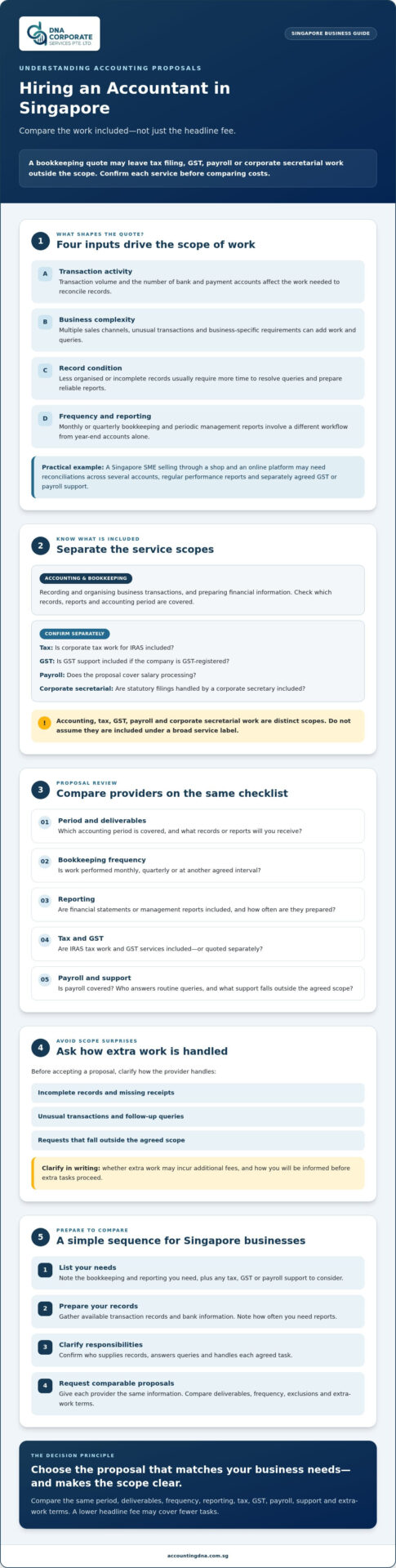
The cost of hiring an accountant in Singapore reflects an agreed scope of work, its complexity and frequency, and the responsibility the provider takes on. A bookkeeping quote does not automatically include tax filing or other compliance work. Check each deliverable rather than relying on a broad service label.
Accounting and bookkeeping generally involve recording and organising business transactions and preparing financial information. Taxation, GST, payroll and corporate secretarial services are separate scopes that should be stated in the proposal. For example, confirm whether the quote covers corporate tax work for IRAS, GST support if the company is GST-registered, salary processing, or statutory filings handled by a corporate secretary. Do not assume these are included in an accounting fee.
It is also worth clarifying the provider’s qualifications and level of responsibility. The Institute of Singapore Chartered Accountants (ISCA) offers background on Singapore’s accountancy body. Ask providers about relevant qualifications and who will review or approve the work.
Which business factors change an accounting quote?
Transaction volume, the number of bank and payment accounts, and the condition of your records all affect the work involved. More transactions and less organised records usually mean more time is needed to reconcile accounts, resolve queries and prepare reliable reports. Reporting frequency matters too. Periodic management reports require a different workflow and level of detail from year-end accounts alone.
Consider a Singapore SME selling through a shop and an online platform. The provider may need to reconcile transactions across several accounts, prepare regular performance reports and handle GST or payroll under a separately agreed scope. A smaller startup with orderly records and simpler reporting needs may require a different arrangement. Ask providers to base their proposals on your actual activity and reporting expectations, not a generic package description.
How to compare accountant fees in Singapore without missing hidden scope
A lower quote can cover fewer tasks, so compare deliverables before comparing fees. Give each provider the same information and ask for exclusions and additional charges in writing. DNA Accounting’s pricing information can help you identify what to ask about. Remember that accounting and bookkeeping are distinct from tax, GST, payroll and corporate secretarial work.
Compare these proposal items:
- Period and deliverables: Which accounting period is covered, and what records or reports will you receive?
- Bookkeeping frequency: Is work performed monthly, quarterly or at another agreed interval?
- Reporting: Are financial statements or management reports included, and how often will they be prepared?
- Tax and GST: Are IRAS tax work and GST services included, or quoted separately?
- Payroll and support: Is payroll covered? Who answers routine queries, and what support falls outside the agreed scope?
What should a Singapore accounting proposal include?
Ask the provider to state the covered period, deliverables, your responsibilities for supplying records and the reporting schedule. Confirm separately whether tax, GST, payroll and corporate secretarial work are included. When assessing the cost of hiring an accountant in Singapore, compare proposals on the same basis: period, deliverables, frequency, reporting, tax, GST, payroll, support and extra-work terms.
Clarify how the provider handles incomplete records, unusual transactions and requests beyond the agreed scope. For example, ask whether missing receipts require additional work and how you will be told before extra tasks proceed. This helps prevent an attractive headline quote from becoming an unexpected bill. If you are preparing proposals, you can discuss your requirements before deciding which scope fits your business.
Choose the right Singapore accountant and request a tailored proposal
The right support depends on how your business operates, not simply whether it is labelled a startup or SME. Before requesting quotes, follow a clear sequence:
- List your needs: Note the bookkeeping and reporting you need, along with any tax, GST or payroll support to consider.
- Prepare your records: Gather available transaction records and bank information. Note how often you need reports so providers can assess a comparable scope.
- Clarify responsibilities: Confirm who will provide records, answer queries and handle each agreed task.
- Request comparable proposals: Share the same information with each provider, then compare deliverables, frequency, exclusions and how extra work is treated.
A newly incorporated company with limited activity may need a different arrangement from an established SME with regular reporting needs or staff. There is no single service model that fits every business. A tailored proposal should reflect your activity and clarify which work is covered. Reviewing accounting and bookkeeping services can help you identify the scope to discuss.
When should a Singapore business seek professional accounting support?
The cost of hiring an accountant in Singapore is easier to assess once your needs and responsibilities are clear. DNA Accounting serves Singapore SMEs and startups with accounting and related services. To discuss your requirements and the scope that may fit your business, contact DNA Accounting.
Make your accounting scope work for your business
The cost of hiring an accountant in Singapore makes more sense when you assess the work behind the quote, not just its headline fee. Transaction volume, record quality and reporting needs help determine the accounting scope. Tax, GST, payroll and corporate secretarial support should be checked as distinct services. Compare proposals using the same deliverables and clarify how extra work will be handled.
A startup may need a focused scope, while a growing SME may need more regular reporting or additional support. The right fit depends on your activity and responsibilities. DNA Accounting is a Singapore-based provider founded in 2016, with accounting, tax, GST, payroll and corporate support available as distinct service areas. Confirm which services match your requirements and what a proposal includes.
Ready to discuss a scope tailored to your business? Discuss your Singapore accounting requirements with DNA Accounting.
Frequently Asked Questions
How much does it cost to hire an accountant in Singapore?
There is no single fee that applies to every business. The cost of hiring an accountant in Singapore depends on the agreed scope, transaction volume, record quality, reporting needs and services requested. Ask each provider for a written proposal that itemises deliverables and exclusions. Comparing equivalent services gives you a clearer basis for assessing the quoted amount.
What affects the cost of accounting services for a Singapore SME?
The amount and complexity of transactions, the state of your bookkeeping records, reporting frequency and additional requests can all affect the work involved. Records that need organising, for example, may require more follow-up than complete, well-maintained records. Tax, GST, payroll and corporate secretarial services may be separate scopes. Describe your business activity and needs clearly so providers can prepare comparable proposals.
Are bookkeeping and tax filing included in an accountant’s fees in Singapore?
It depends on the provider’s agreed engagement scope. Bookkeeping, financial reporting, corporate tax work and GST filing are related but distinct tasks, so do not assume they are bundled together. Check the proposal for each deliverable, the period covered, the records or information you must provide, and how out-of-scope requests are handled. Ask the provider to clarify any item that is not explicit.
How can I compare accountant quotes in Singapore fairly?
Compare proposals using the same accounting period, record-volume assumptions, bookkeeping frequency, reports, tax or GST work and support arrangements. Ask each provider to list exclusions and explain how additional work is identified and approved. A lower headline fee may cover less work, so consider the proposal’s clarity and fit with your business needs alongside the quoted amount.
Disclaimer
The information provided on this website is for general informational purposes only and is not intended to constitute professional accounting, tax, legal, or financial advice. While we strive to ensure that the content is accurate and up to date, regulations in Singapore, including those administered by ACRA, IRAS, CPF Board, and MOM, may change from time to time and may differ depending on individual circumstances.
Readers should not act or rely on any information contained on this website without seeking specific advice from a qualified professional based on their individual situation.
DNA Corporate Services and its affiliates accept no responsibility or liability for any loss or damage arising from reliance on the information provided in this website or any linked materials.
For tailored advice relating to accounting, taxation, corporate secretarial, or compliance matters in Singapore, please contact us directly for professional consultation.



