

Are you spending your late nights wrestling with spreadsheets just to avoid a costly ACRA penalty, or are you actually using those numbers to scale your company? It’s a common struggle for local founders. You likely feel that the more time you spend on manual data entry, the less time you have to lead your team. Managing the nuances of bookkeeping vs accounting for small business Singapore can feel like a daunting maze of regulations. We understand that the fear of filing errors or GST confusion often keeps you up at night.
In this guide, you’ll discover the critical differences between these two pillars and how to structure your financial management for 100% compliance with ACRA and IRAS. We’ll explore how to move from basic record-keeping to gaining the strategic clarity needed to grow your business. You’ll soon know exactly how to protect your firm while reclaiming your time and focus.
Key Takeaways
- Understand the fundamental distinction of bookkeeping vs accounting for small business Singapore to move from simply recording transactions to making data-driven growth decisions.
- Learn how to structure your financial records to ensure 100% compliance with ACRA and IRAS, avoiding the stress of late filing penalties.
- Identify the specific business milestones, such as approaching the S$1 million GST registration threshold, that signal it’s time to shift from basic bookkeeping to strategic accounting.
- Discover the advantages of a centralized, boutique service model that integrates bookkeeping, tax, and secretarial needs into one seamless partnership.
Decoding Bookkeeping vs Accounting: Critical Roles in the Singapore Landscape
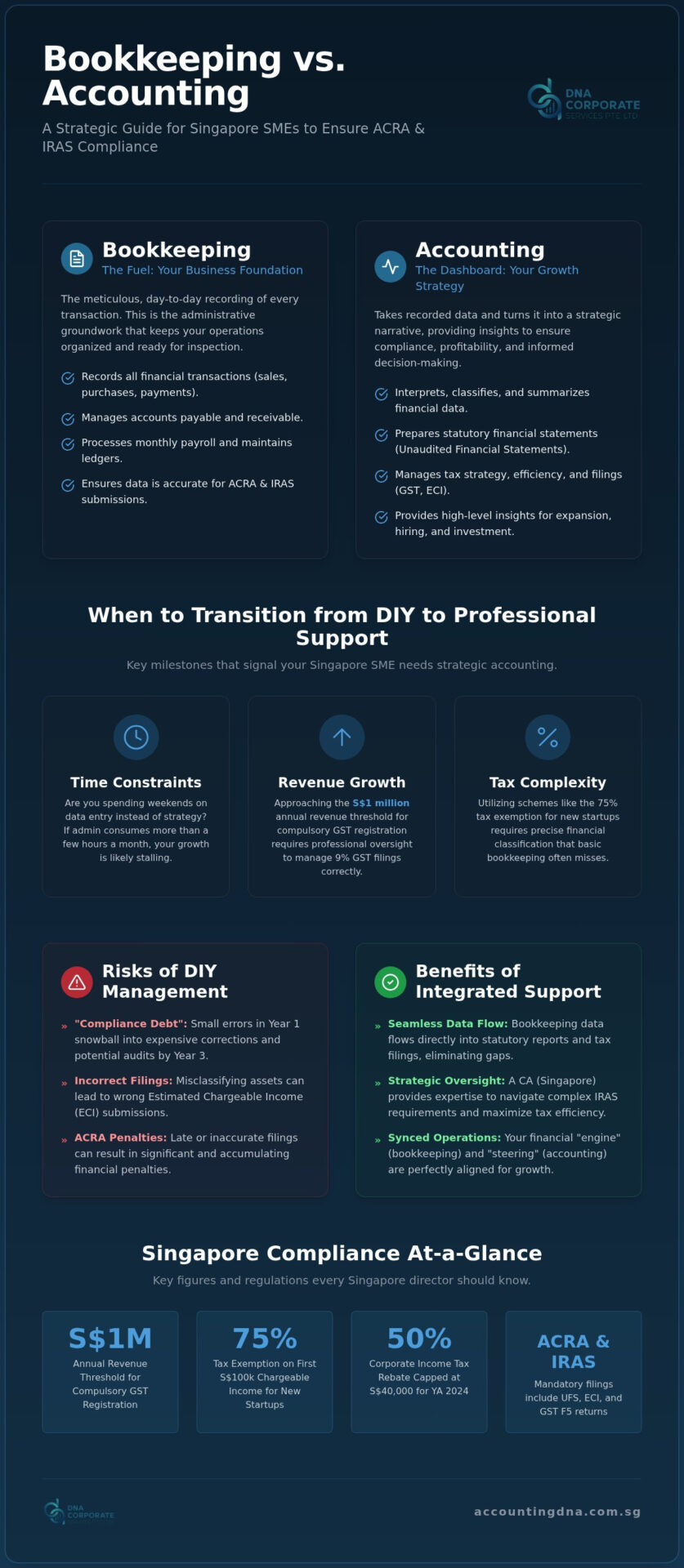
Think of your business as a high-performance vehicle. Bookkeeping is the fuel keeping the engine running, while accounting is the dashboard helping you navigate. For a Pte Ltd company, this distinction isn’t just academic; it’s the difference between a smooth annual return and a frantic scramble to avoid ACRA penalties. Many directors feel overwhelmed by these administrative layers, but understanding how they work together is the first step toward reclaiming your peace of mind.
Bookkeeping involves the meticulous, day-to-day recording of every cent that enters or leaves your business. This includes managing your accounts payable, processing monthly payroll, and maintaining Standard methods of bookkeeping to ensure every receipt is captured. It’s the administrative groundwork that keeps your operations organized and ready for inspection at any moment.
Accounting takes those records and turns them into a strategic narrative. It involves interpreting data to prepare statutory financial statements and ensuring tax efficiency through available grants or rebates. When evaluating bookkeeping vs accounting for small business Singapore, remember that while bookkeepers keep you organized, accountants keep you compliant and profitable. They provide the high-level insights that help you decide when to hire or expand.
Why Bookkeeping is the Foundation for ACRA and IRAS Compliance
Accurate ledgers are mandatory for preparing the Unaudited Financial Statements required by ACRA. If your daily books are messy, your quarterly GST F5 submissions to IRAS will likely contain errors, which can lead to costly penalties or audits in 2026. Consistent record-keeping ensures you don’t miss out on the 50% Corporate Income Tax rebate for YA 2026. The Singapore Financial Reporting Standards (SFRS) provide the essential framework that accountants use to interpret your books and ensure your reports meet national legal requirements.
When Should Your Singapore SME Transition from Basic Bookkeeping to Accounting?
Many founders begin their journey by recording every S$5 coffee receipt themselves. While this works for a side hustle, it quickly becomes a bottleneck for a growing Pte Ltd. To decide if you’ve outgrown the DIY phase, first evaluate your time. Are you spending your weekends on data entry instead of strategic planning? If administrative tasks steal more than a few hours a month, your business is likely stalling. Second, watch your revenue closely. If you’re approaching the S$1 million threshold for compulsory GST registration, you need professional oversight to manage the 9% GST filings correctly. Finally, consider your tax strategy. Utilizing the Tax Exemption Scheme for New Startups, which offers a 75% exemption on your first S$100,000 of chargeable income, requires precise classification that basic bookkeeping often misses.
The Risks of DIY Bookkeeping: Avoiding ACRA Late Filing Penalties
Software is a tool, not a strategy. We’ve seen many directors fall into the “compliance debt” trap. This happens when small errors in Year 1, like misclassifying assets, lead to incorrect Estimated Chargeable Income (ECI) filings. By Year 3, these mistakes snowball into expensive corrections during an audit. ACRA’s enforcement is strict, and late filing penalties can add up quickly. Relying solely on software without professional review often creates a false sense of security. If you’re unsure where your records stand, it’s helpful to speak with a specialist who understands the local landscape. For a deeper dive into scaling safely, read our Professional Accounting Services in Singapore: The 2026 SME Growth Guide. Balancing bookkeeping vs accounting for small business Singapore ensures you don’t just stay organized; you stay protected.
Choosing the Right Financial Model: Why Integrated Support Wins
DNA Accounting: Your Partner for Bespoke Financial Management
We know that entrepreneurship doesn’t follow a 9-to-5 schedule. That’s why our boutique firm prioritizes extreme accessibility, offering support during evenings and non-working days to suit your specific schedule. By integrating our bookkeeping and accounting services, we eliminate the friction of year-end filings. We handle the heavy lifting of ACRA and IRAS compliance, from quarterly GST submissions to essential corporate secretarial duties. This allows you to stop worrying about late filing penalties and focus entirely on your core business DNA. Our team provides the reliable, personalized care you need to feel secure in Singapore’s complex regulatory environment.
Securing Your Company’s Financial Future in 2026
Mastering the balance between bookkeeping vs accounting for small business Singapore is about more than just checking boxes; it’s about building a resilient foundation for growth. You’ve seen how precise record-keeping feeds into strategic tax planning and why waiting until an audit to fix errors is a costly gamble. By integrating these functions, you ensure that every transaction supports your long-term vision while keeping you on the right side of ACRA and IRAS.
At DNA Accounting, our ACRA-certified advisors and GST specialists provide the boutique care your business deserves. We offer extreme accessibility, even outside traditional hours, to ensure you never feel stranded by complex regulations. Ready to move beyond manual entry and start making data-driven decisions? Get a Personalized Consultation for Your Singapore SME today. Your business DNA is unique; let’s ensure your financial management reflects that same level of dedication.
Frequently Asked Questions
Is it legally required for a small business in Singapore to have an accountant?
No, Singapore law doesn’t strictly require you to hire a person with the official title of “accountant.” However, the Companies Act mandates that every company maintains proper accounting records that sufficiently explain its transactions. Since directors are personally liable for ACRA and IRAS compliance, most small businesses find professional oversight essential to avoid heavy late filing penalties.
Similarly, specialized professionals often require niche expertise; for instance, Performance Accountancy provides the technical guidance needed for performers to manage their unique tax accounts and self-assessment filings with confidence.
What is the difference between a bookkeeper and a Chartered Accountant (CA) in Singapore?
A bookkeeper focuses on the administrative recording of daily transactions and bank reconciliations. In contrast, a Chartered Accountant (CA) Singapore is a member of the Institute of Singapore Chartered Accountants who handles complex statutory reporting. When comparing bookkeeping vs accounting for small business Singapore, the CA provides the high-level tax expertise needed for quarterly IRAS submissions.
Can I use Xero or QuickBooks to replace my bookkeeper entirely?
While Xero and QuickBooks are powerful tools for automation, they can’t replace the judgment of a professional. Software only processes the data you enter; it won’t notice if you’ve misclassified a capital expense or missed a 2026 tax rebate. Human review ensures your digital records are actually compliant with Singapore Financial Reporting Standards and ready for annual ACRA filing.
How much do bookkeeping and accounting services typically cost for an SME in Singapore?
Service costs typically depend on your monthly transaction volume and whether you require quarterly GST filing. Most boutique firms in Singapore offer tiered packages that scale alongside your revenue growth. Instead of searching for the lowest price, it’s wiser to find a partner who integrates bookkeeping and tax services to prevent communication gaps and expensive statutory filing errors.
Disclaimer
The information provided on this website is for general informational purposes only and is not intended to constitute professional accounting, tax, legal, or financial advice. While we strive to ensure that the content is accurate and up to date, regulations in Singapore, including those administered by ACRA, IRAS, CPF Board, and MOM, may change from time to time and may differ depending on individual circumstances.
Readers should not act or rely on any information contained on this website without seeking specific advice from a qualified professional based on their individual situation.
DNA Corporate Services and its affiliates accept no responsibility or liability for any loss or damage arising from reliance on the information provided in this website or any linked materials.
For tailored advice relating to accounting, taxation, corporate secretarial, or compliance matters in Singapore, please contact us directly for professional consultation.



