

Would you bet your company’s reputation on a spreadsheet formula that hasn’t been updated for the latest CPF contribution tiers? For many directors, the fear of an unexpected MOM audit or a late payment penalty from IRAS is a constant shadow over their daily operations. You already know that calculating SDL, FWL, and varying CPF rates for different age groups is a tedious, high-stakes chore that pulls you away from your core mission. This guide will show you how to master small business payroll Singapore by navigating the 2026 compliance landscape with total confidence. You’ll discover how bespoke outsourcing provides a protective shield for your SME, ensuring 100 percent accuracy while simplifying leave and claim management. We will break down the latest statutory requirements and explain how a personalized approach to payroll allows you to focus on growing your business instead of chasing deadlines.
Key Takeaways
- Master the latest 2026 statutory requirements for CPF and levies to ensure your SME remains fully compliant with MOM and IRAS.
- Discover how a bespoke approach to small business payroll Singapore offers more security and precision than generic software or large-scale payroll factories.
- Learn to reclaim your time by integrating payroll tasks into a centralized model alongside your bookkeeping and GST filing.
- Identify the value of a partner who offers extreme accessibility, including evening support, to handle the unique challenges of running a growing business.
Navigating Singapore’s Payroll Regulatory Landscape in 2026
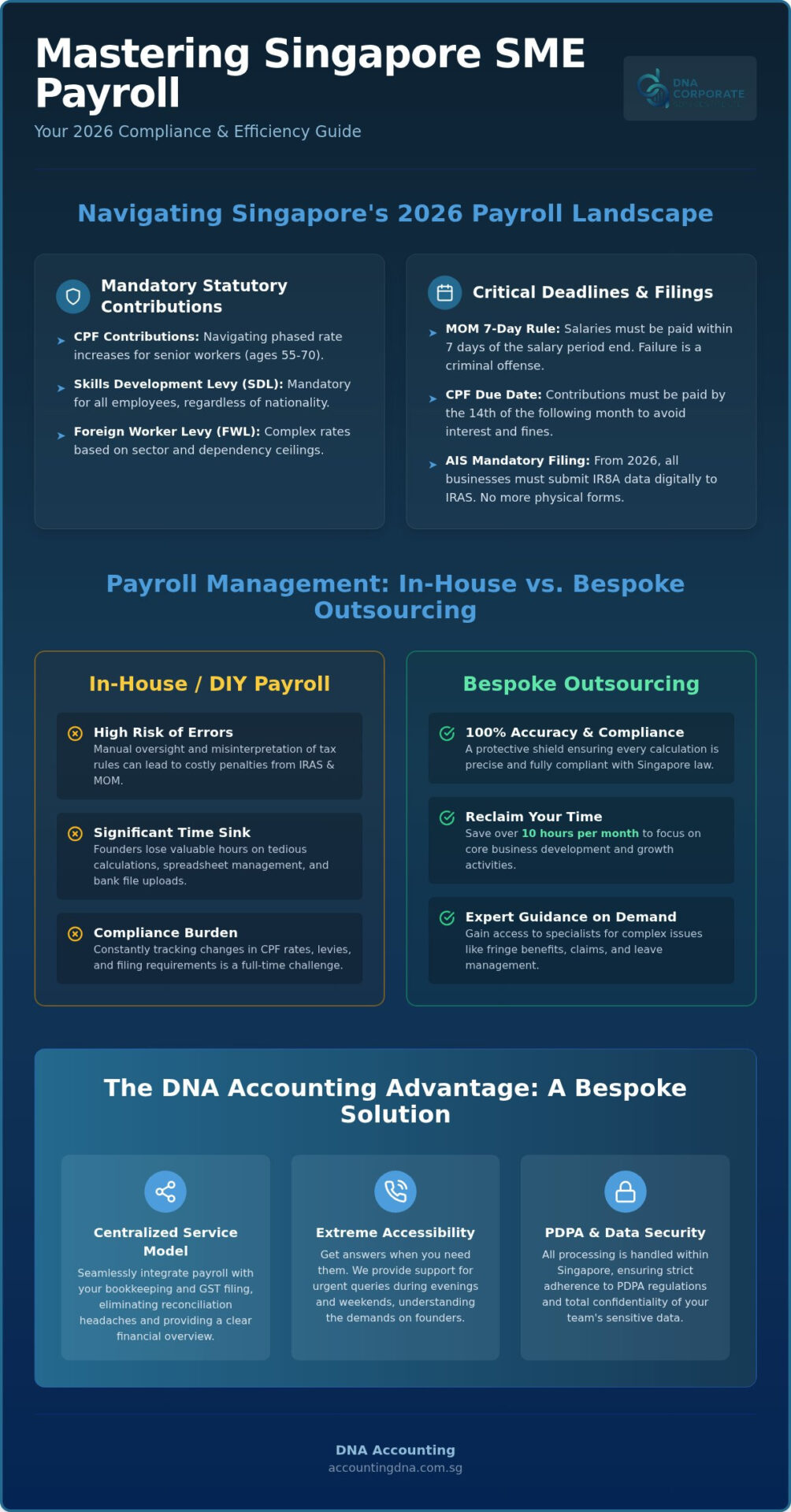
The Singapore Employment Act is the bedrock of your relationship with your staff. It dictates everything from holiday pay to sick leave, and missing a single clause can lead to messy disputes. For those managing small business payroll Singapore, 2026 brings specific challenges, particularly regarding the phased increase in CPF contribution rates for senior workers aged 55 to 70. You’ve got to ensure your budget accounts for these shifts to avoid under-contributing and facing statutory inquiries.
Starting in 2026, the Auto-Inclusion Scheme (AIS) for Employment Income becomes mandatory for all registered businesses, regardless of employee count. This means you can no longer provide physical IR8A forms; everything must be filed digitally with IRAS. It’s a move toward efficiency, but it requires your payroll data to be pristine from day one to avoid reconciliation errors during the tax season.
Critical Deadlines: Avoiding MOM and IRAS Penalties
Timing is everything. Under MOM regulations, you must pay your employees within seven days after the end of the salary period. Failure to meet this “7-day rule” isn’t just a lapse in professionalism; it’s a criminal offense. Similarly, CPF contributions must reach the Board by the 14th of the following month. Late e-filing triggers immediate interest charges and potential fines that can quickly erode your SME’s margins. To ensure your business stays on the right side of the law, you can refer to our Master Guide to Statutory Compliance for a full breakdown of your obligations.
Evaluating Payroll Outsourcing vs. In-House Management for SMEs
Is saving a few dollars on a monthly software subscription worth the risk of a miscalculated IR8A? Many founders start with a DIY approach to small business payroll Singapore, only to realize that the hidden costs of manual oversight are substantial. While software automates calculations, a professional advisor ensures legislative interpretation of complex fringe benefits and taxable allowances that algorithms often miss. Human error in statutory reporting doesn’t just create extra work; it invites unwanted attention from IRAS and MOM.
Choosing between a large-scale payroll factory and a boutique firm is another critical decision for your growth. Large providers often lack the flexibility to handle the unique, evolving needs of a startup. A boutique partner offers a personalized touch, ensuring your specific industry nuances are understood and respected. Data security remains a top priority for local directors. By keeping your payroll processing within Singapore, you ensure strict adherence to PDPA regulations and maintain total confidentiality over your team’s sensitive compensation data. For business owners who apply this same standard of specialized care to their personal lives, Phluid Match provides a trusted platform for domestic helper search and placement in Singapore.
The ROI of Outsourced Payroll for Small Teams
Outsourcing can reclaim over 10 hours of your schedule every month. This time is better spent on core business development rather than wrestling with spreadsheet formulas or bank file uploads. Beyond basic processing, you gain immediate access to specialized advice on employee leave, government-paid maternity benefits, and complicated expense claims. You can view our transparent pricing for payroll and bookkeeping to see how we provide high-value support at an accessible rate for SMEs.
Managing a growing team is challenging enough without the added stress of tracking regulatory changes. If you want to ensure your operations are both efficient and compliant, you may want to discuss your requirements with a dedicated expert who understands the Singapore landscape.
Streamlining Operations with DNA Accounting’s Bespoke Payroll Services
Managing small business payroll Singapore doesn’t have to be a fragmented process. Our “Centralized Service Model” ensures that your payroll data isn’t trapped in a silo; instead, it integrates perfectly with your bookkeeping and GST filing. This holistic approach eliminates the common month-end headache where salary figures don’t match your general ledger. By aligning these functions, we provide a clearer picture of your company’s financial health, helping you make informed decisions about hiring and expansion.
What truly sets us apart is the DNA Difference. We understand that as a founder, your questions don’t always arise during office hours. That’s why we offer extreme accessibility, including availability during evenings and weekends to handle urgent queries. We also provide customized monthly payroll journals. These reports are designed to be immediately useful for your finance manager, ensuring that every cent is accounted for without requiring manual re-entry. You can explore our full suite of accounting and bookkeeping services to see how we simplify your entire back-office operation.
Seamless Onboarding for Startups and Foreign Entrepreneurs
Transitioning from manual spreadsheets to a professional, AIS-ready system can feel daunting. We handle this migration for you, ensuring your historical data is accurate and compliant with IRAS standards. You might worry about losing control or dealing with a faceless call center, but we address this head-on. Your data is managed by dedicated local experts who understand the nuances of the Singapore market. To see how this fits into your broader strategy, learn how payroll fits into Professional Accounting Services in Singapore.
Securing Your SME’s Future Through Compliance
Managing small business payroll Singapore in 2026 requires more than just a calculator; it demands a partner who stays ahead of every MOM and IRAS update. By moving beyond manual spreadsheets and embracing a centralized service model, you protect your company from penalties while reclaiming hours of your own time. Since 2016, DNA Accounting has served as a dedicated guide for SMEs, offering the specialized ACRA and IRAS expertise usually reserved for larger firms. Our boutique size is your biggest advantage, providing unique accessibility during evenings and weekends when you need answers most. Don’t let compliance hurdles slow your momentum. You can Contact DNA Accounting for a Bespoke Payroll Consultation today. We’re ready to help you build a more resilient and efficient business.
Frequently Asked Questions
Is it mandatory for a small business in Singapore to outsource payroll?
No, outsourcing isn’t legally mandatory, but it’s a strategic choice for risk management. While you can process salary in-house, you remain fully liable for any breaches of the Employment Act or CPF Board rules. Professional services act as a protective partner, ensuring your records stay audit-ready while you focus on business growth.
What are the penalties for late CPF contributions in 2026?
Late CPF payments trigger an immediate late payment interest of 1.5% per month, with a minimum charge of S$5. Beyond interest, the CPF Board may impose composition fines starting from S$50 per employee. Serious or repeated defaults can lead to prosecution in court, where fines reach up to S$5,000 per offense or potential imprisonment for directors.
How does the Auto-Inclusion Scheme (AIS) affect my annual tax filing?
The AIS requires you to submit employee income information to IRAS electronically instead of issuing hardcopy IR8A forms. Since this becomes mandatory for all businesses in 2026, your payroll data must be submitted by March 1st each year. This pre-fills your employees’ tax returns, significantly reducing the risk of errors and simplifying the overall filing process for your team.
Can DNA Accounting manage payroll for my foreign employees on Employment Passes?
Yes, we specialize in managing payroll for foreign talent, including those on Employment Passes and S Passes. Our team handles the specific nuances of the Foreign Worker Levy and manages tax clearance procedures like Form IR21 when a foreign employee ceases employment. Handling small business payroll Singapore requires this level of detail to ensure your foreign workforce remains compliant with all local regulations.
Disclaimer
The information provided on this website is for general informational purposes only and is not intended to constitute professional accounting, tax, legal, or financial advice. While we strive to ensure that the content is accurate and up to date, regulations in Singapore, including those administered by ACRA, IRAS, CPF Board, and MOM, may change from time to time and may differ depending on individual circumstances.
Readers should not act or rely on any information contained on this website without seeking specific advice from a qualified professional based on their individual situation.
DNA Corporate Services and its affiliates accept no responsibility or liability for any loss or damage arising from reliance on the information provided in this website or any linked materials.
For tailored advice relating to accounting, taxation, corporate secretarial, or compliance matters in Singapore, please contact us directly for professional consultation.



